
SUMA Acquisition Corp Maintains Strong Trust Account Liquidity as De-SPAC Deadline Approaches
Latest quarterly filing confirms stable financial position but limited operational disclosures typical of early-stage SPACs.
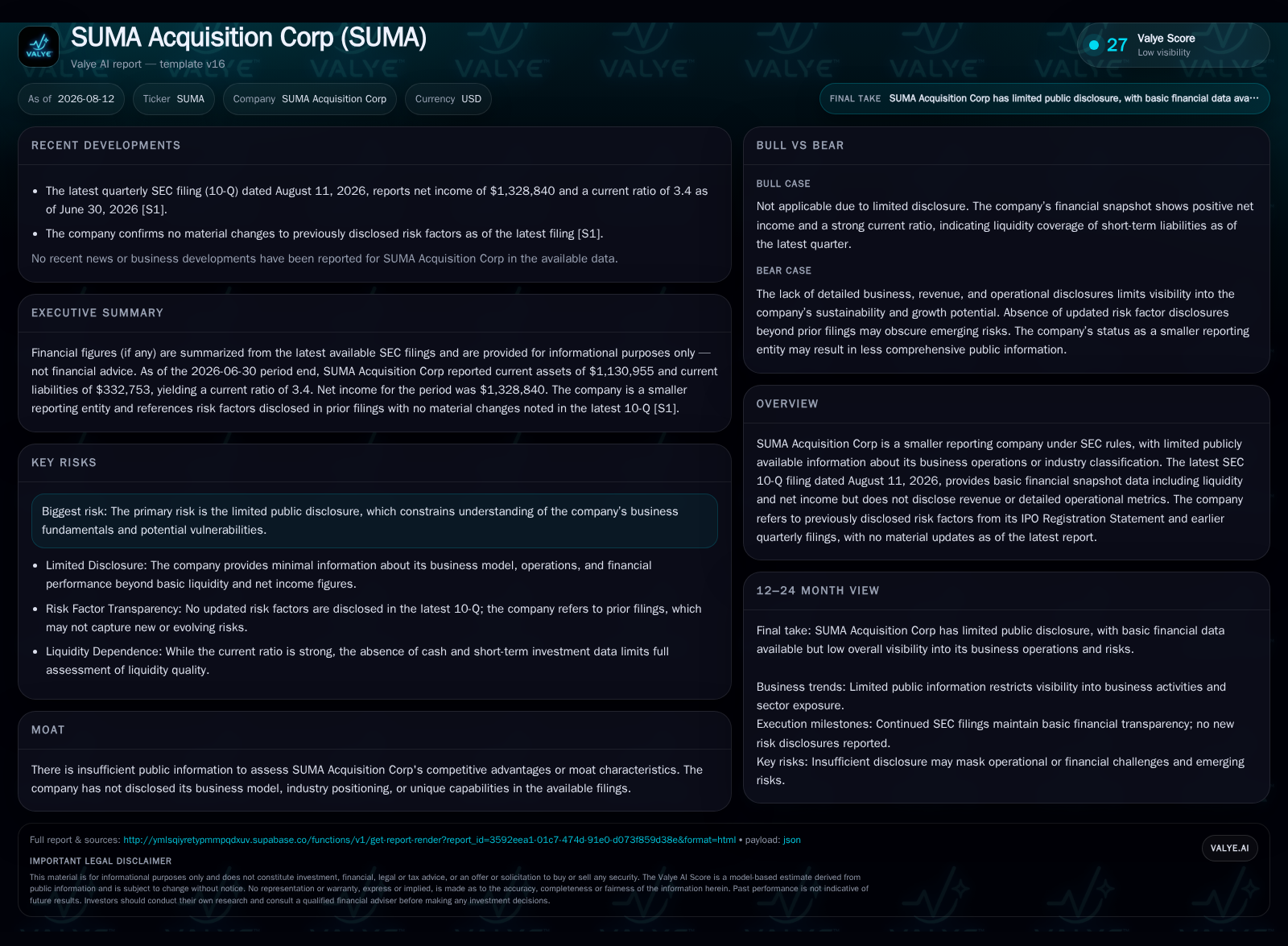
SUMA Acquisition Corp, a Special Purpose Acquisition Company (SPAC) listed on Nasdaq, reported in its August 2026 quarterly filing that it holds substantial liquidity with no material operating activity. The company raised $172.5 million in its initial public offering (IPO) and private placement in March 2026, funds now secured in a trust account pending an initial business combination. While risk factors remain unchanged, geopolitical and market uncertainties continue to present challenges for identifying suitable merger targets within the mandated timeline ending March 2028. SUMA's current ratio of approximately 3.4 indicates strong short-term financial flexibility ahead of executing its de-SPAC transaction.
Recent Operating Update
SUMA Acquisition Corp released its first quarterly report following its March 2026 initial public offering (IPO), filing the Form 10-Q on August 11, 2026 [S2]. The filing reveals that since its IPO, SUMA has raised gross proceeds of $172.5 million through issuance of 17.25 million units priced at $10 each [S9]. Each unit confers one Class A ordinary share alongside one right exercisable for one-fifth of an ordinary share upon successful completion of an initial business combination [S5]. Concurrently, additional private placement units valued at $4.46 million were sold to sponsors and underwriters as part of the capital formation strategy [S11].
Following the deal closing, all net proceeds—totaling roughly $170.5 million after underwriting discounts—plus additional proceeds from private placements have been placed into a dedicated U.S.-based trust account held by Continental Stock Transfer & Trust Company [S7][S8][S11]. This trust mechanism secures investor capital while SUMA actively pursues a merger or acquisition target that can satisfy Nasdaq listing requirements and shareholder scrutiny.
Financial results for Q2 ended June 30, 2026 show a modest net income of approximately $1.33 million which predominantly reflects non-operating gains rather than commercial operations given that business combinations have yet to commence [F1]. The company incurred an operating loss close to $200k during this period, which aligns with administrative and sponsor-related expenses characteristic of SPACs prior to completing their de-SPAC transition [F1]. Current assets recorded at nearly $1.13 million against current liabilities around $0.33 million produce a healthy current ratio near 3.4, signaling conservative balance sheet management appropriate for preserving liquidity ahead of pursuing merger deals [F1].
The filing reiterates that there have been no material changes to previously disclosed risk factors originating from the IPO registration statement or earlier quarterly filings [S14]. These risks prominently include global geopolitical instability—such as ongoing conflicts involving Ukraine-Russia and tensions in the Middle East—as well as broader trade policy uncertainties that could hinder identification or valuation of suitable combination targets [S17][S18][S19][S21][S23]. Such macroeconomic concerns exert pressure on transactions across the SPAC space by potentially constricting available targets or increasing risk premiums demanded by counterparties.
Business Model Discussion
As a classic SPAC vehicle, SUMA Acquisition Corp generates capital through public investors participating in the IPO purchase of units bundling ordinary shares with accompanying rights/warrants exercisable later as part of a business-combination event. Until consummation of such an initial business combination—which serves as the pivotal event transforming it from a shell company into an operating entity—SUMA operates without commercial revenue streams or product/service offerings.
The IPO proceeds essentially represent deployed investor capital held securely in trust until utilized for acquisition financing alongside possible PIPE (Private Investment in Public Equity) injections arranged concurrently during de-SPAC deals. Sponsor fees and underwriting discounts reduce net proceeds upfront while administrative expenses constitute ongoing disbursements reducing trust balances marginally over time absent any deal completion.
Investor decision-making hinges largely upon the eventual announced target company’s sector attractiveness, strategic fit with sponsor expertise, anticipated post-merger earnings potential, and terms including redemption rights protecting public shareholders who may opt out if dissatisfied with proposed combinations. The presence of separate trading symbols for shares (SUMA) and rights (SUMAR) after April 20, 2026 allows market participants more granular trading strategies pre-transaction [S12]
Industry Structure and Competitive Position
The SPAC industry has undergone cycles marked by influxes of newly listed blank-check vehicles seeking to capitalize on robust public market appetite for alternative routes to liquidity beyond traditional IPOs. SUMA's March 2026 IPO places it among recent cohorts aiming to leverage sponsor experience and favorable capital conditions amidst tightening regulatory scrutiny imposed by SEC guidelines impacting disclosures and sponsor incentives.
Its competition primarily consists of peer SPACs launched contemporaneously that similarly must identify promising private companies amenable to public listing via merger within defined Nasdaq deadlines—typically three years from IPO date—in order to avoid mandatory liquidation or delisting scenarios impacting shareholder value negatively [S19][S20]. Compared to legacy SPAC sponsors with lengthy track records or those focusing on specific vertical sectors like technology or healthcare, SUMA's filings do not reveal explicit industry focus or preferred target profiles at this stage.
Sponsors’ reputations and deal origination capabilities remain pivotal competitive differentiators; however absent disclosed announcements regarding prospective mergers or PIPE arrangements as yet limits assessment versus peers. Also important is management’s discipline in balancing speed-to-deal against valuation rigor amid fluctuating market sentiment amplified by unfolding geopolitical risks affecting target companies’ operational viability or financing access.
Growth Drivers
SUMA’s growth potential derives principally from successfully completing a value-enhancing business combination before its deadline (March 12, 2028). Favorable growth levers include rising investor interest toward alternative public listing vehicles amidst volatile capital markets that complicate traditional IPO paths; robust sponsor networks facilitating deal sourcing; improving regulatory clarity around SPAC transaction structures; and availability of attractive private companies seeking enhanced liquidity options.
Additionally, market innovations such as increased utilization of PIPE investments alongside shareholder protections like redemption rights provide mechanisms mitigating dilutive impacts while broadening capital base participation during the de-SPAC phase.
Macro tailwinds improving deal feasibility include stabilization or reduction in geopolitical conflicts adversely affecting targeted industries’ outlooks and easing tariffs or trade restrictions enhancing cross-border deal flow prospects—themes referenced explicitly by SUMA in its risk disclosures signaling material importance to future transaction success probabilities [S17][S18][S21].
Risks and Constraints
Key risks facing SUMA encompass failure to consummate an initial business combination before mandated deadlines resulting in forced liquidation and loss scenarios for shareholders; elevated redemption rates that dilute available acquisition capital thereby undermining deal viability; market volatility depressing stock prices hindering shareholder approvals; regulatory developments potentially restricting SPAC structures or increasing disclosure burdens; conflicts of interest between sponsors and shareholders affecting fairness perceptions; dilution from warrant exercises post-combination; uncertainty over target valuations particularly amid persistent geopolitical tensions; limited liquidity prior to deal closure restricting operational flexibility; reputational damage stemming from underperforming merged entities; plus legal/compliance risks tied to adequacy of disclosure norms adhered under SEC frameworks [S14][S17][S19][S21][S23]
Moreover, tariff fluctuations provoke additional unpredictability around choosing geographically diversified targets versus domestic ones due to potential margin erosion post-transaction—a theme noted thoroughly in recent risk commentary underscoring strategic selection difficulties compounded by external economic policy shifts [S18][S19][S21]
What To Watch Next
Market participants should monitor multiple milestones signaling progress toward closing the initial business combination encompassing:
- Formal announcement(s) identifying prospective merger candidates clarifying target sectors, transaction size estimates, PIPE financing details if applicable,
- Shareholder voting outcomes relating to proposed deals which crystallize acceptance levels including redemption rate impact estimates,
- Regulatory filings evidencing definitive agreements executed including underwriter amendments,
- Quarterly financial releases post-deal reflecting transition toward operating income generation,
- Securities trading behavior—price stability or appreciation tied to positive sentiment across shares (SUMA) and rights (SUMAR) symbols,
- Sponsor statements documenting pipeline health alongside extensions or amendments requested if nearing deadline without deal consummation.
Given that SUMA’s statutory window extends through Q1 calendar year 2028 per Nasdaq rules outlined explicitly in recent risk factor sections reviewed here [S19], watchpoints concentrating around H2 calendar year 2027 through early 2028 become especially critical for assessing timeline adherence likelihood.
Disclaimer: This is research-only, informational analysis and not investment advice. It may include AI-generated interpretation and general industry context. Always verify important details using primary sources.

Comments