
Cambridge Acquisition's Capital Deployment and Network Strength Define SPAC Prospects
Latest financial filings affirm Cambridge Acquisition’s robust trust account and managerial expertise as critical enablers for its upcoming Business Combination targeting wellness and harm-reduction sectors.
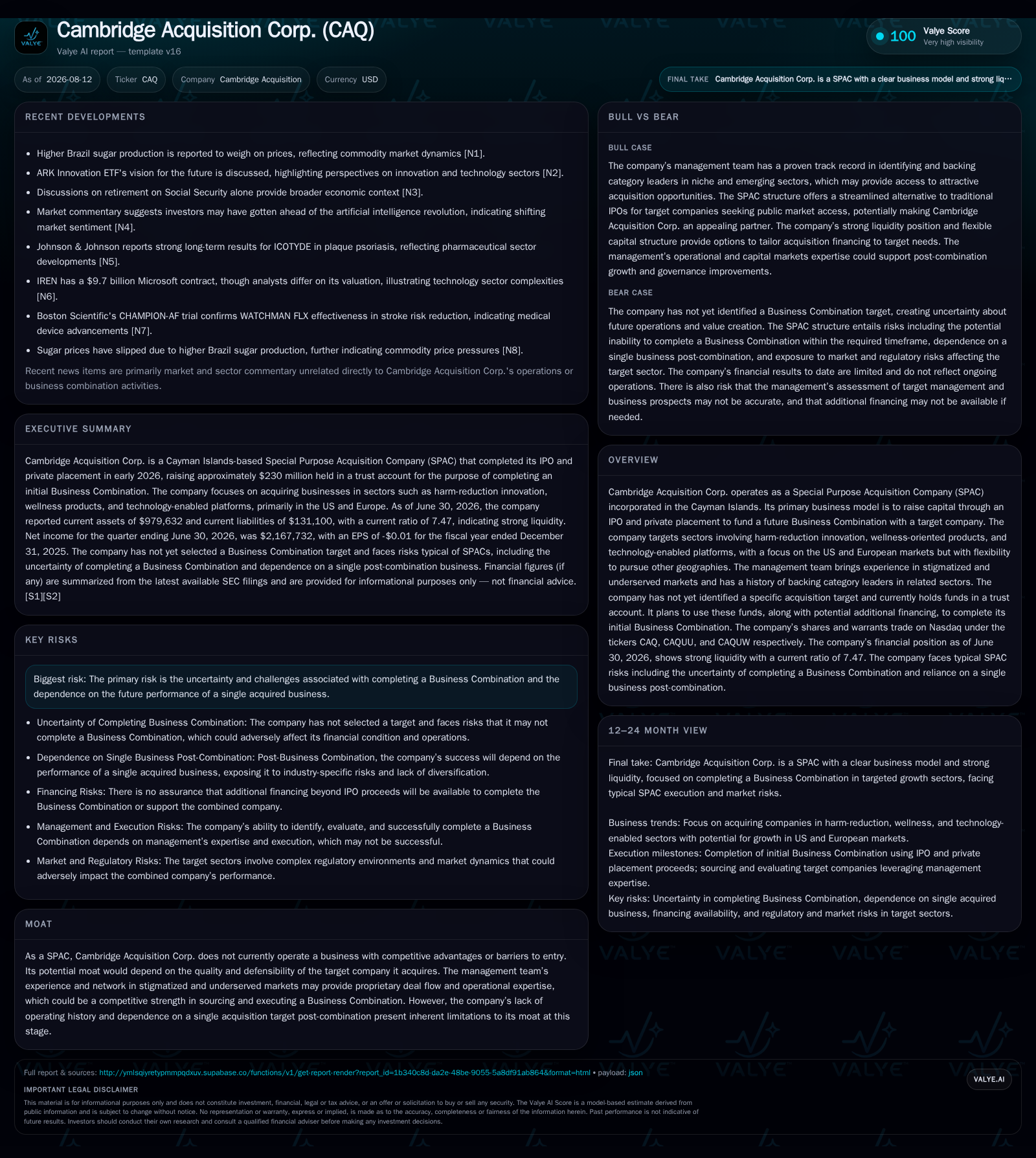
Cambridge Acquisition Corp., a Cayman Islands-based SPAC, reported a stable financial position in its August 11, 2026 10-Q filing, maintaining a trust account of approximately $221.95 million net of underwriting fees. With no target acquired yet, the company leverages a management team experienced in navigating stigmatized and underserved markets to source proprietary acquisition candidates focused on harm reduction, wellness, and tech-enabled platforms primarily in the US and Europe. The SPAC model relies heavily on completing a Business Combination within regulatory timeframes, with key risks including shareholder redemption rates and execution challenges. Cambridge’s capital structure and sector focus position it favorably versus peers like Social Capital Hedosophia Holdings, though the absence of operating history leaves inherent execution uncertainty.
Latest Filing Highlights: Capital Position Supports Deal Readiness
In its August 11, 2026 quarterly report (10-Q), Cambridge Acquisition Corp. reaffirmed a well-capitalized status with approximately $979,632 in current assets against $131,100 in liabilities (a current ratio of about 7.47), consistent with its role as a Special Purpose Acquisition Company holding most funds in trust pending an acquisition [F1][S2]. The Trust Account balance stands at around $222 million net of underwriting fees reflecting IPO proceeds plus private placement capital raised earlier in 2026 [S1], providing substantial dry powder for sourcing and consummating a Business Combination aimed at disruptive firms within wellness and harm-reduction technology sectors. This capital stability underpins the ability to shape transaction structures flexibly—using cash, equity securities, or debt—with potential PIPE financings augmenting base proceeds if needed [S1]. No change in previously disclosed risk factors was noted in the filing, indicating management’s steady stance on hurdles such as timing constraints and shareholder redemption possibilities that could materially affect deal outcomes [S2].
Executive Experience: Sourcing Value in Challenging Markets
Cambridge’s management team is a cornerstone asset differentiating it within the blank check landscape. Their proven track record includes co-founding investments in category-leading companies serving stigmatized or underserved industries—areas often overlooked by mainstream investors due to regulatory complexity or cultural stigma but ripe for innovation-driven growth [S1]. The leadership’s network generates proprietary deal flow advantages through early-stage access to promising firms that might otherwise be inaccessible amid general market noise. This operational experience spans mergers, acquisitions, roll-ups, public listings via SPAC transactions, and strategic capital deployment across economic cycles [S1]. Their insight into regulatory inflection points fosters higher-quality target screening beyond price-based criteria alone. Successful de-SPAC transactions demand such relationship-driven sourcing since competing vehicles lack comparable networks—a factor that enhances Cambridge’s probability of closing impactful deals aligned with its investment thesis.
Core SPAC Model Orientation: From Blank Check to Sector Focus
Fundamentally, Cambridge operates as a blank check company incorporated in the Cayman Islands—meaning it has no commercial operations or revenues until a Business Combination is completed [S1]. Its business model monetizes by initially raising capital ($230M IPO plus private placements totaling approximately $5M) from public investors who receive units consisting of shares plus warrants exercisable post-combination [S1]. These funds are held securely in a Trust Account until deployed toward acquiring or merging with one or more target companies that fit its strategic verticals—harm reduction innovation, wellness products, and technology-enabled platforms chiefly focused on US and European markets but with geographic flexibility [S1]. Prior to consummation of an acquisition, Cambridge incurs administrative expenses but lacks operating income streams typical of traditional companies [F1].
Competitive Landscape: Peers, Alternatives, and Differentiators
Within the diverse SPAC universe—from large-cap vehicles like Pershing Square Tontine Holdings (PSTH) targeting mega-deals to sector-specialist platforms such as Social Capital Hedosophia Holdings—Cambridge occupies a niche favorable for investors seeking exposure to emergent wellness-related disruptors backed by experienced sponsors. Unlike generic SPAC shells competing solely on timing or valuation concessions, Cambridge benefits from differentiated human capital that helps secure proprietary transactions unlikely accessible by purely transactional competitors or traditional IPO underwriters who focus on scale rather than sector specialization. Moreover, compared with private equity (PE) funds or venture capital firms competing for similar targets via direct ownership stakes, Cambridge offers an alternative liquidity pathway enabling companies fast-track access to public markets through de-SPAC transactions—which typically require less marketing effort and provide greater execution certainty relative to initial public offerings (IPO) subject to market volatility and syndicate influence [S1]. However, the ultimate competitive advantage depends heavily on successful identification and closing of quality targets.
Strategic Growth Levers: Target Sector Potentials and Financing Flexibility
The themes targeted by Cambridge resonate with large addressable markets undergoing secular shifts driven by evolving consumer preferences toward health consciousness and regulatory relaxation around substances fostering harm reduction such as psychedelics or hemp-derived products [S1]. These sectors combine recession resilience with potential high margins when paired with technology-enabled distribution or platform business models—a growth profile attractive for public investors post-merger. Additionally, PIPE financing post-announcement remains a critical lever permitting transaction size expansion beyond IPO proceeds alone—a common necessity given many disruptive targets’ significant capital needs exceeding initial trust balances [S1]. This dual-access to primary cash via trust funds plus secondary PIPE commitments offers structural flexibility unmatched by standard IPO-only pathways.
Watchpoints: Redemption Risks, Regulatory Shifts, and Execution Challenges
Among key risks facing Cambridge are shareholder redemption rights which can reduce available transaction capital if public investors elect out upon combination vote—potentially forcing deal re-negotiations or downsizing [S2]. Such redemptions also dilute sponsor ownership percentages post-transaction affecting alignment incentives. Conflicts arising from sponsor Founder Shares ownership may influence valuation negotiations or decision-making around target choice—a perennial SPAC governance critique requiring transparent controls [S1]. Furthermore, regulatory scrutiny by the SEC continues evolving around disclosures specific to SPAC structures including warrant accounting treatment—compliance failures risk litigation or de-listing events impacting investor confidence broadly. Evidence of increasing redemption requests or protracted combination timelines would signal rising execution risk whereas prompt announcements validating favorable valuations might mitigate concerns.
Financial Profile Discussion: Liquidity, Operating Expenses, and Leverage
As of the latest quarter ending June 30, 2026, Cambridge maintains sound liquidity with current assets ($980K) far exceeding liabilities ($131K), consistent with a pre-combination operating expense run-rate mainly related to corporate administration without revenue contribution [F1][S2]. Operating income remains negative (-$253K), reflecting expected costs incurred pre-acquisition while net income trailing December 31 shows similarly minimal losses (-$63K) given low operational activity historically [F1]. Debt levels are modest (~$106K noted end-2025), implying little leverage pressure thus preserving financial flexibility during the search phase [F1]. The substantial Trust Account balance approximates $222 million net after underwriting commissions aligns closely with reported IPO proceeds origin—available exclusively for deal funding unless redeployed following combination completion or liquidation scenarios per SEC regulations [S1][F1]. This capitalization profile compares favorably versus peers who may experience higher burn rates or face refinancing needs ahead of deal closure.
Disclaimer: This report is an independent industry analysis focusing on operating fundamentals based on publicly filed SEC documents as of August 11, 2026. It does not constitute investment advice nor does it predict future performance outcomes. Readers should conduct additional due diligence before forming opinions regarding securities mentioned herein.
Disclaimer: This is research-only, informational analysis and not investment advice. It may include AI-generated interpretation and general industry context. Always verify important details using primary sources.

Comments