
TOFUTTI BRANDS Navigates Co-Packing Transition and Commodity Pressures in Plant-Based Dairy Alternatives
Securing a new co-packing agreement mitigates immediate supply risks for TOFUTTI’s core products amid volatile input costs and competitive pressures.
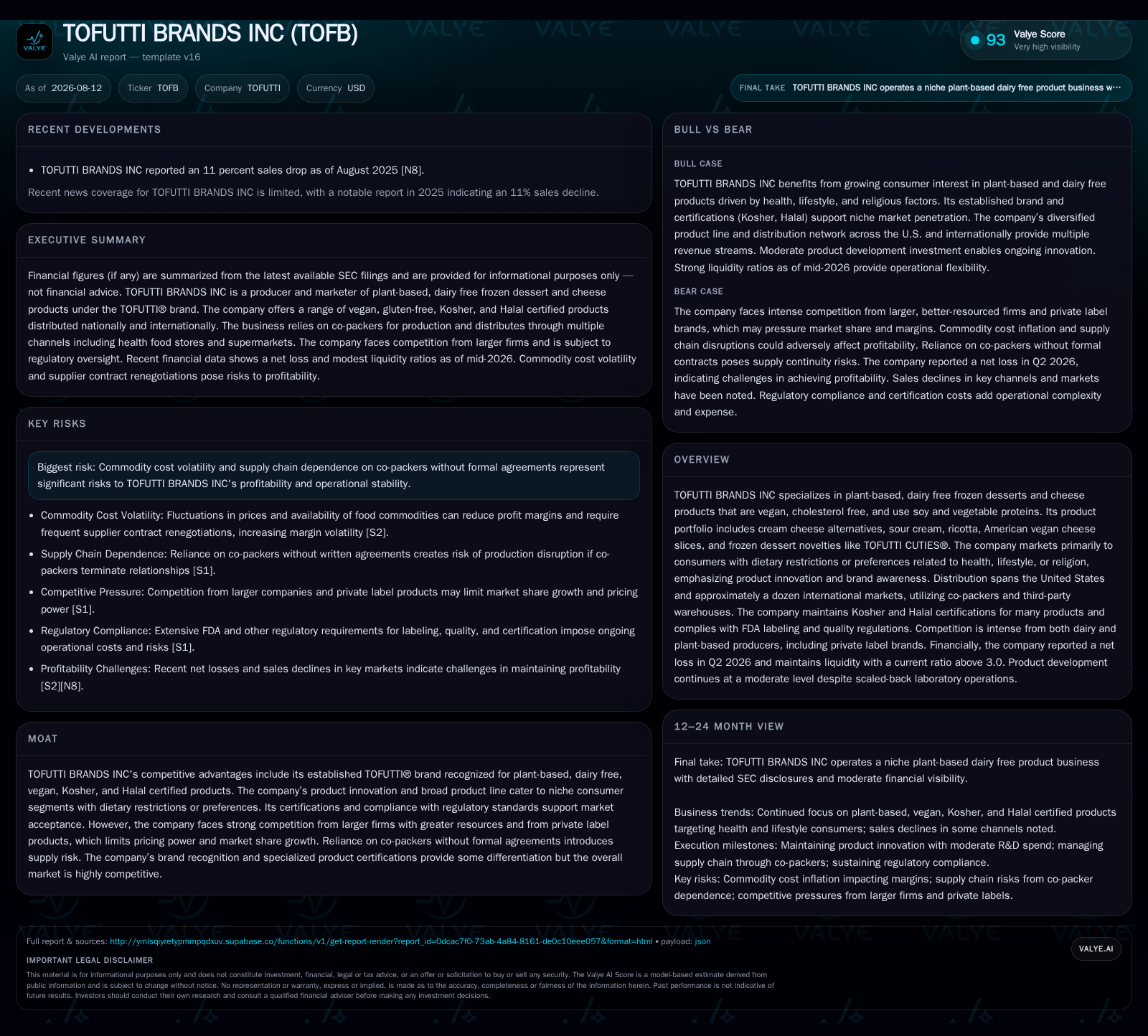
TOFUTTI BRANDS INC specializes in plant-based, dairy-free frozen desserts and cheese alternatives marketed to niche dietary consumers. In its latest quarterly filing, the company disclosed a critical transition of its primary co-packing facility, which produced about 80% of sales, now under new ownership but preserving prior terms. This resolves a major supply disruption risk that had cast doubt on the firm’s going concern. TOFUTTI faces margin pressure from rising commodity costs and intense competition from larger branded and private label producers. Its financial profile shows tight liquidity but sufficient current assets to cover liabilities. Monitoring how the co-packing relationship stabilizes production, alongside product innovation and distribution expansion, will be key to reestablishing growth momentum.
Recent Operating Update: Co-Packing Transition Resolution
This development materially alleviates substantial uncertainty that had called TOFUTTI's ability to continue as a going concern into question earlier in 2026 after learning of the impending plant closure [S1]. Maintaining this manufacturing relationship without interruption is crucial given the firm outsources all production using independent co-packers. Loss or delay of capacity could sharply reduce sales volume given the absence of owned facilities.
Business Model: Brand-Focused Plant-Based Dairy Alternatives
TOFUTTI Brands specializes in manufacturing and marketing plant-based dairy substitutes—including frozen desserts like TOFUTTI CUTIES® and a spectrum of vegan cheese analogs such as Better Than Cream Cheese®, sour cream alternatives, ricotta-style spreads, and American vegan cheese slices [S1]. These products emphasize attributes appealing to consumers with dietary restrictions related to health (e.g., cholesterol-free), lifestyle choices (veganism), or religious requirements (Kosher-parve and Halal certifications). The company's offering derives fat primarily from vegetable oils like corn and palm oil rather than animal butterfat or cholesterol.
Revenue is generated mainly through wholesale channels supplying supermarkets, specialty health food stores, food service customers (restaurant chains or caterers), and international distributors spanning roughly a dozen countries [S1,S28]. The company uses multiple independent third-party co-packers for production alongside third-party warehouses strategically located across the U.S., facilitating timely customer fulfillment despite limited direct logistics investment
Marketing efforts center tightly on brand awareness within niche dietary segments via product innovation (approximately $150K spent annually on development), trade promotions, eye-catching packaging compliant with FDA labeling standards (recently updated per the Food Safety Modernization Act), digital advertising initiatives, and strong word-of-mouth programs [S1,S5]. Product innovation aims at periodic introduction of new flavors or improved formulations critical in deterring competitive erosion.
Industry Structure and Competitive Position
The plant-based dairy alternative sector is marked by rapid growth yet intense competition from both traditional dairy producers expanding plant-based lines (players like Danone or Kraft Heinz) as well as specialized brands such as Miyoko's Creamery or Daiya Foods. Private label offerings from major grocery chains also apply downward pricing pressure limiting margin expansion.
TOFUTTI competes by leveraging its longstanding brand recognition established since the early 1980s around being fully vegan, cholesterol free, kosher parve certified—and importantly also Halal certified—which cater to religious niche markets less emphasized by competitors [S1,S22]. However, this leadership position is tempered by limited scale relative to larger multisystem competitors who benefit from diversified manufacturing footprints reducing dependency risks inherent in TOFUTTI’s outsourcing model.
The reliance on several co-packers without long-term contracts exposes TOFUTTI to operational disruptions if any partner cannot fulfill demand or alters terms unfavorably [S1,S2]. The recent near-closure event underscores this vulnerability but was successfully mitigated via renegotiation with new facility ownership maintaining continuity.
Growth Drivers
Structural growth drivers supporting TOFUTTI include increasing consumer adoption of plant-based diets fueled by health consciousness (cholesterol/saturated fat avoidance), ethical veganism trends, environmental concerns about animal agriculture impacts, along with rising prevalence globally of lactose intolerance or dairy allergies. Additionally:
- Expansion into new retail outlets across regional U.S. markets and international territories taps unmet demand pockets; overseas shipments accounted for about 15% of sales in fiscal 2025 [S22,S28].
- Continued product innovation introducing novel flavors or convenience formats can stimulate incremental volume gains despite overall mature market competition [S5,S23].
- Strengthening brand loyalty through certification distinctions (Kosher/Halal) deepens penetration in specific consumer cohorts often underserved by mass-market offerings.
- Regulatory engagement facilitating clear labeling claims supporting plant-based attributes enhances consumer trust.
These drivers depend heavily on stable co-packing capacity utilization as well as effective pricing strategies amid inflationary cost pressure.
Risks and Constraints
TOFUTTI faces several prominent headwinds impacting operational stability:
- Co-Packer Dependency: No owned manufacturing capacity means reliance on external contract manufacturers poses risks around capacity constraints or contractual renewal uncertainties without guaranteed long-term agreements [S1,S3].
- Commodity Cost Volatility: Key raw ingredients like soy protein isolates, vegetable oils (corn/palm), packaging materials face price fluctuations influenced by inflation trends, trade tariffs, weather disruptions impacting agricultural yields—leading to margin compression if price increases cannot be fully passed through to customers due to competitive pricing pressure [S2].
- Competitive Pressures: Larger companies with scale advantages can afford deeper promotional discounts or absorb commodity cost spikes better; private label entrants intensify these dynamics especially within mainstream grocery chains.
- Regulatory Compliance: Complex FDA labeling rules combined with food safety oversight impose ongoing quality control costs; failure risks product recalls which could damage reputation and incur material expenses [S4,S7].
- Limited Financial Cushion: Ongoing net losses reflected in continuing negative operating cash flows constrain ability to invest aggressively in marketing or R&D; reported net loss was $778K for fiscal year ending Dec 2025 despite modest working capital improvements indicating fragile liquidity balance [F1,S1].
What To Watch Next
Monitoring execution against these key milestones will illuminate near-term trajectory:
- Successful commencement of production under the new co-packer ownership starting mid-September is crucial; any delays or quality issues here could disrupt sales continuity.
- Tracking input cost trends versus pricing adjustments made will serve as leading margin indicators; further inability to raise prices may stress profitability.
- New product introductions' market acceptance evidenced through incremental volume lift or broadened distribution footprint will test innovation efficacy.
- International sales performance amidst currency fluctuations should be watched given ~15% revenue exposure outside U.S. markets.
- Customer retention especially in niche Kosher/Halal segments will reveal brand strength amid rising competition.
Financial Profile Discussion
As per the latest available balance sheet data dated June 27, 2026, TOFUTTI reported $2.5 million in current assets against $743K current liabilities yielding a healthy current ratio near 3.37x—a positive liquidity buffer supporting near-term obligations [F1]
Nonetheless, historical earnings trends reveal consistent net losses ($778K in fiscal 2025) accompanied by negative cash flow from operations highlighting persistent challenges turning profitability around amidst unfavorable top-line dynamics and cost pressures [F1,S1]. This underscores the need for disciplined cost management combined with successful revenue progression through stabilized manufacturing capacity utilization post-co-packer transition.
Capital allocation appears conservative given limited product development spend (~$150K annually) consistent with a tightly managed innovation pipeline balancing budget constraints against necessity for periodic SKU refreshment [S5]. Free cash flow generation remains an important metric to watch going forward especially as commodity inflation persists globally.
This analysis incorporates data extracted directly from recent SEC filings including the August 2026 quarterly update alongside annual reports synthesizing business fundamentals against industry dynamics within the plant-based dairy alternative sector. The company's strategic focus on niche dietary certifications combined with renewed co-packing agreements positions it cautiously but favorably against immediate operational risks. Sustained improvement hinges critically on managing input cost pressures while expanding distribution efficiently within highly competitive food retail landscapes.
Disclosure: This analysis is provided solely for informational purposes without any investment research view regarding securities mentioned herein.
Disclaimer: This is research-only, informational analysis and not investment advice. It may include AI-generated interpretation and general industry context. Always verify important details using primary sources.

Comments