
Hoyne Bancorp’s Strategic Shift Post-Conversion Highlights Competitive Banking Challenges
Hoyne Bancorp leverages its local legacy and diversified loan portfolio while managing regulatory and market pressures in Cook County.
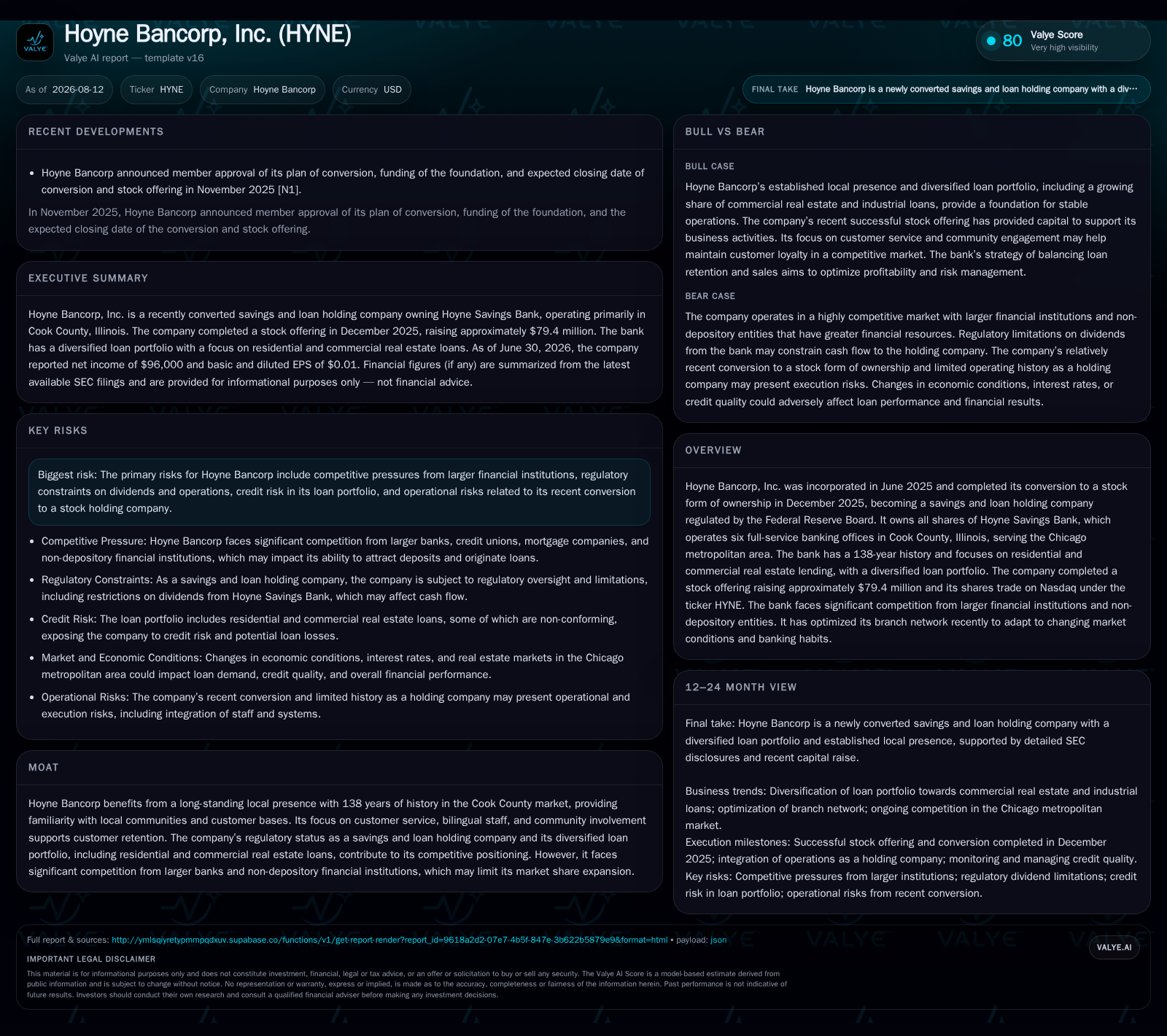
Hoyne Bancorp, after completing its mutual-to-stock conversion in December 2025, is navigating early post-IPO dynamics characterized by unrealized losses in investment securities and ongoing competitive pressures in the Chicago metro market. Its historically rooted focus on residential and commercial real estate loans funded primarily by core deposits supports steady net interest margin generation, though regulatory capital rules impose constraints on dividends and growth flexibility. The bank’s concentrated branch network caters to a bilingual community base, providing a moat through localized service despite competition from larger, digitally advanced regional banks. Credit quality remains stable with limited non-performing assets, but investment portfolio volatility introduces near-term capital risk.
Recent Operating Dynamics Following Public Listing Shift
Hoyne Bancorp completed its conversion from mutual-to-stock ownership on December 3, 2025, raising approximately $79.4 million in gross proceeds through a public offering [S1]. This transition positioned it as a savings and loan holding company regulated by the Federal Reserve Board. The August 11, 2026 10-Q update provides the first comprehensive quarterly insight into operational trends following this structural change [S2]. A prominent near-term challenge emerges from investment securities: by June 30, 2026, significant unrealized depreciation exists with 23 agency securities down 15.87% and 172 mortgage-backed securities down 12.49% relative to amortized cost bases [S2]. These unrealized losses influence comprehensive income and potentially constrain regulatory capital buffers critical for sustaining dividend capacity and strategic flexibility.
The mutual-to-stock conversion dispersed ownership among public shareholders, the employee stock ownership program (ESOP), and the Hoyne Charitable Foundation. This shareholder diversification introduces new governance dynamics and increases pressure for transparent earnings trajectory improvement while the bank retains its historical roots in local customer relationships [S1].
Loan Portfolio Composition Reflecting Risk Diversification Imperatives
Hoyne Savings Bank's lending emphasis is split primarily between residential real estate loans and commercial real estate loans—a classic strategy among regional savings institutions balancing relatively stable mortgage yield with higher but more volatile commercial lending returns [S1], [S21]. As of Q2 2026, the portfolio includes $274.9 million in residential loans including home improvement first mortgages, owner-occupied one-to-four family mortgages, and purchased participations. On the commercial side, loans total approximately $132,168 thousand across commercial real estate development projects, construction lending, lines of credit, and commercial & industrial loans [S21].
This diversification mitigates concentration risk inherent in narrower portfolios while reflecting medium-sized bank underwriting standards that emphasize conservative debt coverage ratios and regular collateral monitoring [S19]. Credit quality indicators remain sound: very limited non-accruals were reported with only one residential non-accrual loan approximately $254.8 thousand balanced against an allowance of $164.9 thousand [S21]. Participation loans experienced some late payments but remained generally accruing interest [S21]. The bank’s approach to troubled loan modifications has been minimal recently with no defaults within twelve months of modification since conversion [S21].
This mixed loan mix supports maintaining net interest margin (NIM) stability despite interest rate fluctuations that impact yields on both sides of the balance sheet attributable to short- and intermediate-term shifts in market rates.
Local Branch Network Adaptation Amid Changing Customer Preferences
Operating six full-service branches in Cook County—including Chicago proper and suburban locations such as Oak Lawn, Wheeling, Worth—and an additional loan production office in Oak Park reveals Hoyne’s commitment to physical presence amid widespread industry trends favoring digital modalities [S1]. This footprint targets local community engagement leveraging bilingual staff to serve diverse neighborhoods effectively.
Post-conversion restructuring has involved optimizing this branch network to align operating costs with volume shifts as consumer preferences evolve away from branch-heavy transactions toward electronically facilitated banking. Yet these branches remain critical for customer retention given competition from larger institutions offering expansive digital platforms alongside broad product suites [S1], [S2]. Hoyne’s strategy preserves a community bank aspect valued by customers seeking personal service combined with localized knowledge.
Regulatory Framework Impact: Capital Ratios, Dividend Limits, and Strategic Flexibility
Transitioning into Federal Reserve regulation as a savings and loan holding company entails adherence to community bank leverage ratio frameworks intended to ensure well-capitalized status with attendant dividend payout restrictions [S1]. At closing fiscal year-end 2025, Hoyne Savings Bank met "well-capitalized" criteria under these norms but must continuously monitor regulatory capital ratios to avoid prompting corrective action measures [S1].
Dividend policy is constrained by these regulatory thresholds limiting free cash distribution at the holding company level—a factor directly linked to earnings retention necessary for organic capital build and potential future acquisitions or technology investments [S1], [S2]. Unrealized losses on securities portfolios amplify this pressure by reducing tangible equity temporarily though they do not impair cash solvency.
The newly introduced public ownership structure demands careful capital management since increased external investor scrutiny raises expectations for disciplined stewardship of regulatory capital alongside measured growth initiatives balanced against credit risk conservatism.
Competitive Position within Metro Chicago’s Banking Landscape
Hoyne Bancorp competes in metro Chicago where national banks with extensive branch networks (e.g., JPMorgan Chase) coexist alongside regional mid-sized institutions like Wintrust Financial which offer a broader array of digital services and regional scale advantages. Despite this crowded environment, Hoyne capitalizes on its 138-year heritage fostering trust particularly within ethnic communities served via bilingual staff support—a niche less accessible to larger peers often focused on digital-first propositions or corporate lending sectors [S1].
Technology adoption lags behind larger peers but branch intimacy compensates partially through strong local relationships enabling cross-selling of mortgage refinancing or commercial credit products. Peer examples Wintrust Financial or First Midwest Bancorp illustrate potential scale advantages not yet accessible to Hoyne but operational efficiency benchmarks suggest room for improving expense ratios without sacrificing frontline customer interaction quality.
Growth Catalysts: Lending Expansion, Deposit Base, and Fee Income Opportunities
Key growth drivers post-conversion rest on increasing core deposits—principally low-cost demand deposits sourced through deep-rooted neighborhood banking—and disciplined expansion in residential/commercial real estate lending volumes enabled by fresh capital infusion from stock issuance [S1], [S2]. Hoyne’s diversified loan segments provide flexibility to pivot between residential mortgages yielding stable spreads versus higher-yield commercial lending.
Ancillary fee-based income stemming from deposit services or ancillary products remains modest but presents an area for incremental revenue growth tied closely to effective client engagement strategies within local markets.
Successful execution depends on continually optimizing branch cost structures while preserving the brand equity associated with personalized service—critical when competing against scale-driven digital platforms offered by larger community banks or neobanks.
Risk Factors: Credit Quality, Investment Securities Volatility, and Regulation Watchpoints
Although loan credit quality reports favorably with minimal non-performing asset ratios even after recent economic fluctuations typical of metropolitan markets like Chicago [S21], vigilance remains crucial given concentrated exposure in both residential mortgages sensitive to rate hikes and commercial real estate vulnerable to broader market cycles [S1], [S21].
Investment securities present marked volatility risks. Substantial unrealized depreciation on agencies (down ~15.9%) and mortgage-backed securities (down ~12.5%) underscores exposure to interest rate risk affecting available-for-sale portfolios impacting other comprehensive income and tangible common equity measures relevant for regulatory compliance [S2]. If sustained or worsened, these losses may curtail payout capacity or necessitate additional capital buffering.
Operationally, transitioning from mutual to stock ownership introduces governance complexity coupled with heightened reporting obligations increasing fixed costs relative to historic mutual operations—factors monitored carefully by management and stakeholders alike.
Upcoming Milestones: Execution Markers and Demand Signals to Monitor
Forward-looking attention should center on subsequent quarterly filings measuring loan portfolio growth velocity relative to deposit inflows indicating franchise health under prevailing market conditions. Monitoring net interest margin trends vis-à-vis interest rate movements will clarify earnings resilience.
Further scrutiny of investment securities valuation shifts is warranted given their direct impact on capital adequacy metrics essential for dividend policy calibration.
Additionally, metrics around branch utilization changes reflecting evolving customer behaviors post-pandemic will offer insights into operational efficiency adaptation effectiveness [S2]. Any public disclosures regarding acquisition opportunities or digital innovation initiatives would signal strategic directional shifts post-initial public phase
This analysis emphasizes Hoyne Bancorp's balancing act between leveraging its deep local banking heritage while confronting challenges typical for small-to-mid-sized regional financial institutions undergoing critical ownership transformations combined with market pressures affecting lending economics and regulatory frameworks. Investors should observe upcoming operating reports for evidence of execution progress within these thematic areas.
Disclaimer: This is research-only, informational analysis and not investment advice. It may include AI-generated interpretation and general industry context. Always verify important details using primary sources.

Comments