
Taysha Gene Therapies' Quarterly Reporting Highlights Clinical Progress Amid Cash Resilience
Taysha’s Q2 2026 report underscores advancing clinical trials, particularly TSHA-102’s regulatory momentum, supported by a strong balance sheet to fuel ongoing R&D.
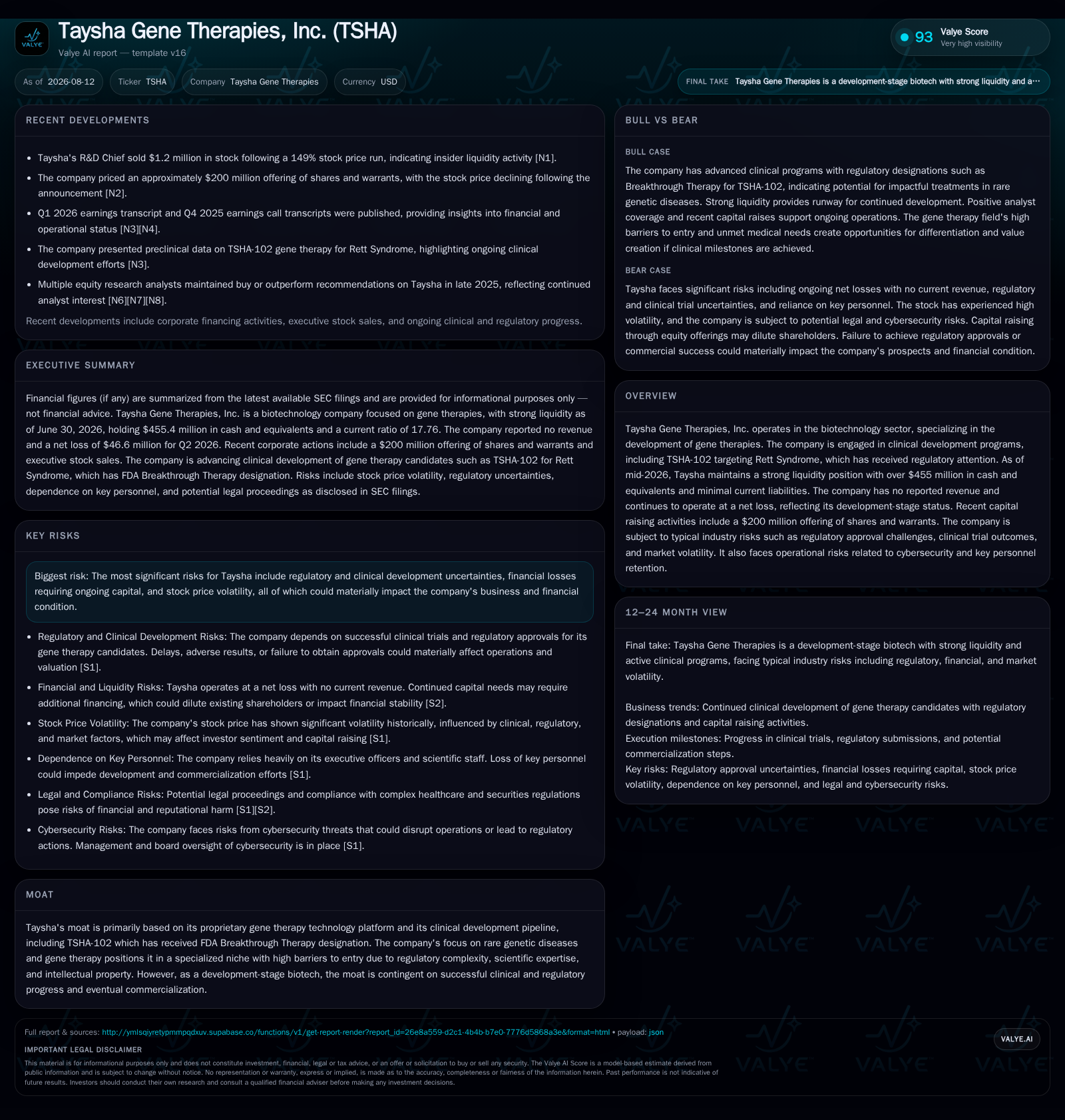
In its latest quarterly filing, Taysha Gene Therapies emphasized continued progress in its gene therapy pipeline with a focus on TSHA-102 for Rett Syndrome, a candidate benefiting from FDA Breakthrough Therapy designation that elevates expectations for accelerated review. The company maintains robust liquidity with over $455 million in cash and equivalents against minimal liabilities, providing ample runway to sustain costly clinical programs despite lacking product revenues. Positioned within the rare genetic disease niche, Taysha’s proprietary gene therapy platform underpins its clinical assets, although risks typical of development-stage biotech remain salient. Investor attention should center on upcoming clinical milestones, patient enrollment dynamics, and capital management execution.
[S2] Q2 Operating Update: Clinical Development Momentum with TSHA-102 Spotlighted
Taysha Gene Therapies’ Q2 2026 10-Q filing highlights sustained activity across its gene therapy pipeline, underscoring TSHA-102 as the strategic lead candidate targeting Rett Syndrome [S2]. This asset holds FDA Breakthrough Therapy designation, granting it an expedited regulatory review pathway which not only accelerates potential market entry but also typically improves investor confidence due to the reduced time and risks associated with approval delays. The quarterly update suggests dense clinical activity remains underway without material interruptions or trial pauses reported since the prior quarter [S2], signaling operational discipline critical for value creation in development-stage biotechs.
Given that gene therapies aimed at rare genetic disorders must navigate complex patient recruitment challenges—often limiting enrollment pace—the uninterrupted progression substantiates effective trial management. The Breakthrough designation also reflects positive initial data or unmet medical need consensus recognized by regulators; this status creates a strategic inflection point where positive trial readouts could trigger major valuation uplifts by validating technology efficacy and safety [S2]. As such, TSHA-102’s clinical signals represent a central growth driver for Taysha amidst an otherwise pre-revenue development portfolio.
[S3] Capital Structure Stability Supported by $200 Million Equity/Warrant Raise in June
The August 11 event filing (8-K) confirms a sizable $200 million capital raise executed through a combination of common stock issuance and warrants in June 2026 [S3]. Coupled with an already robust cash position, this recent funding surge has elevated Taysha’s liquidity foundation to approximately $455 million as of June-end [F1], providing buffer against the inherently volatile operating cash flow experienced in biotech R&D cycles.
This financial solidity translates into an extended cash runway critical to maintaining momentum across multiple simultaneous clinical programs without pressure from imminent refinancing risk. Taysha’s reported current ratio of over 17x further illustrates minimal near-term liabilities relative to available assets [F1], sharpening its profile relative to peers who often face compressed funding horizons post-series financing rounds. The capital raise timing also appears proactive given that net losses persist (exceeding $108 million annually) owing to high R&D expense intensity typical in gene therapy development phases [F1]. Strong liquidity mitigates dilution concerns linked to recurrent fundraising while enabling strategic optionality around licensing or partnership negotiations that could unlock additional milestone revenue streams.
Proprietary Gene Therapy Platform Anchoring a Rare Disease Pipeline with Regulatory Distinctions
Taysha’s core competitive advantage stems from its proprietary gene therapy platform designed specifically for addressing monogenic rare diseases—a sector characterized by stringent scientific complexity and regulatory scrutiny [S1]. The company’s pipeline includes multiple candidates beyond TSHA-102 targeting distinct indications within this niche, supported by orphan drug designations which confer benefits like market exclusivity and regulatory fee waivers.
Its platform technology integrates advanced vector engineering and delivery systems purposed to achieve durable therapeutic expression following single-dose administration—an increasingly sought attribute distinguishing next-generation gene therapies. Intellectual property filings bolster this moat by protecting novel modalities underpinning treatment candidates [S1]. Regulatory milestones such as Breakthrough Therapy designations highlight validation not only of product potential but also underpin reputational advantages fundamental during clinical-investor dialogues. The synergy between scientific innovation, rare disease market specialization, and regulatory incentives forms the backbone of Taysha’s value creation framework.
Competitive Biotech Landscape: Benchmarking TSHA’s Clinical Pipeline Against Peer Innovators
Within the gene therapy arena targeting rare disorders, companies like uniQure and Spark Therapeutics serve as qualitative comparators illustrating typical development trajectories and valuation inflection benchmarks. Both peers have established precedence with FDA approvals validating their platforms after similar Breakthrough Therapy designations were assigned to lead indications.
Taysha’s current pipeline advancement speed is broadly consistent with these models regarding phase progression milestones and patient enrollment strategies [S1]. However, peers’ historical success highlights the critical importance of meeting safety endpoints without delay—failure or elongated timelines can markedly depress valuations in this sector due to elevated sunk costs. Furthermore, capital efficiency represents another touchpoint wherein Taysha’s strong cash reserves relative to burn partially offset sector norm financing volatility seen elsewhere.
Thus far, Taysha exhibits promising alignment with industry standards for clinical progress cadence and regulatory recognition yet remains exposed to classic biotech risks until proof-of-concept achievements crystallize.
Growth Drivers: Upcoming Clinical Milestones, Rare Disease Expansion, and Partnership Prospects
Key catalysts expected to drive near-term value include interim data releases from ongoing TSHA-102 trials, patient enrollment acceleration metrics across other candidates, and potential licensing discussions hinted at implicitly due to strengthened balance sheet flexibility [S2][S3]. A successful transitional event such as positive Phase 2 data readout or FDA Pathway acceptance is anticipated to materially derisk the portfolio while offering commercial blueprint visibility.
Furthermore, advancements in gene editing tools and delivery technologies integrated into Taysha's platform may accelerate expansion into new rare disease targets beyond current indications—increasing addressable market scope. Increasing physician awareness of gene therapies’ transformative potential coupled with orphan drug incentives enhances adoption dynamics once approvals occur. Strategic partnerships or co-development licenses remain viable routes for risk sharing and capital optimization though no explicit agreements were highlighted recently.
Collectively these factors underpin Taysha’s growth outlook rooted fundamentally in science-driven catalyst execution.
Risks & Constraints: Regulatory Uncertainty, Financing Needs, Cybersecurity Vigilance, Personnel Stability
Despite tactical strengths detailed above, several systemic risks impose constraints on trajectory realization. Foremost are unpredictable regulatory approvals given the novelty of gene therapies which historically encounter intricate clinical endpoints evaluation stages causing delays or outright rejections [S1][S2]. Continuous capital raising necessity amid negative earnings renders operational continuity dependent on equity markets’ health and investor appetite—both subject to biotechnology sector volatility exacerbated by macroeconomic factors.
Additionally, cybersecurity threats pose practical risks due to sensitive data reliance whereby breaches could disrupt trial conduct or incur reputational damage; documented governance measures including Audit Committee oversight mitigate but do not eliminate exposure [S1]. Leadership retention emerges as another watchpoint since founder-level expertise is integral for navigating complex developmental terrain—with no key person insurance coverage currently maintained [S1]. These combined elements introduce execution variability warranting cautious monitoring even alongside encouraging clinical signals.
Eyes on Execution: What Investors Must Track—Patient Enrollment Rates, Data Milestones, Runway Updates
Investor focus should gravitate toward specific KPIs illuminating progression quality including pace of patient accrual within pivotal studies (which historically bottlenecks gene therapy trials), timing and robustness of interim efficacy/safety results especially for TSHA-102 leveraging FDA Breakthrough status [S2], and adherence to predefined milestone timelines guiding valuation ceilings.
Financially, monitoring quarterly burn rates juxtaposed against updated liquidity figures will confirm sustainability assumptions grounded partly on recent $200 million capital influx [F1][S3]. New patent grants or expanded orphan drug designations would serve as qualitative signals reinforcing IP moat durability. Any announced partnerships or licensing initiatives could materially alter risk profiles if structured adequately around milestone incentives resembling peer patterns.
These operationally granular elements collectively inform near-term trajectory adjustments essential for nuanced risk-reward assessment.
Financial Profile Discussion: Robust Liquidity Enables Sustained R&D; Minimal Debt Profile Supports Flexibility
As of June 30, 2026, Taysha held approximately $455 million in cash and cash equivalents against total debt estimated at $50 million; resulting in a net cash position exceeding $405 million underscores substantial liquidity cushions atypical among early-stage biotechs without product revenues [F1]. Current liabilities remain low around $26 million yielding an exceptional current ratio above 17x indicating strong short-term solvency [F1].
The company reported continuing net losses reflecting heavy research & development expenditures inherent in clinical trial-intensive operations (operating loss exceeding $110 million trailing annual figure) but manageable given financing strategy recently enacted via a significant equity/warrant offering in mid-2026 [F1][S3]. This fiscal posture supports unfettered advancement of TSHA-102 alongside parallel pipeline candidates without urgent refinancing concerns.
Overall financial health empowers Taysha strategically amidst typical biotech capital demands while preserving negotiating leverage vis-à-vis potential collaborators or acquirers who prioritize stable funding frameworks during drug development architectures.
Disclaimer: This analysis is based solely on publicly available information from SEC filings dated through August 11, 2026 ([S1], [S2], [S3]) and companyfacts financial data ([F1]). It does not constitute investment advice or research views. All forward-looking observations are qualified by inherent uncertainties typical of biotechnology companies engaged in early-stage clinical development.
Disclaimer: This is research-only, informational analysis and not investment advice. It may include AI-generated interpretation and general industry context. Always verify important details using primary sources.

Comments