
Absci Corp Advances AI-Designed Biologics with Focus on Clinical Milestones and Platform Growth
Recent quarterly disclosures underscore Absci’s clinical-stage progress, milestone-driven revenue model, and strong liquidity amid ongoing losses.
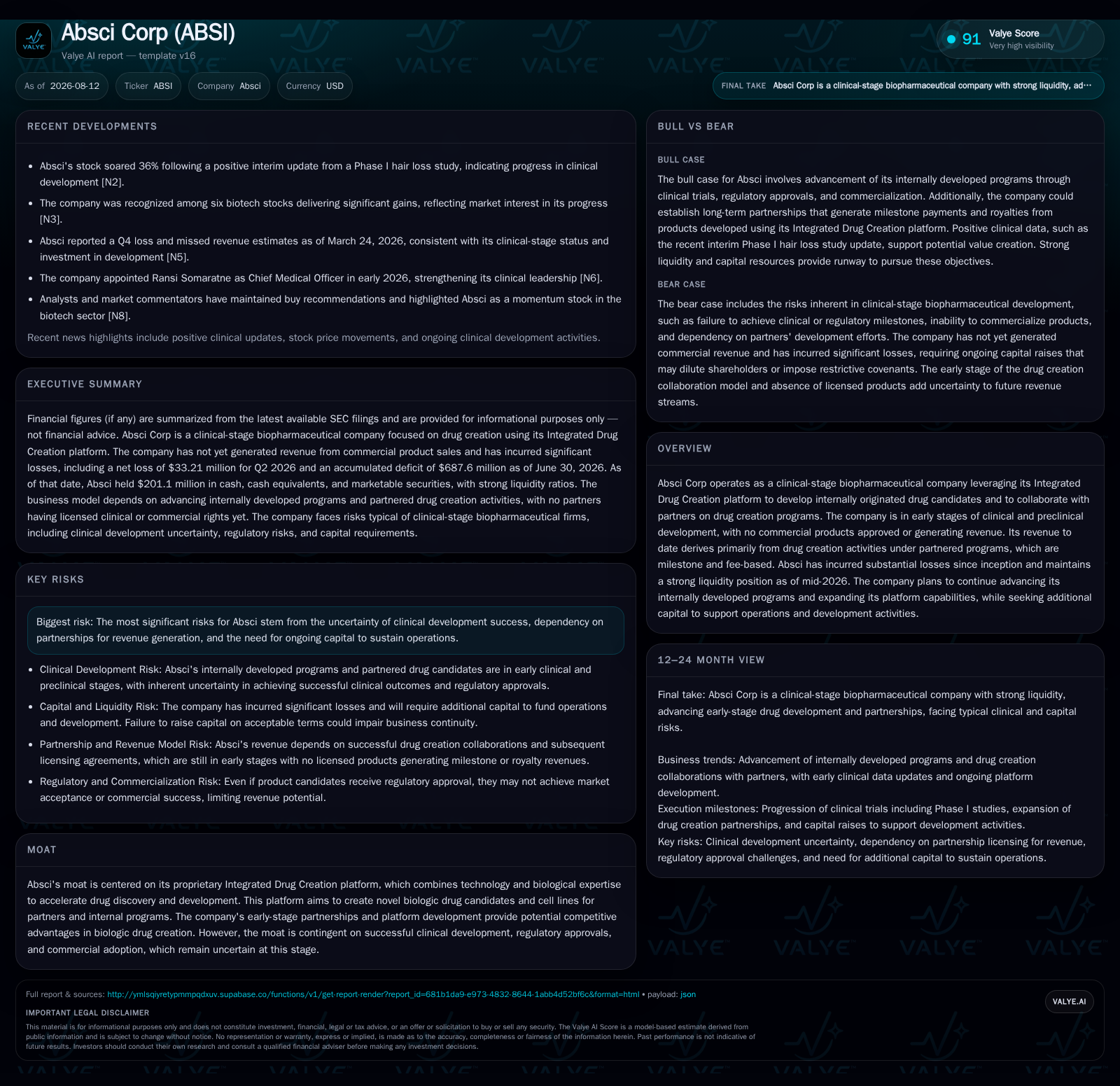
Absci Corp remains a clinical-stage biopharmaceutical company leveraging its proprietary Integrated Drug Creation platform to accelerate biologic therapeutic discovery. The latest second quarter filing confirms continued reliance on milestone and fee-based revenue from partnered drug creation programs, with no commercial sales yet, reflecting the early-stage nature of its pipeline. Absci’s lead candidate ABS-201 is progressing through Phase 1/2a trials targeting androgenetic alopecia, with interim data expected in H2 2026 and a Phase 2 trial for endometriosis planned. Financially, the company holds a robust cash position exceeding $107 million at mid-2026 and maintains a strong current ratio, despite ongoing significant operating losses typical for biotech firms at this stage. The core investment thesis hinges on platform scalability, clinical and regulatory milestones execution, and successful transition toward licensing or commercialization opportunities.
Recent Operating Update
Absci’s latest quarterly filing dated August 11, 2026, confirms its continuation as a clinical-stage biopharmaceutical company focused on using AI-driven technologies within its Integrated Drug Creation platform to develop biologic therapeutics [S2]. Revenue generation remains exclusively tied to milestone payments and fee-based collaborations under partnered drug creation agreements, with no products yet commercialized or licensed [S2]. This highlights the company's current reliance on partnership-driven funding typical of early-stage biotech firms.
The lead candidate ABS-201 is an anti-prolactin receptor antibody engineered for extended half-life dosing convenience. It is currently in a Phase 1/2a HEADLINE™ trial addressing androgenetic alopecia (pattern hair loss), which affects a large patient population underserved by existing therapies due to limited efficacy and durability [S1]. Initial single ascending dose cohorts have been dosed safely. Interim proof-of-concept data including exploratory efficacy endpoints are anticipated in the second half of 2026, constituting a key near-term clinical milestone that will influence the program's valuation.
Additionally, Absci plans to initiate a Phase 2 study of ABS-201 targeting endometriosis in Q4 2026 [S1]. This indication currently lacks FDA-approved disease-modifying therapies despite significant unmet need. The non-hormonal mechanism targeting prolactin receptor signaling offers potential differentiation if supported by clinical data from the ongoing HEADLINE trial and regulatory feedback
On the technological front, Absci's platform integrates Origin-1, its generative AI design model, with rapid lab-in-the-loop validation processes enabling accelerated biologic candidate optimization. The company reports advancing candidates from design to IND filing in roughly two years at approximately $15 million per program—significantly faster and more cost-efficient than conventional biologics development that typically requires four to six years and exceeds $50 million per candidate [S1]. This efficiency provides a competitive edge among emerging AI-enabled drug discovery companies.
Business Model
Absci operates through three main activities: developing internally originated clinical pipeline assets; executing partnered drug creation programs that generate fee and milestone revenues; and continuously enhancing its Integrated Drug Creation platform capabilities. To date, all revenues stem from collaborative contracts rather than product sales or IP licenses since none of its candidates have reached market authorization or out-licensing stages [S1], [S2].
Milestone payments underpinning revenues are contingent upon partners achieving defined development progress markers. This model introduces inherent revenue volatility linked to individual program timing and success probabilities. Therefore, sustaining and growing partner collaborations alongside advancing internal pipeline assets are critical to maintaining funding flows.
ABS-201 exemplifies how the integrated AI-enabled approach enables quicker transitions from concept to clinic within capital constraints uncommon in traditional biologics research. Successful advancement through early clinical trials could unlock licensing or co-development monetization opportunities.
Industry Context and Competitive Positioning
Within the biotechnology sector characterized by lengthy R&D cycles and milestone-dependent income streams before commercialization, Absci distinguishes itself by combining proprietary AI-native technology integration with an emphasis on underexplored biological targets like the prolactin receptor pathway. Unlike many peers focused solely on computational platforms or traditional wet-lab methods, Absci integrates computational design with rapid experimental validation.
Comparable AI-driven drug discovery players include firms such as Recursion Pharmaceuticals or Exscientia; however, differences exist in modality focus or scale. Absci’s reported capital efficiency and accelerated development timeline provide relative advantages assuming upcoming clinical milestones validate therapeutic efficacy.
Nonetheless, competitive barriers remain limited until regulatory approvals confirm product viability. Maintaining technological leadership through continuous platform innovation coupled with broadening partnership engagements will be essential for sustainable differentiation.
Growth Drivers
Key growth vectors include:
- Progression of ABS-201 through clinical phases delivering pivotal data readouts that enable licensing or co-development deals.
- Expansion of partnered drug creation programs generating increasing milestone revenues aligned with partner development successes.
- Ongoing evolution of the Integrated Drug Creation platform facilitating faster design cycles and scaling biologic throughput capacity broadening future pipeline potential.
- Securing new partnerships or licensing arrangements leveraging differentiated antibody engineering targeting areas of high unmet medical need.
- Growing industry adoption of AI-assisted discovery approaches fostering deal flow dynamics favorable to technology-centric platforms.
These drivers correlate directly with KPIs such as number of IND filings from internal and partner programs, quarterly booked milestones achieved, R&D expenditure trends versus cash reserves indicating operational sustainability.
Risks and Watchpoints
As a pre-commercial biotech entity, Absci faces typical risks including:
- Clinical Development Uncertainty: Delays or failures in ABS-201 trials could materially impact near-term value inflection points.
- Partnership Revenue Variability: Dependence on collaborators progressing candidates sufficiently rapidly to trigger milestones introduces revenue timing unpredictability.
- Capital Intensity: Despite reported efficiencies, substantial R&D investments require ongoing fundraising that may dilute shareholders if commercial progress slows.
- Regulatory Challenges: Achieving approvals demands robust safety/efficacy evidence amid evolving regulatory landscapes potentially extending timelines.
- Platform Validation Risk: Sustained demonstration across multiple assets is necessary to substantiate platform claims; failure may weaken competitive positioning.
- Competitive Pressure: Established pharmaceutical companies utilizing conventional biologics development present formidable competition especially post-clinical validation.
Monitoring upcoming data releases expected late in 2026 alongside partnership expansions will provide insight into execution effectiveness against these risks.
What To Watch Next
Immediate catalysts include:
- Interim results from the HEADLINE™ Phase 1/2a trial assessing safety/tolerability plus preliminary efficacy signals expected by year-end 2026 [S8].
- Confirmation of Phase 2 endometriosis study initiation timing linked to regulatory feedback informed by earlier results [S1].
- Announcements regarding new or expanded partnerships signaling increasing commercial validation of Absci’s Integrated Drug Creation platform.
- Quarterly financial disclosures revealing R&D spending patterns relative to cash runway metrics informing capital sufficiency outlooks.
Execution across these milestones will shape strategic options including licensing agreements or potential co-commercialization structures.
Financial Profile Discussion
As of June 30, 2026, Absci held approximately $107.9 million in cash and equivalents against current liabilities near $19.6 million resulting in a current ratio above 10.6x — indicating robust short-term financial flexibility uncommon among similarly situated early-stage biotechs [F1], [S2]. Total debt remains minimal relative to cash (~$4.25 million last reported), reflecting low leverage risk supporting capital raising capacity if needed [F1].
Overall, while loss-making status continues emblematic of developmental phase biotechs, Absci’s strong liquidity position provides operational runway sufficient to pursue upcoming catalyst events without immediate solvency concerns barring unforeseen circumstances.
Disclaimer: This is research-only, informational analysis and not investment advice. It may include AI-generated interpretation and general industry context. Always verify important details using primary sources.

Comments