
Achieve Life Sciences’ Quest for FDA Approval Hinges on Manufacturing Compliance Progress
Achieve Life Sciences faces a pivotal period as FDA manufacturing compliance challenges delay cytisinicline approval, with capital strategy and clinical data underpinning its near-term outlook.
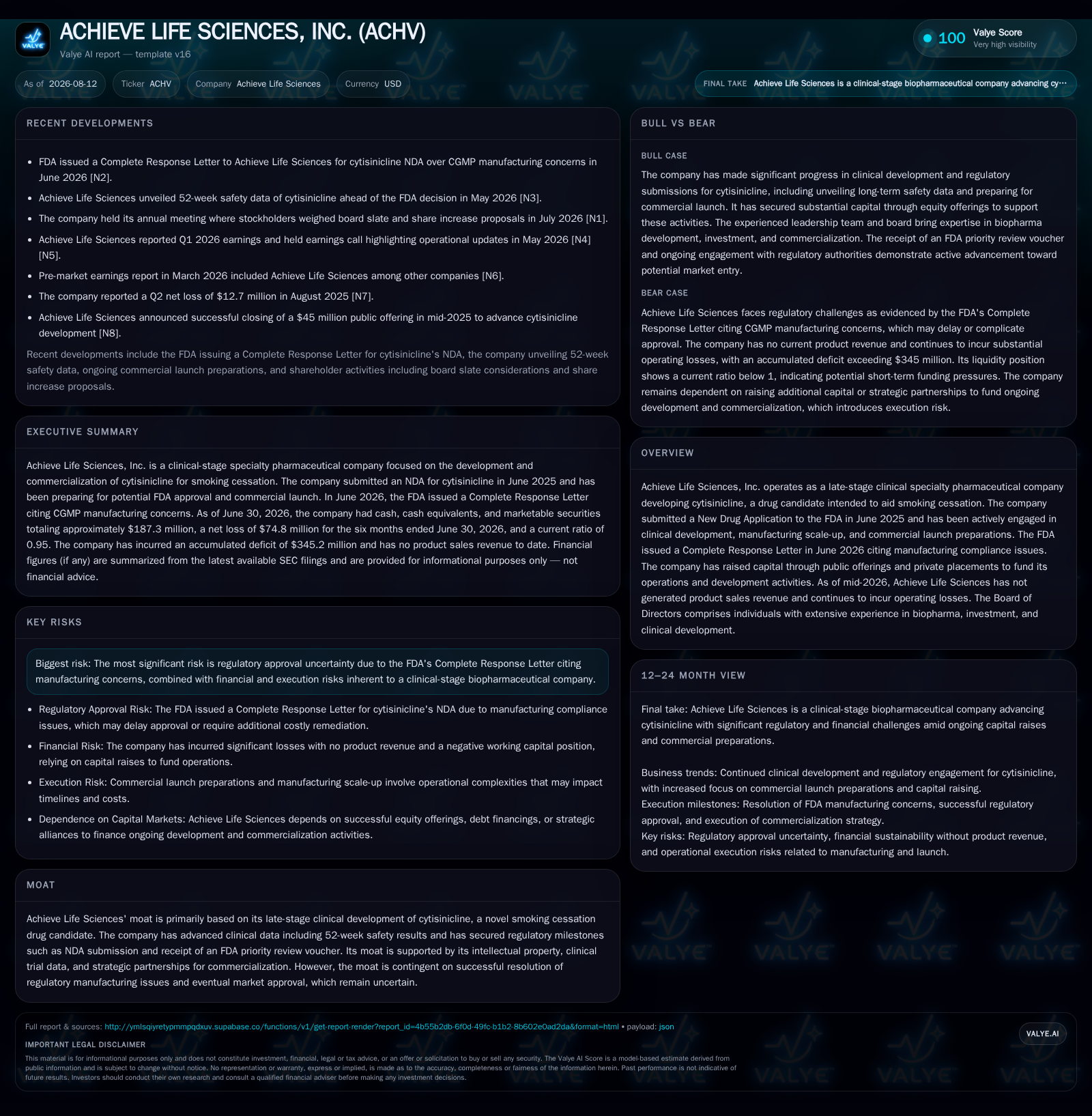
Achieve Life Sciences continues to address FDA manufacturing deficiencies following a Complete Response Letter issued in June 2026, which has introduced uncertainty into the cytisinicline approval timeline. The company’s robust clinical data package and priority review voucher offer strategic advantages but hinge critically on resolving manufacturing compliance issues. Recent capital raises have bolstered liquidity, while operating losses persist amid decreased R&D expenditure post-trial completion and increased commercial readiness spending. The firm's path to commercialization depends on successful regulatory clearance, manufacturing scale-up, and effective burn management.
Manufacturing Compliance Challenges Set Approval Timeline Uncertainty
Achieve Life Sciences disclosed in its August 11, 2026 quarterly filing that the U.S. Food and Drug Administration issued a Complete Response Letter (CRL) in June 2026 citing deficiencies primarily related to manufacturing operations at Adare Pharma Solutions’ facility, where Achieve's cytisinicline drug substance is produced [S2], [S3]. This CRL halts the NDA approval process until these compliance issues are resolved satisfactorily. The delay shifts the expected FDA decision into the first half of fiscal 2027 according to company guidance [N1]. Manufacturing compliance is a critical gating factor because regulatory agencies require validated quality systems ensuring drug safety and batch consistency before granting market authorization.
Key operational metrics now focus on resolving batch success rates, passing regulatory quality assessments, and establishing supply chain robustness. These elements will determine how quickly Achieve can overcome this hurdle. Given typical biopharma delays associated with such compliance issues, this represents a significant timeline risk with implications for valuation since cytisinicline’s commercial potential depends on timely market access.
Cytisinicline’s Clinical Data Underpinning Intellectual Property Value and Regulatory Hope
Despite regulatory setbacks, Achieve’s cytisinicline benefits from comprehensive clinical data supporting its safety and efficacy profile within the smoking cessation therapeutics niche. The recently completed ORCA-OL open-label pivotal trial provided long-term safety data over 52 weeks essential for chronic use indications [S1], [S2]. Completion of this trial marks a transition from active clinical development to regulatory response focus.
Beyond data strength, Achieve holds intellectual property protecting cytisinicline’s chemical composition and method-of-use patents, creating a barrier against generic competitors typical of specialty pharmaceutical firms at late-stage development. Moreover, Achieve possesses an FDA priority review voucher obtained upon NDA submission that can expedite review timelines under normal circumstances and carries intrinsic monetization value through sale or licensing—an asset enhancing strategic flexibility if approval materializes.
Strategic Capital Raises and Burn Management Fund Critical Milestones
Financial disclosures reveal that Achieve raised gross proceeds of approximately $180 million via a private placement in April 2026 to fund ongoing development activities including manufacturing remediation efforts and commercial capability buildout [S6], [S2]. This capital boost expanded cash balances to about $47.96 million as of June 30, 2026—a necessary cushion given persistent operating losses characteristic of clinical-stage biopharma without product revenues [F1].
Research and development expenses declined substantially year-over-year—from $13.8 million in H1 2025 down to $7.1 million by mid-2026—as major trials concluded; however, increased manufacturing preparation costs related to raw material procurement and batch testing prior to resubmission partially offset these savings within R&D spend [S2]. Concurrently, general and administrative expenses nearly doubled driven by investments in commercial infrastructure such as personnel hiring, consultancy services for market research, and launch planning essential for rapid market entry upon approval.
Operating cash burn remains elevated with expenditures outpacing inflows; thus continued access to capital markets will be vital [S9]. Existing convertible debt facilities with floating interest rates provide some financial flexibility but introduce servicing obligations amidst uncertain revenue streams—potentially constraining strategic options if financing conditions tighten or regulatory milestones slip further
Competitive Dynamics in Smoking Cessation Therapeutics
In the nicotine dependence treatment market dominated by nicotine replacement therapies (patches, gums) and pharmaceuticals like varenicline, cytisinicline aims to differentiate through its novel plant-derived alkaloid mechanism combined with encouraging long-term safety signals [S1]. Specialty pharmaceutical companies developing niche cessation drugs typically face payer reimbursement frameworks favoring generics or established brands.
Achieve’s intellectual property portfolio alongside clinical validation supports competitive differentiation relative to generic substitution risks common in this segment. However, failure to timely resolve FDA manufacturing concerns risks ceding advantage to competitors advancing alternative or improved delivery modalities.
Key Growth Drivers: Regulatory Clearance, Partnerships, and Commercial Preparedness
Near-term growth catalysts center on successfully addressing manufacturing deficiencies to secure FDA approval within the H1 FY27 guidance window [N1], unlocking downstream commercial opportunities otherwise inaccessible. Strategic partnerships for marketing distribution or co-promotion could amplify scaling beyond Achieve’s internal resources.
Operational KPIs critical to launch include successful quality audits at contract manufacturers, timely submission of supplemental chemistry/manufacturing/controls documentation, completion of GMP-compliant prelaunch inventory builds, and readiness metrics tied to salesforce deployment—all pivotal for effective market entry execution [S2], [N1], [S3]. This reflects the company’s evolution from development stage toward commercial execution contingent on overcoming current bottlenecks.
Risks to Monitor: FDA Response, Manufacturing Scale-Up, Financing Needs
Principal risks involve regulatory unpredictability heightened by cited manufacturing quality deficiencies potentially prolonging time-to-market with adverse effects on product lifecycle economics. Delays intensify cash runway pressure necessitating additional equity raises or debt refinancing under restrictive covenants that could limit operational flexibility [S2], [S3], [S19].
Supply chain disruptions affecting raw material availability pose further risks post-approval production stability. Market access challenges including payer coverage dynamics remain external yet materially influence commercial viability.
Milestones Ahead: FDA Decision Outlook, Collaborations, Funding Status
Upcoming quarters will reveal progress resolving FDA manufacturing concerns through agency communications or inspections anticipated before mid-2027 as per management commentary [N1]. Additional data releases supporting product safety or efficacy will bolster prescriber confidence.
New strategic collaborations announced could materially enhance commercial infrastructure readiness. From financing perspectives, disclosures regarding planned capital raises or convertible debt amendments will indicate sufficiency of liquidity against ongoing burn during extended launch cycles.
Financial Profile Discussion: Cash Position, Expense Dynamics, Runway Analysis
As of June 30, 2026, Achieve held approximately $47.96 million in cash and equivalents supported by current assets totaling $188.3 million against current liabilities near $197.7 million—yielding a working capital ratio close to parity at 0.95—indicative of tight short-term liquidity typical for late-stage biotech firms reliant on timely capital infusion absent revenue streams [F1], [S2].
In summary, successful milestone execution combined with prudent financial stewardship remains critical as Achieve transitions from clinical validation toward anticipated market entry while navigating pressing regulatory challenges.
This analysis integrates recent SEC filings alongside biotech industry context relevant to late-stage clinical companies managing regulatory complexities impacting time-to-market dynamics. It avoids speculative revenue forecasts focusing instead on validated milestones central to valuation assessment.
Disclaimer: This is research-only, informational analysis and not investment advice. It may include AI-generated interpretation and general industry context. Always verify important details using primary sources.

Comments