
SharonAI Accelerates GPU Fleet Expansion Amid Execution Risks and Sovereignty Advantages
Latest quarterly filings reveal SharonAI's capital-efficient scaling strategy strained by execution risks and pricing pressures as sovereign AI demand rises.
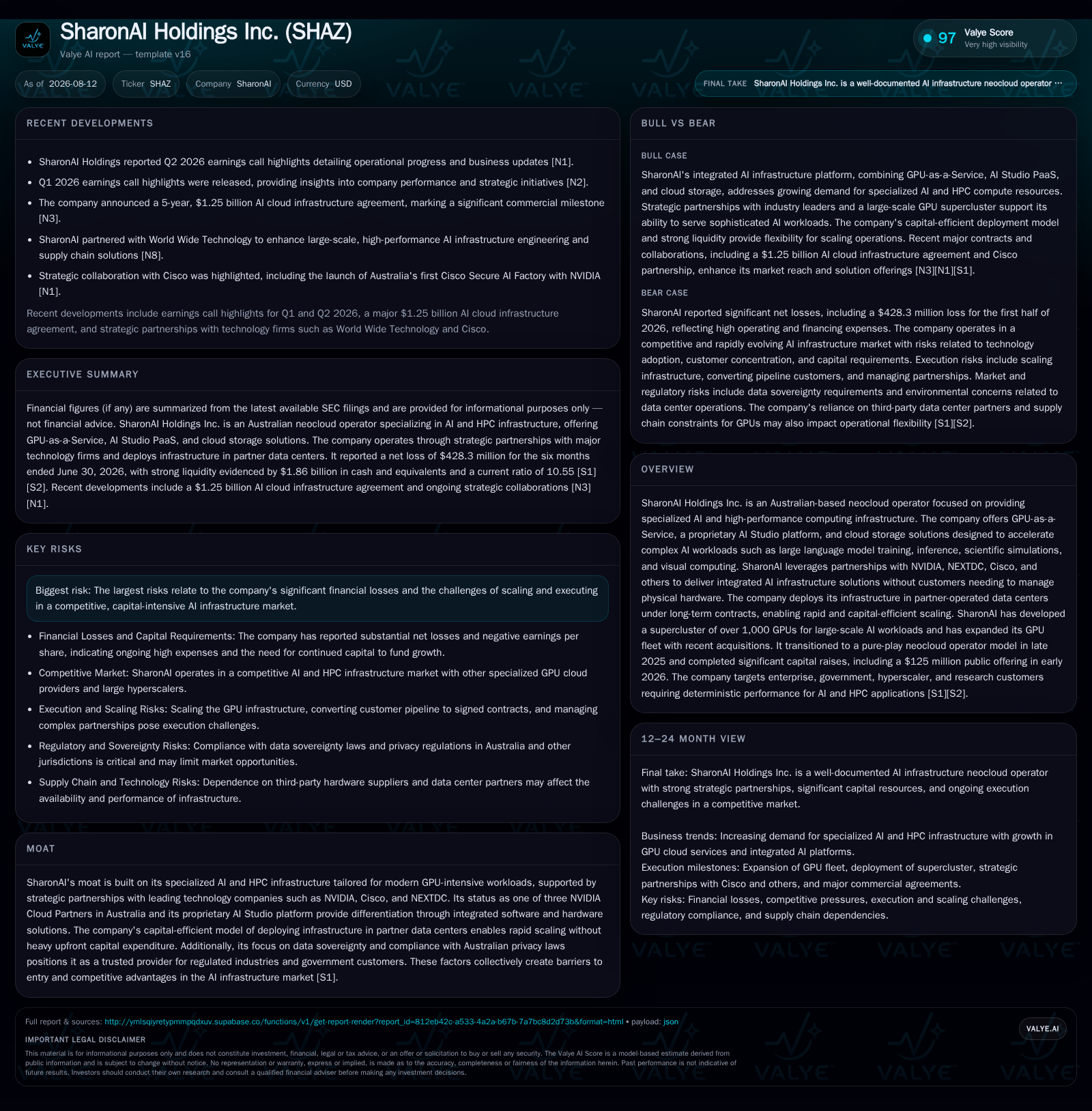
SharonAI Holdings Inc. reported continued expansion of its specialized GPU infrastructure in Q2 2026, leveraging partnerships with NEXTDC and NVIDIA to serve the growing Australian AI market. Despite operational progress including a 1,000+ GPU supercluster and a significant five-year service agreement, the company faces material execution risks linked to data center capacity delivery and contract milestone adherence. Pricing pressures from declining per-GPU hour rates under a key customer contract add financial strain, compounded by ongoing operating losses. SharonAI's focus on sovereign cloud offerings provides differentiation amid rising data privacy demands from government and regulated industries. Key metrics to watch include capacity provisioning timelines, GPU utilization rates, and third-party compute revenue generation.
Recent Operating Update
SharonAI Holdings Inc.'s latest quarterly filing dated August 6, 2026 ([S2]) outlines ongoing deployment progress of its GPU-accelerated infrastructure central to its neocloud AI platform. The company secured up to 87 megawatts (MW) of capacity at NEXTDC-operated data centers under long-term contracts allowing capital-efficient scaling without building owned facilities. This volume is critical given the power-intensive nature of modern AI workloads reliant on high-performance GPUs. However, reliance on NEXTDC also concentrates operational risk; any delays or disruptions in delivering this contracted capacity could materially impair SharonAI's ability to fulfill customer contracts or grow revenue [S2]. Furthermore, the company disclosed a six-year contract with a major customer featuring a declining rate structure per GPU hour. While the business model anticipates partially reselling this compute to third parties at higher margin spreads, competitive market dynamics introduce uncertainty about successfully offsetting these declines [S2]. Such developments underscore execution challenges at play even as the topline opportunity broadens.
In tandem with quarterly results, an August 4, 2026 press release detailed a US$373 million five-year AI cloud service agreement [S8], signaling meaningful commercial traction in enterprise and government sectors demanding sovereign AI compute in Australia. The deal highlights SharonAI's growing footprint but also amplifies delivery milestones pressure given penalties linked to delayed cluster deployments [S2]. Additionally, the company's status as one of three NVIDIA Cloud Partners in Australia supports its positioning with early access to latest GPU models such as NVIDIA's B300 and upcoming GB300 GPUs integrated into its offerings [S1].
Business Model Overview
SharonAI operates as a neocloud provider specializing in GPU-as-a-Service (GPUaaS) for advanced AI and high-performance computing workloads primarily targeting enterprise, government, and research customers within Australia. Unlike traditional hyperscalers owning vast global data centers, SharonAI strategically deploys its proprietary accelerated computing clusters inside partner-operated facilities—primarily NEXTDC—to minimize upfront capital outlay while scaling compute density tailored for generative AI tasks including large language model training and inference workloads [S1].
The company's proprietary AI Studio platform couples access to physical GPUs with integrated software frameworks optimized for complex simulations and machine learning training pipelines—a valuable bundle reducing customer complexity around infrastructure rollout and management [S1]. Revenue is derived mainly from long-term subscription or usage-based contracts for GPU compute hours delivered through these clusters. Pricing dynamics hinge on negotiated contracts; one significant customer agreement features scheduled price declines over time balanced by intended third-party compute sales within that capacity footprint [S2].
SharonAI emphasizes data sovereignty compliance as a competitive moat due to Australia's strict privacy regulations. By hosting compute locally within jurisdictional boundaries under compliant controls, SharonAI caters effectively to regulated industry verticals and governmental entities that face barriers adopting foreign hyperscaler cloud services on sovereignty grounds [S1].
Industry Structure and Competitive Positioning
The AI and HPC cloud infrastructure industry is witnessing rapid structural demand growth driven largely by generative AI adoption accelerating requirements for scalable GPU-accelerated compute resources with low latency and high bandwidth connectivity. Industry participants typically operate between hardware suppliers (notably NVIDIA), data center operators (colocation partners like NEXTDC), and end-customers consuming AI services.
Within this context, SharonAI differentiates through tightly integrated hardware-software stacks purpose-built for modern accelerated workloads—departing from generic cloud offerings by focusing exclusively on intensive AI/HPC use cases. Partnering among industry leaders such as NVIDIA (granting Cloud Partner status), Cisco (for networking), Lenovo (server provisioning), VAST Data (storage optimization), WWT (systems integration), and Megaport (network fabric) consolidates SharonAI’s ecosystem advantage by blending best-in-class technologies without owning data centers directly [S1].
Comparatively, global hyperscale providers like AWS or Microsoft Azure offer broader-but-less-specialized AI compute services often shipping older generation GPUs or relying on multi-tenant infrastructure where sovereignty assurances may be weaker outside major hubs. Specialized players such as CoreWeave or Lambda Labs provide focused GPUaaS solutions but are predominantly US-centric without local Australian infrastructure or the sovereign compliance dimension SharonAI emphasizes.
Growth Drivers
The primary engine fueling SharonAI’s business expansion remains the explosive surge in demand for GPUs supporting generative AI frameworks like large language models alongside complex HPC simulations. As enterprises across sectors embrace these technologies—from financial modeling to automated design—and governments invest heavily in strategic AI capabilities domestically ([S1]), SharonAI’s sovereignly compliant infrastructure gains importance.
Capital-efficient scaling via partner-operated data center contracts offers agility advantages over own-data-center builds capped at multi-year lead times and high capital expenditures. The recent five-year $373 million service agreement ([S8]) exemplifies traction securing multi-year visibility while enabling incremental cluster expansions aligned with evolving demand.
Sophisticated customers increasingly seek integrated platforms that combine accelerated hardware access with optimized software ecosystems reducing total cost of ownership and operational complexity—a niche SharonAI addresses through its proprietary AI Studio platform bundling hardware/software provisioning seamlessly [S1].
Regulatory frameworks mandating strict data sovereignty further restrict options for many domestic organizations favoring localized cloud environments compliant out-of-the-box rather than adapting foreign-based hyperscaler services.
Risks and Watchpoints
Execution risks rank foremost—NEXTDC’s ability to timely deliver contracted facility capacity directly impacts SharonAI’s ability to deploy planned GPU infrastructure milestones ([S2]). Given large-scale cluster rollouts involve complex integration across cooling (liquid preferred over air for energy efficiency), power allocation, networking fabric setup, any delay compresses service periods potentially triggering contract penalties or termination rights.
Pricing risks emerge from the six-year declining rate schedule embedded in key customer contracts creating headwinds unless third-party compute sales recuperate margins amid volatile competitive pricing influenced by evolving NVIDIA GPU generations and competition from hyperscalers ([S2]). Third-party market success depends on maintaining utilization rates amid fluctuating demand curves.
Financial sustainability also bears monitoring: continued operating losses reflect high upfront investment phases typical for specialized AI platforms but require careful cash management especially if external financing conditions tighten. While liquidity appears strong with $1.86 billion in cash equivalents as of June 2026 available ([F1]), the transition toward positive operating income depends heavily on ramping utilization efficiently.
Customer concentration risk exists given dependence on a few large contracts driving substantial portion of committed revenues. Failure to renew or extend terms under favorable conditions would impair base revenue visibility.
Technological obsolescence risk is inherent due to fast-paced NVIDIA GPU upgrades necessitating continual refresh cycles impacting near-term capex intensity.
Finally, regulatory changes affecting cloud privacy frameworks or government procurement policies could reshuffle sovereign preferences impacting demand patterns.
What To Watch Next
- Timelines for full provisioning of the contracted 87MW data center capacity at NEXTDC facilities reflecting ability to meet cluster deployment milestones.
- Progression metrics on expanding the deployed GPU fleet beyond the existing supercluster exceeding 1,000 GPUs.[S1]
- Revenue trends particularly growth in third-party compute sales acting as offset against declining per-hour rates from anchor customers.[S2]
- Renewal rates or extensions on significant long-term service contracts signaling customer retention strength.
- Updates regarding NVIDIA partnership developments relating to new-generation GPU integration timing sensitive given rapid technology cycles.[S1]
- Platform uptime statistics ensuring reliability benchmarks essential for mission-critical government clientele.
- Any adjustments or communication around execution risks impacting contractual penalty exposure levels.[S2]
- Cash burn trajectory vis-à-vis capital expenditure outlays required for further cluster expansions.
Financial Profile Discussion
As of June 30, 2026, SharonAI reported a robust liquidity position highlighted by $1.86 billion in cash and equivalents against current liabilities of approximately $184 million resulting in an exceptionally strong current ratio of approximately 10.55 indicating low near-term liquidity risk ([F1]). The company's business model inherently entails significant upfront capital investments tied primarily to procurement and installation of advanced GPUs alongside network fabric enhancements housed within third-party colocation sites rather than owned premises—allowing scaled growth with reduced fixed asset burdens but prolonging path toward profitability until utilization thresholds are achieved ([S1], [S2]). Therefore, managing cash burn relative to ramp speed across new cluster deployments remains critical alongside diversifying revenue streams beyond anchor client agreements reducing concentration exposure risks.
Capital structure currently does not show disclosed debt draws posing immediate refinancing concerns although ongoing monitoring necessary should execution timelines extend drawing on liquidity reserves ([F1], [S3]).
This analysis synthesizes recent SEC filings alongside sector context to appraise SharonAI Holdings Inc.'s current operational positioning within the fast-evolving Australian AI cloud infrastructure landscape. While demonstrating strategic moats related to partnerships and sovereign compliance advantages plus progress expanding specialized GPU clusters underpinning core product offerings, notable execution challenges tied to facility provisioning timelines combined with evolving contract pricing frameworks create near-term uncertainties evident in ongoing financial losses. Key monitoring focuses include capacity ramp adherence alongside expanding third-party market penetration essential for translating foundational strength into durable commercial success.
Disclaimer: This article is an analytical discussion based on publicly available information provided by SEC filings and industry research; it does not constitute investment advice.
Disclaimer: This is research-only, informational analysis and not investment advice. It may include AI-generated interpretation and general industry context. Always verify important details using primary sources.

Comments