
GrowGeneration Advances Proprietary Brands and Streamlines Retail Amid Margin Pressure
Q2 2026 marks a turning point for GrowGeneration with profitability-focused restructuring and enhanced proprietary brand penetration shaping its specialty hydroponic retail operations.
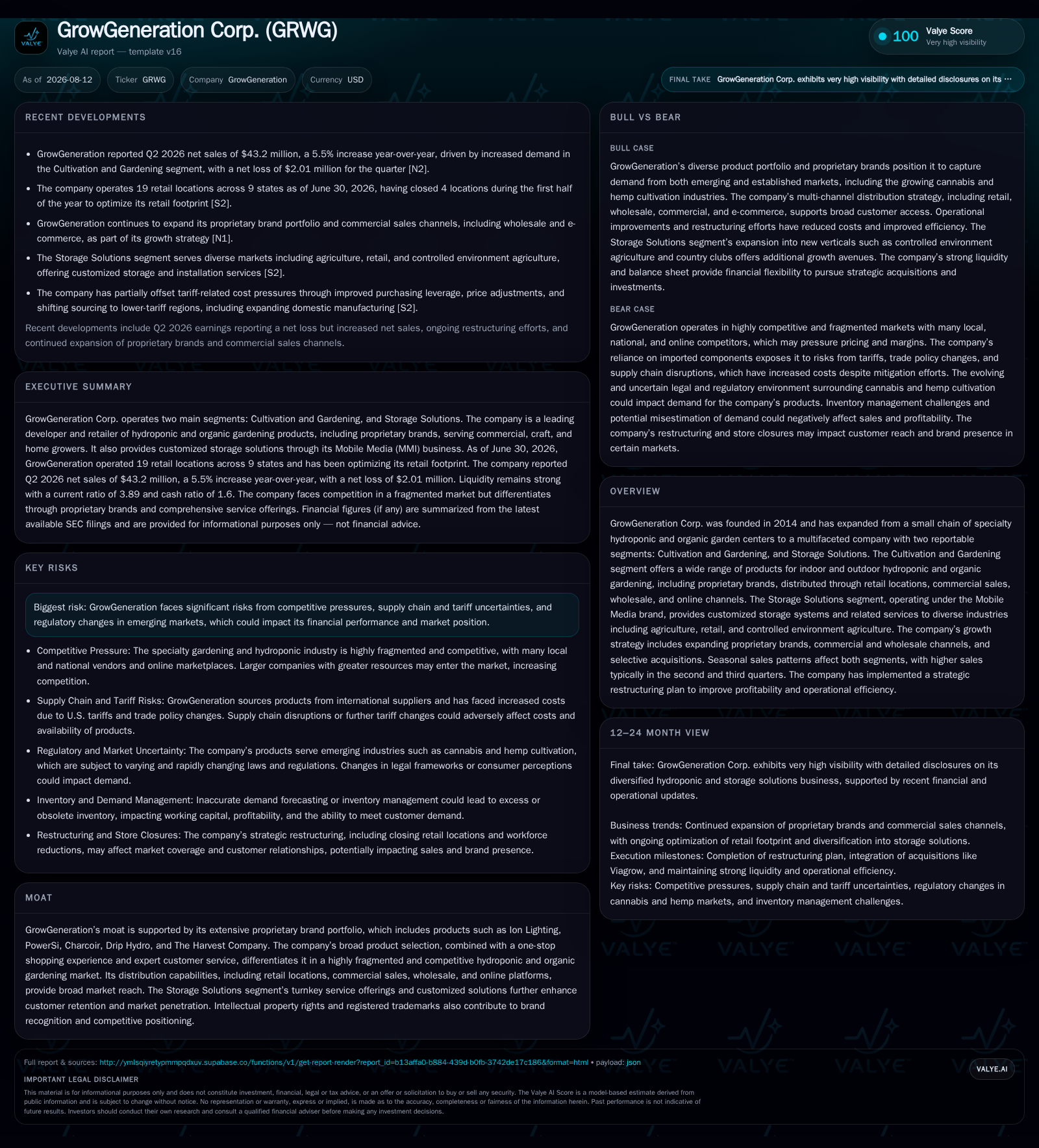
GrowGeneration Corp.’s latest quarter reflects the ongoing execution of its strategic restructuring plan initiated in mid-2024, targeting long-term profitability by closing underperforming stores and bolstering proprietary brands alongside e-commerce and commercial sales. Despite an operating loss, adjusted EBITDA turned positive in Q2 2026 as cost reductions offset margin pressures from supply chain tariffs and competitive pricing. The company’s multi-channel model, led by hydroponic retail centers, wholesale distribution, and online platforms, remains well positioned within a fragmented specialty gardening industry leveraging proprietary products as key differentiators. Key risks include tariff-related cost volatility, competitive intensity, seasonal demand swings, and regulatory uncertainties particularly tied to emerging cannabis markets.
Recent Operating Update
GrowGeneration’s second quarter ended June 30, 2026 highlights continued execution on its strategic restructuring plan announced in July 2024 aimed at enhancing long-term profitability. The plan involved closing or consolidating twelve redundant or underperforming retail locations through late 2025 into early 2026; notably, four additional locations were closed during H1 2026 as part of this streamlining effort. These closures have contributed to significant reductions in operating expenses—store operations costs fell nearly 25% year-over-year for the six months ended June 30, reflecting leaner payroll, rent, and utilities burdens. Digital transformation initiatives alongside workforce reductions further support this efficiency drive [S2], [S17].
Cash and equivalents stood at $41 million as the company consumed cash primarily through operating activities during investments into proprietary brand development and inventory management enhancements [S2]. No extraordinary liabilities threaten near-term liquidity
Adjusted EBITDA swung positive in Q2 after multi-quarter losses due largely to cost structure improvements offsetting ongoing headwinds including margin pressure from tariff-induced cost increases on imported inputs such as coir substrates and lighting components sourced internationally (India, Mexico, China). The Storage Solutions segment experienced some pricing compression consistent with broader industry trends but retained healthy gross margins above 39% despite these pressures [S17], [S22].
Business Model Analysis
GrowGeneration operates two distinct though complementary segments: the Cultivation and Gardening segment specializing in hydroponic and organic growing products for indoor/outdoor use; and the Storage Solutions segment providing benching, racking, and customized storage solutions under the Mobile Media brand. This dual-segment approach allows GrowGeneration to serve a wide customer base ranging from home growers to large-scale commercial cultivators employing controlled environment agriculture (CEA) techniques.
Revenue generation stems primarily from product sales across multiple channels: approximately two dozen retail garden centers distributed across ten states offer direct-to-consumer access; a commercial sales division delivers white-glove service to large cultivators; wholesale efforts target mass-market retailers and independent resellers; while an e-commerce platform supports B2B wholesale customers alongside online retail consumers. This channel diversity mitigates concentration risk while maximizing market reach.
Product mix is weighted towards high-margin proprietary brands including Ion Lighting (LED grow lights), PowerSi nutrient supplements, Charcoir coco coir media products, Drip Hydro liquid/powder nutrients/additives, The Harvest Company lifestyle gardening consumer goods, Viagrow tools/accessories from recent acquisition activities, and MMI’s storage hardware. Proprietary brands typically command greater gross margins than third-party offerings due to closer supplier control and brand loyalty-building attributes. Management explicitly ties portfolio expansion and innovation—including digital sales tools—to future margin improvement goals [S1], [S23].
Operating costs are skewed towards fixed expenses like lease obligations (rent/utilities) across physical retail footprints totaling over half a million square feet combined with distribution facilities strategically located nationwide for fulfillment efficiency. Payroll constitutes another significant fixed cost but was materially reduced post-restructuring.
Industry Structure & Competitive Position
The specialty hydroponic and organic gardening supplies industry is fragmented with numerous small regional providers alongside larger chains like GrowGeneration that are consolidating assets for scale advantages. Competition arises not only from similar specialty retailers but also increasingly from general garden chains, big-box retailers occasionally expanding hydroponics assortments, online marketplaces (where price competition is fierce), plus direct-to-grower manufacturers aiming for bypass strategies.
GrowGeneration’s moat centers on its broad product breadth fused with deep category expertise—the "grower-first" culture projected through expert staff advisory services—and its extensive proprietary brand suite that creates differentiation difficult for competitors replicating third-party assortments alone. Multi-channel distribution enhances customer accessibility while physical presence supports buyer confidence particularly among novice or commercial growers needing hands-on consultation.
Despite solid positioning, costs related to international supply chain tariffs enacted since early 2025 impose ongoing margin pressure especially on imported components crucial for core products like lighting solutions or environmental controls. Competitor reaction includes product repricing strategies that could accelerate compression within Storage Solutions amid general price sensitivity across B2B horticultural infrastructure buyers.
Growth Drivers
Organic growth drivers encompass rising consumer interest in sustainable organic gardening coupled with adoption growth in commercial cannabis/hemp cultivation that relies heavily on indoor hydroponic techniques due to regulatory compliance or space optimization needs.
Strategically prioritized growth levers include:
- Expanding penetration of proprietary brands which enhance margin profiles while incentivizing customer retention through differentiated quality/value merits.
- Growing commercial sales volume leveraging specialized account management for scalable CEA facilities.
- Increasing e-commerce contribution reflecting shifting buyer preferences toward online procurement channels especially post-pandemic.
- Pursuing accretive acquisitions of complementary specialty hydroponic businesses or innovative product lines exemplified by the Viagrow acquisition finalized mid-2025 improving product breadth.
- Enhancing supply chain efficiency and deploying digital transformation tools enabling better inventory turnover metrics amidst seasonally fluctuating demand.
- Geographic footprint expansion selectively targeting high-growth states aligned with favorable regulatory environment for cultivation sectors.
Seasonality remains significant with peak buying clustered around spring/summer months affecting inventory build-up tactics; initiatives post-restructuring aim at better forecasting accuracy reducing obsolete inventory risk that previously strained working capital dynamics.
Risks & Watchpoints
Key risks persist around macro-level tariff volatility impacting input costs unpredictably given rapid U.S. trade policy changes implemented since early 2025 under Executive Order 14257 framework enforced by IEEPA authority [S2]. These tariffs challenge price stability especially where costs cannot be fully passed through without losing market share.
Competitive intensity involves not just price wars but also innovation races around lighting technology or nutrient formulations where intellectual property rights enforcement becomes critical; litigation regarding patents or trademarks represents potential financial exposure accompanying proprietary brand expansion strategies [S24].
Product liability risk related to proprietary brands could manifest via recall events or injury claims necessitating costly defense or settlements impacting reputation further intensified by evolving regulatory frameworks especially around cannabis sector compliance nuances operationalized differently state-by-state.
Retail footprint consolidation must balance efficiency gains against potential revenue loss from reduced geographic coverage requiring monitoring same-store sales metrics closely.[
Customer retention amidst shifting buying behaviors demands sustaining superior advisory services quality while competitors innovate digitally creating pressure on GrowGeneration’s service differentiation premium.[
Integration risks from acquisitions persist particularly harmonizing legacy systems/processes impacting operating expense structure realization timeline.[
Lastly economic cycles affecting discretionary consumer spending can censor growth momentum given hobbyist gardening represents a non-essential category vulnerable to downturns.
What To Watch Next
Investors should monitor sequential quarterly KPIs including same-store sales growth post-store closures to assess restructuring impact durability along with proprietary brand penetration percentage shifts signaling margin trajectory improvements.[
Tracking commercial sales volume upticks will illuminate success penetrating institutional customers benefiting from licensed cannabis/hemp cultivation growth.[
Margin analysis segmented by product categories – particularly Storage Solutions vs Cultivation & Gardening – will clarify pricing power sustainability amid external cost headwinds.[
Inventory turnover ratios reflecting improved demand forecasting efficacy following digital transformation initiatives should herald more stable working capital cycles.[
Announcements of new proprietary brand launches or strategic acquisitions comparable to Viagrow may indicate ongoing portfolio strengthening consistent with declared growth priorities.[
Legal proceedings updates related to IP disputes or product liability claims could presage increased contingency risks affecting operating income volatility.[
Full-year guidance revisions provided by management during earnings calls can reveal confidence levels around market demand assumptions considering external uncertainties.[
Financial Profile Discussion
As of June 30, 2026 GrowGeneration maintains solid liquidity positioning with working capital at $74.0 million supported by $41.0 million in cash, cash equivalents, and marketable securities signaling adequate runway for ongoing operations even as net cash outflows continue from operating activities largely related to higher inventories ahead of seasonal demand peaks [S2]
Total debt remains negligible relative to cash resources indicating low leverage risk providing flexibility for future growth capital deployment or opportunistic acquisitions without refinancing constraints [F1]
Operating expenses decreased nearly 19% year-over-year driven by store consolidation-induced reductions primarily cutting fixed costs like lease obligations alongside lower depreciation expense reflecting asset retirements following impairment charges tied to store closures completed earlier reflecting disciplined asset base management reducing non-core overhead burden [S17].
Overall cash flow patterns reveal cautious investment into growing proprietary branded portfolios balanced against prudent inventory control fostering gradual restoration of free cash flow generation capacity critical for sustainable expansion phases beyond restructuring completion horizon expected in recent years’ filings [S14]
This analysis reflects key insights drawn from GrowGeneration Corp.’s recent SEC filings supplemented by sector expertise in specialty hydroponic retail markets emphasizing operational changes shaping financial outcomes amid evolving external challenges including trade policy shifts and emerging cultivation industry dynamics. No investment research view is expressed herein.
Disclaimer: This is research-only, informational analysis and not investment advice. It may include AI-generated interpretation and general industry context. Always verify important details using primary sources.

Comments