
Founder Strength and Capital Position Set Stage for Spartacus Acquisition’s Next Strategic Move
Spartacus Acquisition Corp. II leverages a robust $230 million IPO trust and a seasoned TMT-focused management to pursue timely Business Combination execution within a full two-year window.
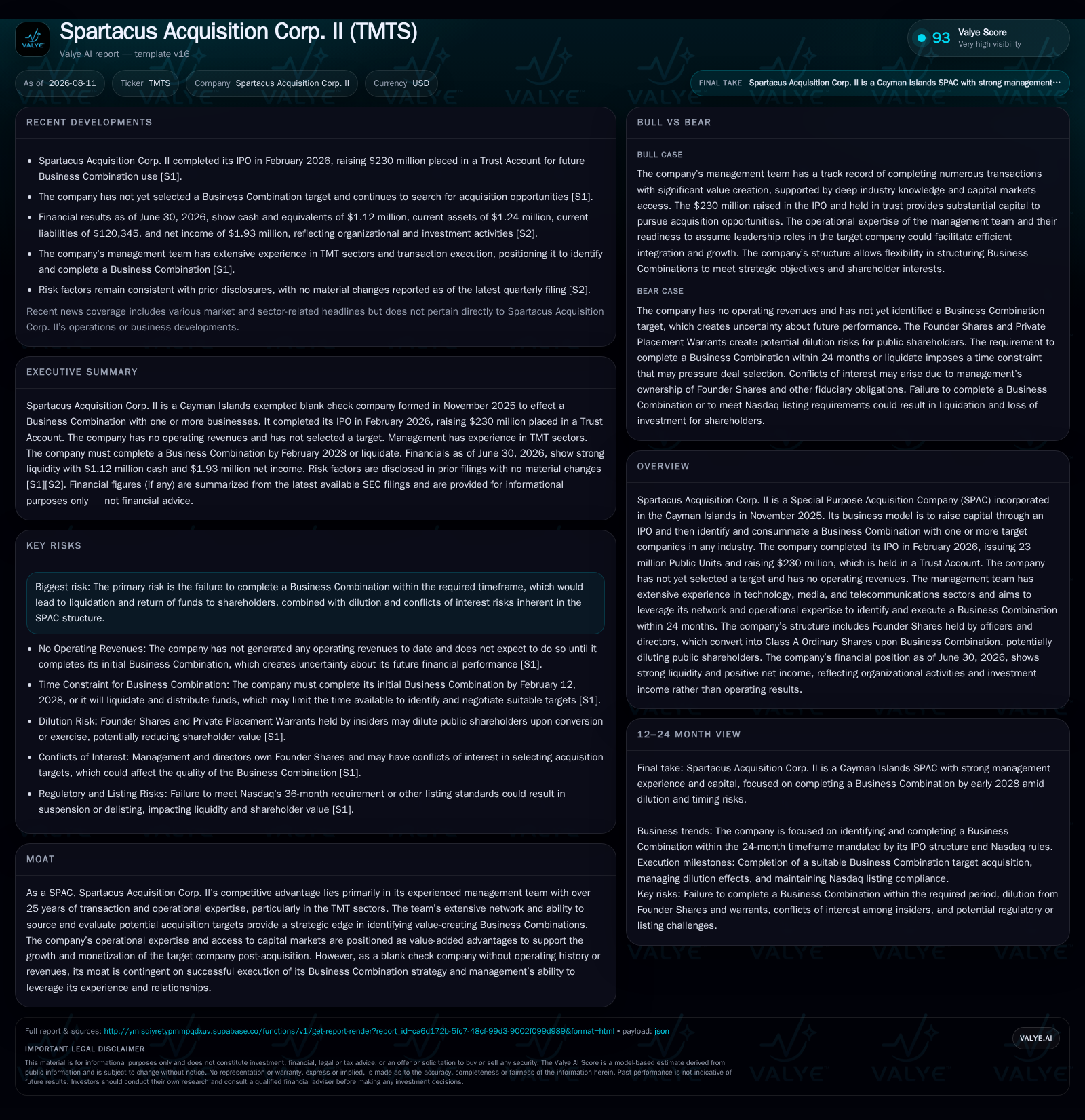
Established in late 2025 as a Cayman Islands exempted blank check company, Spartacus Acquisition Corp. II raised $230 million through its February 2026 IPO, positioning itself with capital held securely in trust and guided by an experienced sponsor team focused on the technology, media, and telecommunications sectors. The latest quarterly filing to June 30, 2026, shows the SPAC holding over $1.1 million in cash with minimal debt, preserving strong liquidity as it progresses toward its February 2028 Business Combination deadline. While no target has yet been identified, the management’s extensive sector expertise and network represent key competitive advantages amid an increasingly crowded SPAC market. Execution risks remain, notably around shareholder redemptions and timing constraints, but the company's financial footing and governance framework create a clear runway for deal origination and completion efforts over the coming 18 months.
Midpoint Check: Trust Account Position and Time Remaining in Combination Window
Spartacus Acquisition Corp. II’s August 11, 2026 quarterly filing provides a critical update approximately six months after its IPO closing in February 2026. The company’s capital remains securely held in its Trust Account totaling $230 million initially raised from public investors via sale of 23 million units priced at $10 each plus private placement proceeds from Sponsor warrants sold concurrently [S1]. As of June 30, 2026, Spartacus reported cash and equivalents of about $1.12 million alongside a small debt load near $300k—reflecting only nominal post-IPO operational financing or setup costs—and an exceptionally strong current ratio of over 10x indicates ample short-term liquidity given negligible liabilities [F1]. This financial positioning is consistent with SPAC norms where funds cannot be deployed until a qualifying Business Combination closes.
The operational window remains intact with just under two years left before the February 12, 2028 Combination Period deadline by which the company must consummate a merger or capital raise transaction to remain viable. Failure to complete within this timeframe mandates liquidation with return of trust assets to public shareholders [S1]. The retention of this full timeframe supports strategic flexibility for target evaluation but also imposes urgency given typical SPAC lifecycle compression.
Sponsor Experience and Sector Focus: Competitive Edge Amidst SPAC Crowding
Management capabilities differentiate Spartacus within an increasingly competitive SPAC landscape characterized by proliferating blank-check companies vying for quality targets. Led by Chairman Peter D. Aquino and CEO Igor Volshteyn—combined decades deeply rooted in technology-media-telecommunications (TMT) sectors—the Sponsor team brings not only transactional expertise but hands-on operational insight crucial for value creation post-combination [S1].
This mosaic of skill sets comprises reputation leverage in sourcing vetted targets via extensive personal networks developed over many completed deals in the TMT verticals. Beyond pure financial sponsorship roles typical for many SPACs whose managers lack domain focus or operational experience, Spartacus positions itself as an active partner capable of guiding acquired businesses strategically after going public. Such strategic sophistication can provide access advantages relative to competitors whose management teams are less specialized.
Capital Structure Mechanics: IPO Units, Private Placement Warrants, and Dilution Considerations
Spartacus completed its Initial Public Offering (IPO) on February 12, 2026 issuing a total of 23 million Public Units consisting each of one Class A Ordinary Share plus one-third warrant exercisable at $11.50 per share—a structure designed to incentivize long-term holders while providing meaningful equity upside exposure [S1]. In addition to public units was a concurrent Private Placement Warrants issuance directly to the Sponsor totaling approximately 4.125 million warrants purchased at $1 per warrant generating incremental capital that also feeds into the Trust Account balance [S1].
A customary element embedded in this structure involves Founder Shares granted to officers and directors that convert fully into common equity upon consummation of the Business Combination which inherently dilutes preexisting public shareholders on transaction closing unless redeemed shares proportionally adjust equity stakes accordingly [S11]. Moreover, warrants held by both public investors and Sponsor can introduce additional dilution upon exercise post-combination depending on capital structure decisions made during transaction consummation.
Understanding these mechanics is critical as dilution magnitudes directly impact shareholder value creation trajectories post-de-SPAC compared against traditional IPOs where sponsor equity incentives may differ.
SPAC Lifecycle Risks: Redemption Rights and Execution Deadline Implications
A quintessential risk embedded within Spartacus’s business model relates to timing discipline imposed by the fixed Combination Period coupled with redemption rights exercised by Public Shareholders at closing. Shareholders retain the option to redeem their Class A Ordinary Shares for their pro-rata portion of amounts held in trust prior to any completed Business Combination transaction [S25].
In scenarios where substantial redemptions occur—common during volatile market phases—available cash decreases correspondingly reducing funds deployable toward acquisition consideration or working capital resulting post-merger capital constraints that could impair deal attractiveness or feasibility.
Furthermore, if Spartacus fails to finalize any qualifying merger or acquisition by February 12, 2028 without extension approval from shareholders—which itself requires careful governance processes—the company must liquidate [S1]. Such forced liquidation results in dissolution costs paid out of net proceeds along with limited economic participation beyond initial invested capital given absence of operating revenues.
Hence, navigating redemption dynamics alongside expeditious yet prudent deal origination is instrumental for successful de-SPAC execution within prescribed regulatory timelines.
Peer Context: Comparing Capital Raise Scale and Deal Sourcing Capabilities
At an IPO funding scale topping $230 million—accounting for full Over-Allotment Option exercise—Spartacus situates itself among moderately sized recent special purpose acquisition vehicles targeting TMT sectors on major exchanges such as Nasdaq [S1]
This capital base aligns favorably versus peers whose raise brackets frequently range from $100 million up to several hundreds of millions depending on Sponsor reputation and anticipated deal size. Larger trusts permit pursuit of sizable targets yet increase pressure for high valuation thresholds whereas smaller pools constrain acquisition flexibility but mitigate overall risk exposure.
Compared against traditional TMT IPO candidates navigating conventional roadshows fraught with market uncertainties circa initial listing windows, SPACs like Spartacus offer private companies an expedited pathway to public markets circumventing extended underwriting cycles while injecting flexible Deal structuring options (cash/equity mixes).
Nonetheless competition persists not only across other active SPAC sponsors wielding similar sector-specific knowledge but also against entrenched private equity funds aiming at scalable ventures meeting comparable investment profiles.
Growth Outlook: Potential Pathways to Meeting Business Combination Targets
Growth potential for Spartacus principally hinges upon activating its Sponsor team's extensive deal pipeline cultivated through longstanding market relationships coupled with operational advisory capacity resonant among potential target entrepreneurs seeking credible go-public partners. Favorable wider macro conditions conducive to robust capital markets appetite toward alternative listing vehicles enhance potential deal volumes.
However hurdles remain severe including intensified competition from numerous contemporaneous SPAC sponsors engaged in parallel searches targeting overlapping segments possibly leading to pricier valuations or protracted negotiations diminishing transaction certainty; additionally evolving regulatory environments particularly around SEC scrutiny impose added diligence burdens impacting timelines.
Overall balance tilts toward structural advantages stemming from team credibility offsetting cyclical acquisition headwinds inherent in blank-check company frameworks.
Watchpoints Ahead: Key Milestones Before the February 2028 Deadline
Investors should closely monitor announcements regarding definitive target business identification signaling transition from search phase into negotiation stage—a significant catalyst typically backed by prior shareholder communications mandated by SEC proxy rules once a Business Combination candidate is selected [S1][S2]. Important concomitant events include notifications surrounding potential shareholder votes approving or rejecting planned combinations or requests for extension amendments lengthening the available Combination Period which influence timing confidence.
Additionally tracking redemption vote outcomes provides forward indicators regarding public investor sentiment supporting deal terms; high redemption rates reduce available acquisition cash potentially necessitating supplemental financings dilutive to existing holders [S25]. Progress updates contained within periodic SEC filings such as Form 10-Q provide transparency into operational expenses remaining at minimal yet monitored levels ahead of any merger expenses ramp-up commencing post-announcement.
These milestones collectively offer tangible benchmarks informing execution capability evaluation.
Financial Profile Discussion: Liquidity Status and Operating Expense Run-Rate
From a financial perspective through June 30, 2026 quarter-end Spartacus exhibits solid liquidity positioned well above immediate liabilities evidenced by cash & equivalents near $1.12 million versus current liabilities of approximately $120k reflective in a current ratio exceeding ten times—a comfortable buffer consistent with limited operational burn typical pre-Business Combination stage [F1]. Total debt is modest at about $300k, consistent with limited operational financing rather than acquisition-related leverage, which would be sourced separately contingent upon target selection [F1].
The company reported operating losses historically excluding revenues since no Business Combination has occurred yet; net income loss around -$1M historically mainly reflects administrative costs inherent in maintaining reporting compliance typical among emerging growth blank-check structures lacking commercial ops [F1]. No indications suggest material changes since IPO consistent with expectations that material revenue generation begins only post-merger close when acquired operating subsidiaries consolidate results.
This pristine financial footing grants sufficient runway contingent on scrupulous cost control pending successful deal closure while highlighting sensitivity to protracted search periods eroding non-trust-held reserves.
Disclaimer: This analysis does not constitute investment advice or research view regarding securities transactions involving Spartacus Acquisition Corp. II (TMTS). It aims solely to provide an informed understanding grounded in public disclosures regarding company operations, capital structures, industry context, and associated risks relevant up through August 11, 2026.
Disclaimer: This is research-only, informational analysis and not investment advice. It may include AI-generated interpretation and general industry context. Always verify important details using primary sources.

Comments