
Auburn National Bancorporation Strengthens Liquidity and Navigates Interest Rate Volatility
The latest quarter shows Auburn National Bancorporation balancing loan and deposit growth with disciplined liquidity and capital management amid a changing interest rate environment.
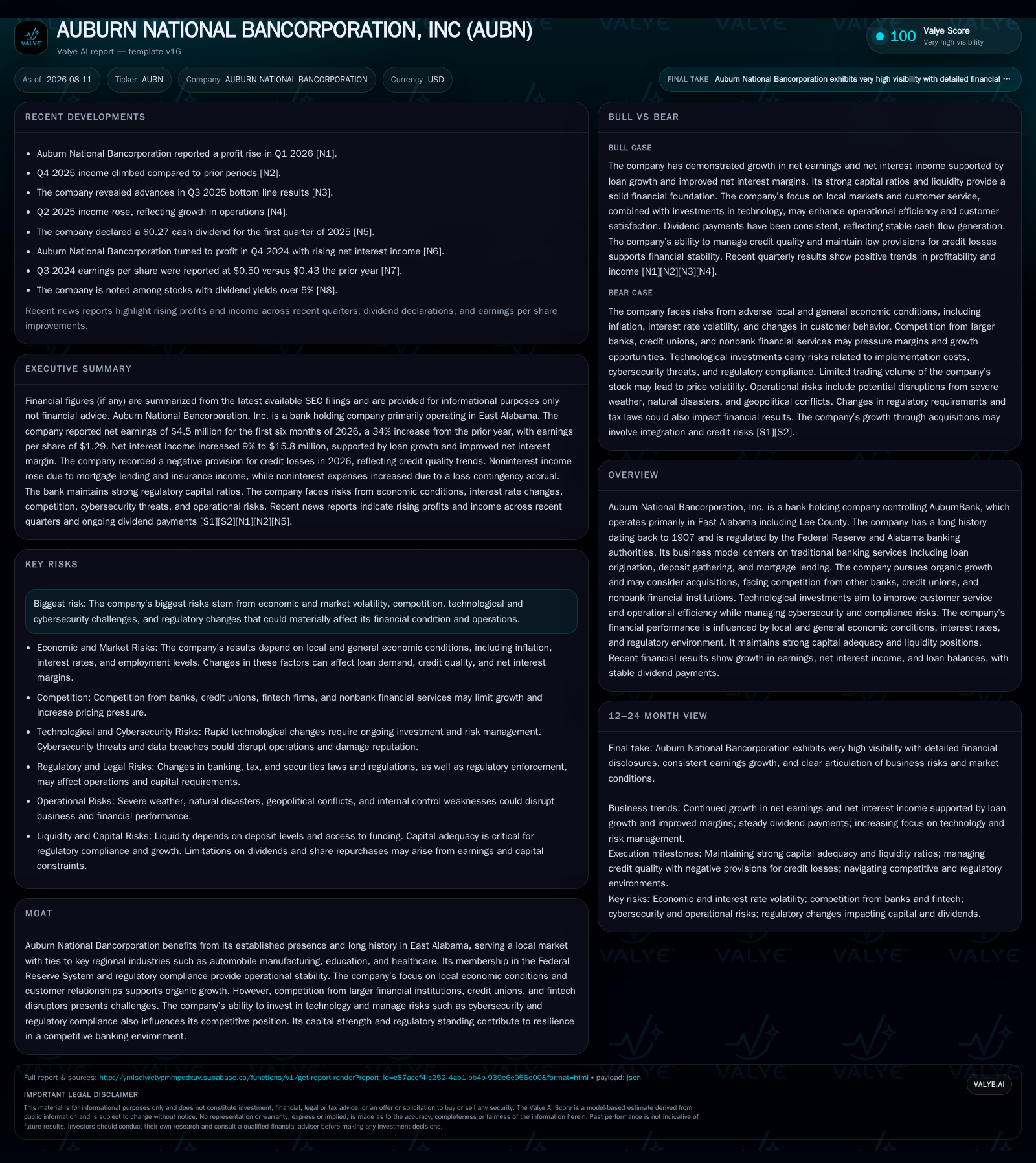
In its Q2 2026 report, Auburn National Bancorporation demonstrated solid loan and deposit growth alongside an improvement in net interest margin to 3.31%, supported by effective asset-liability management strategies. The bank’s dual-level liquidity management at the holding company and bank subsidiary levels underscores its operational discipline required by regulatory constraints. Despite headwinds from fixed-rate loan portfolios amid fluctuating interest rates, Auburn National maintains strong capital ratios well above regulatory minima. Its credit quality metrics remain robust with minimal nonperforming loans, while its provision for credit losses reflects careful CECL-based assessments shaped by local economic conditions. Dividend declarations further signal confidence in ongoing earnings and capital strength.
Steady Quarter Highlights Robust Liquidity Balancing Growth and Funding Costs
Auburn National Bancorporation reported steady growth in its second quarter ended June 30, 2026, with net loans increasing modestly to about $579.9 million from $562.9 million in the prior quarter. Simultaneously, total deposits increased to $928 million from $906 million [S2]. This balanced growth underlines AuburnBank’s ability to attract local credit demand while maintaining stable funding sources. The net interest margin (NIM) rose from 3.13% to 3.31% sequentially, indicating successful asset-liability management (ALM) amid interest rate pressures that have challenged many regional banks [S2].
The company employs a two-tier liquidity management approach—managing liquidity separately for the bank subsidiary and the bank holding company—as both are regulated entities with distinct funding needs and legal limitations on transactions between them under Federal Reserve Regulation W [S2]. The holding company relies chiefly on dividends from AuburnBank to meet its operating expenses, debt servicing (none currently outstanding), and dividend payments to shareholders [S2].
Core Revenue Model: Managing Fixed-Rate Loan Exposure Amid Rising Interest Rates
AuburnBank’s principal revenue driver remains net interest income derived from the spread between interest earned on loans/securities and interest paid on deposits/borrowings [S1]. A significant portion of the loan portfolio consists of fixed-rate commercial real estate (58% of loans) and residential real estate (21%), which creates sensitivity as asset yields reset more slowly than some liabilities [S1][S20].
The bank actively deploys asset-liability strategies including derivatives such as interest rate swaps—to hedge or optimize exposure—having increased such hedging contracts from one at year-end 2025 to two at mid-2026 [S7]. This shift reflects prudent management against potential margin compression if interest rates fluctuate unpredictably.
Despite upward pressure on liability costs linked to market rates, management has succeeded in improving loan/yield repricing faster than deposit cost increases during Q2 2026, lifting NIM by roughly 18 basis points sequentially [S2]. However, sustaining this margin in a competitive regional market remains challenging given overlapping service offerings among community banks, credit unions, and fintech lenders who often compete aggressively on deposit pricing.
Local Market Dynamics Shape Regional Competitive Positioning
Operating primarily in East Alabama—centered around Lee County—AuburnBank’s performance is closely tied to key regional economic sectors such as automobile manufacturing, education, and healthcare [S1]. The cyclical nature of auto sales and housing markets directly impacts commercial lending demand as well as mortgage origination volumes.
Moreover, higher inflation and prevailing tariffs affect borrower cash flows and collateral valuations, requiring vigilant credit risk monitoring [S1]. Competition factors prominently in deposit gathering as local customers have access to alternatives like credit unions offering favorable rates or national banks’ digital platforms.
Though AuburnBank concentrates on relationship-driven organic growth within its footprint leveraging branch offices in Auburn, Opelika, Notasulga, Valley, and a loan production office at Phenix City [S1], technological investments lag behind larger peers due to resource constraints—a common challenge in regional banking that may impact future customer retention amid growing demands for mobile banking capabilities.
Managing Credit Quality through CECL: Implications of Economic Uncertainty
Credit risk provisions rose meaningfully in 2025 with a $631 thousand provision versus only $36 thousand in 2024—primarily related to two identified problem loans including an outright partial charge-off [S1]. These provisions are governed by the CECL accounting standard which requires forward-looking loss estimates influenced heavily by macroeconomic variables like Alabama's unemployment rate and local real estate indices.
At December 31, 2025, allowance for credit losses stood at approximately $7.2 million or about 1.27% of loans—marginally up from prior year—signaling safeguards against potential default spikes arising from adverse economic shifts [S1]. Importantly, nonperforming loans remain negligible at around 0.01% of total loans through Q2 2026 with annualized net charge-offs reflecting recoveries rather than losses (-0.02%) highlighting overall portfolio resilience thus far [S2].
However, reliance on CECL’s complex economic forecasts introduces variability; downturns in auto manufacturing or healthcare funding cuts could amplify future credit costs requiring continued vigilance.
Growth Opportunities Rely on Strategic Expansion and Technological Adaptation
While Auburn National emphasizes organic expansion through loan portfolio growth supported by deep customer relationships within a defined geographic area [S1], management acknowledges potential mergers or acquisitions may supplement growth but carry risks including integration complexity and possible EPS dilution [S1]. The competitive bidding environment for acquisitions elevates pricing which could limit accretive deals.
Technological enhancements remain a vital long-term factor influencing competitiveness. Despite investments aimed at operational efficiency gains and customer service—critical given fintech platform encroachments—the bank faces headwinds against better-resourced peers able to deploy cutting-edge digital tools faster [S1]. Balancing cost-effective innovation while controlling cybersecurity threats continues as both an opportunity and challenge.
Key Risks: Interest Rate Fluctuations, Competition, Cybersecurity, and Regulatory Pressures
Interest rate volatility stands as a primary risk impacting net interest margin sustainability when liability repricing outpaces asset yield adjustments or when prolonged low-rate environments compress spreads [S1]. Credit risk elevates during economic stress phases potentially increasing allowances beyond current levels.
Competitive dynamics introduce pressure not only around pricing but also customer acquisition channels due to fintech digital experiences that traditional branch-centric banks like Auburn may find costly to replicate fully [S1]. Cybersecurity incidents represent operational risks requiring ongoing investment absent which reputational harm could follow.
Regulatory changes affecting capital requirements or dividend policies also impose constraints on financial flexibility especially given the holding company’s dependence on the bank’s dividend flows constrained further under Basel III capital conservation buffer rules [S12][S21].
Upcoming Catalysts: Monitoring Loan Demand, Deposit Trends, Dividend Policy
Near-term milestones include tracking sustained loan demand growth particularly in commercial real estate segments tied to local manufacturing activity plus mortgage origination trends sensitive to long-term U.S. Treasury yields which influence homebuyer affordability [S3].
Deposit behaviors will be critical indicators reflecting consumer confidence amidst inflation-adjusted returns; continued retention amid competition will test pricing strategies deployed.
Dividend announcements reinforce confidence in earnings quality amid cautious macroeconomic outlooks; any deviations therein would warrant scrutiny as they directly link back to capital adequacy requirements maintained at robust levels currently exceeding "well-capitalized" standards [S3][S21].
Financial Profile Discussion: Well-Capitalized With Disciplined Capital Allocation
Auburn National Bancorporation maintains solid capital health evidenced by a CET1 risk-based ratio of 16.26%, Tier 1 risk-based capital also at 16.26%, total risk-based capital ratio of 17.24%, and Tier 1 leverage ratio of roughly 10.65% as of June 30, 2026—all comfortably above regulatory thresholds for being well-capitalized [S2][S21]
Efficiency measures improved driven by tighter control over noninterest expenses resulting in an efficiency ratio declining from over 72% previously down near 68%, indicating enhanced expense discipline relative to revenues generated including net interest income which grew alongside an expanded earning assets base [S2]
Nonperforming loans hold at minimal levels (~0.01%) while annualized net charge-offs are negative showing recoveries exceeding losses; this speaks to effective credit administration despite economic uncertainties extending into late-2026 [S2]
The company's recent dividend payment reinforces sustained earnings generation capacity while underscoring prudent capital allocation aligned with regulatory oversight constraining excess distributions ensuring ongoing resilience through fluctuating market conditions [S3][S12]
This analysis is based solely on publicly available information sources including SEC filings dated through August 11, 2026. It aims to provide insight into Auburn National Bancorporation's business operations, industry context, financial condition, risks, and growth prospects without constituting investment advice or research views.
Disclaimer: This is research-only, informational analysis and not investment advice. It may include AI-generated interpretation and general industry context. Always verify important details using primary sources.

Comments