
Aardvark Therapeutics Advances ARD-101 in PWS with Strategic Pipeline Expansion and Solid Liquidity
Aardvark Therapeutics progresses its lead candidate ARD-101 in a pivotal Phase 3 trial for Prader-Willi Syndrome while broadening its pipeline through a new dermatology subsidiary, supported by a strong liquidity position amid typical clinical-stage biotech risks.
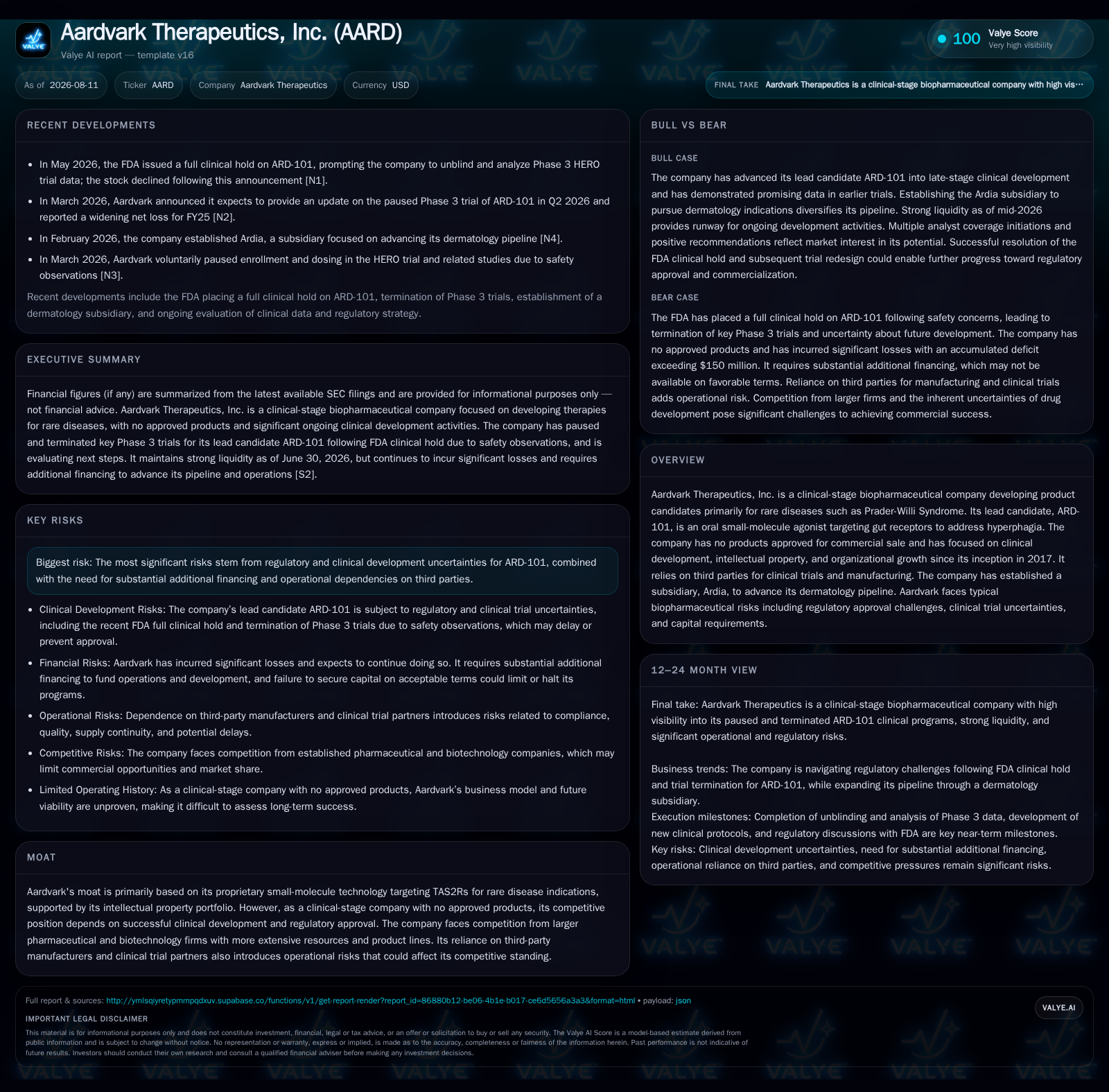
Aardvark Therapeutics, a clinical-stage biopharmaceutical company focused on rare diseases, reported a key protocol amendment in its Phase 3 HERO trial for ARD-101 targeting hyperphagia in Prader-Willi Syndrome, lowering the minimum participant age to enhance enrollment. The company continues to rely on third-party partners for manufacturing and clinical operations and has created Ardia to develop a dermatology pipeline, signaling diversification efforts. Financially, Aardvark maintains robust liquidity with approximately $74 million in cash and equivalents as of June 30, 2026, supporting ongoing R&D despite sustained operating losses. Key risks include patient recruitment challenges, regulatory uncertainties, financing needs, and operational dependencies inherent to clinical-stage biotech firms [S2][S23][F1].
Recent Operating Update
In its latest quarterly filing dated August 11, 2026, Aardvark Therapeutics detailed progress on ARD-101, its lead small-molecule candidate targeting hyperphagia in Prader-Willi Syndrome (PWS) [S2][S25]. The company amended the Phase 3 HERO pivotal trial protocol to lower the minimum eligible participant age from ten to seven years. This change aims to alleviate patient recruitment bottlenecks—a common hurdle in rare disease trials—thereby potentially accelerating enrollment and enhancing the predictability of trial timelines. While no new efficacy data were disclosed this quarter, this operational adjustment signals a pragmatic approach to addressing orphan indication challenges
Additionally, Aardvark has formed Ardia as a wholly owned subsidiary focused on developing dermatology assets including DIA-615 for inflammatory skin conditions like psoriasis [S23]. This organizational expansion reflects an effort to broaden therapeutic focus beyond neurological rare diseases while maintaining dedicated management oversight through appointment of a subsidiary CEO
Business Model Overview
Aardvark Therapeutics functions as a clinical-stage biotech firm specializing in novel small-molecule therapeutics for rare diseases without any approved commercial products. Its value creation hinges on advancing drug candidates through preclinical studies and multiple phases of clinical trials toward regulatory approval. Revenue generation remains prospective pending successful commercialization.
The company’s lead asset ARD-101 leverages modulation of taste receptor mechanisms implicated in appetite regulation—an innovative mechanism distinct from biologic or gene therapy approaches pursued by some peers. Intellectual property protections around this mechanism are central to maintaining competitive advantage.
Operationally, Aardvark outsources manufacturing and clinical trial execution to contract manufacturing organizations (CMOs) and contract research organizations (CROs). While this reduces fixed capital expenditure and enhances flexibility typical of early-stage biotechs, it introduces dependencies that could affect supply reliability and study execution timelines.
The launch of Ardia expands pipeline breadth into dermatology indications requiring significant R&D investment before potential market entry [S1][S23]. This dual focus may diversify risk but also demands effective resource allocation
Industry Structure and Competitive Position
Operating within the clinical-stage rare disease biotechnology segment exposes Aardvark to both significant development risks and potential rewards. Rare conditions like PWS limit patient populations but qualify for regulatory incentives such as orphan drug designations that can expedite approval pathways and provide market exclusivity.
Competitive dynamics include specialized biotech firms developing gene therapies or biologics targeting overlapping indications. Compared with these modalities, Aardvark’s small-molecule approach may offer advantages in oral administration but must demonstrate meaningful clinical benefit on symptom relief endpoints accepted by regulators.
The reliance on third-party CMOs and CROs aligns with industry norms but requires stringent quality oversight given FDA standards. Regulatory uncertainty persists regarding appropriate endpoints for orphan syndromes where symptom reduction rather than traditional biomarker changes may be pivotal.
Growth Drivers
Progression through the Phase 3 HERO trial with timely patient enrollment remains the immediate growth driver for ARD-101. The protocol amendment lowering age eligibility is intended specifically to accelerate this process.
Regulatory milestones including FDA interactions around endpoint validation will provide critical inflection points impacting approval prospects.
Pipeline diversification via Ardia’s dermatology candidates offers additional growth potential contingent on demonstrating efficacy in high unmet need inflammatory skin conditions.
Intellectual property protection around ARD-101’s mechanism underpins long-term value creation by potentially securing exclusivity against generic competition post-approval.
Strategic partnerships or licensing agreements could supplement internal funding needs while enhancing commercialization capabilities once candidates advance toward market readiness.
Risks and Constraints
Challenges inherent to rare disease trials such as limited patient availability pose recruitment risks that can delay pivotal studies and extend cash burn periods.
Regulatory risk is elevated given evolving expectations on novel endpoint acceptance tailored for symptomatic relief in orphan disorders.
Financial sustainability depends heavily on continued capital raising under favorable conditions; failure or delay could force program curtailments or restructuring [S29].
Healthcare compliance requirements impose operational complexity even pre-commercialization; failure to adhere fully could result in penalties or reputational harm [S18][S22].
Dependency on third-party providers introduces vulnerability to delays or quality issues beyond internal control.
What to Watch Next
Monitoring enrollment velocity in the HERO Phase 3 study following protocol amendments will be essential for assessing feasibility of meeting planned timelines.
Regulatory communications clarifying acceptance criteria for pivotal endpoints will shape approval pathways.
Progress updates from Ardia’s dermatology portfolio including early clinical data releases will inform pipeline diversification success.
Financial metrics such as cash burn rate relative to available liquidity will indicate runway sufficiency ahead of anticipated financing events [F1][S29]
Financial Profile Discussion
As of June 30, 2026, Aardvark held approximately $74 million in cash and equivalents versus current liabilities just below $6.4 million, resulting in a strong current ratio exceeding 12 [F1]. This robust liquidity position supports near-term operational needs including ongoing clinical development activities
Despite this liquidity strength, the company continues to operate at a loss consistent with typical clinical-stage biotech profiles; operating loss was approximately $62.7 million for the year ended December 31, 2025, reflecting sustained R&D investment without product revenues [F1]
Maintaining effective cash management alongside successful capital raises remains critical given the high burn rates associated with late-stage trials and pipeline expansion prior to revenue generation [S29]
This analysis is based exclusively on publicly filed SEC documents through August 11, 2026. It avoids speculative projections consistent with Valye News editorial standards.
Disclaimer: This is research-only, informational analysis and not investment advice. It may include AI-generated interpretation and general industry context. Always verify important details using primary sources.

Comments