
Broadwind’s Industrial Fabrication Pivot Highlights Supply-Chain and Customer Risks
Q2 2026 results reveal margin pressure from order volatility amid Broadwind's strategic shift and customer concentration headwinds.
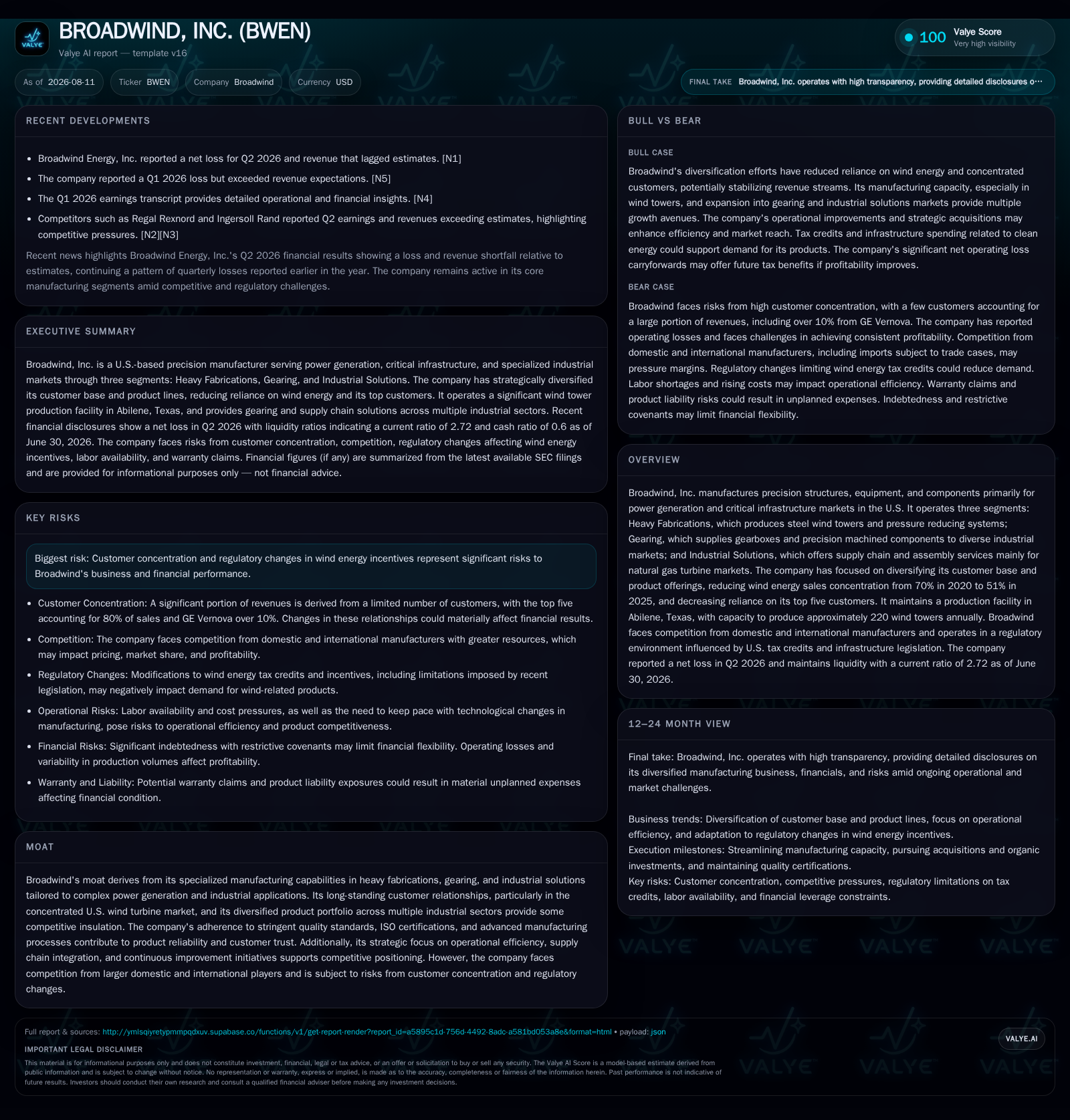
Broadwind's latest quarterly filing displays operating challenges driven by production volume fluctuations and cost pressures, particularly in its Heavy Fabrications and Gearing segments. The company's ongoing consolidation of its wind tower manufacturing footprint underscores capacity limits amid a cyclical market, while substantial customer concentration maintains revenue variability risks. Broadwind pursues diversification beyond wind energy into natural gas turbines and industrial markets to mitigate cyclicality, though technological advances and regulatory shifts remain key growth uncertainties. Financially, the company holds a strong liquidity position with a net cash balance, supporting its near-term operational flexibility despite margin compression.
7/26 Q2 Operating Dynamics: Order Fluctuations Tighten Margins
Broadwind reported Q2 2026 results that undershot revenue expectations and demonstrated pressure on operating income due largely to fluctuating customer order volumes and inflationary cost inputs [S2],[S3],[N1]. The company highlighted variability tied to timing changes in customer purchase orders (POs), an endemic issue shared across its industrial gearing and heavy fabrications segments where large-scale capital equipment manufacture depends heavily on project schedules. These volume swings have historically strained fixed-cost absorption, compressing gross margins during lower output periods. This quarter continued that pattern, evidencing the challenge of managing operational leverage amid an uneven demand environment.
Segmental Profitability Under Volume Variability Pressure
Broadwind’s business is segmented into Heavy Fabrications, Gearing, and Industrial Solutions. The Heavy Fabrications division primarily focuses on steel wind turbine towers manufactured at its Abilene, Texas facility, which has an annual production capacity of approximately 220 towers or 660 sections [S1],[S4]. In 2025, Broadwind consolidated operations by divesting its Manitowoc plant and streamlining fabrication activities into this single site to optimize throughput amid subdued wind tower demand.
The Gearing segment supplies gearboxes and precision machined components across diverse sectors including power generation and oil & gas. Sales here are predominantly driven by individual POs, injecting more unpredictability than the contractually smoother supply agreements often secured for tower manufacturing [S1]. Industrial Solutions caters mainly to natural gas turbine customers through supply chain and assembly services but similarly relies on PO-driven sales.
The interplay between facility capacity constraints in Abilene and volatile order intake influences operational efficiency for Heavy Fabrications. When production falls below optimal utilization owing to PO timing irregularities or cancellations—common with highly concentrated customers—the fixed overhead burden increases per unit output, weighing further on segment profitability [S4],[S15].
Commercial Contracts and Backlog Stability: Balancing POs and Supply Agreements
Broadwind’s revenue recognition depends critically on the mix of long-term supply agreements versus shorter-term individual POs [S1]. Wind towers are often sold under multi-quarter supply agreements providing some revenue visibility; however, these contracts typically require confirmation POs tied to customer forecasts that can vary significantly quarter-to-quarter
As of December 31, 2025, the company reported approximately $96 million in backlog reflecting unfulfilled orders from both contractual channels. While this backlog offers a degree of predictability, the high proportion of sales linked to POs in Gearing and Industrial Solutions exposes Broadwind to order cancellations or delays which could disrupt revenue flow unexpectedly. The company’s top five customers accounted for roughly 80% of consolidated revenues in 2025, signifying material concentration [S4],[S18]. Among them, GE Vernova contributed just over 10%, underscoring dependence upon a few strategic accounts.
Such customer concentration magnifies risk because any material change—whether through scaling back orders or shifts toward vertical integration by clients—can sharply affect quarterly volume trends impacting cost structures and margins [S15]. Liquidated damages clauses exist but are capped; thus timely delivery remains crucial for maintaining contractual terms without financial penalty.
Navigating Industry Cyclicality Through Diversification
Broadwind has actively pursued diversification away from sole reliance on wind energy—a traditionally cyclical market influenced by regulatory incentives and utility procurement cycles—into adjacent industries like natural gas turbines, mining equipment components, and other industrial applications [S1].
This strategy aims to stabilize revenue streams through exposure to varied end markets less correlated with renewable policy cycles. For example, Industrial Solutions’ assembly operations for natural gas turbine component suppliers harness steady aftermarket demand from power generation customers focused on efficiency upgrades rather than new builds alone. The Gearing business also taps into diverse sectors including oil & gas drilling equipment which may follow different investment cadences than renewables.
Still, such diversification introduces operational complexity requiring Maintain engineering capabilities broadly across product lines including heavy fabrications for virtual pipeline pressure reducing systems (PRS) targeting compressed natural gas delivery infrastructure [S1],[S4]. Balancing resources among these lines is critical for consistent profitability.
Competitive Position Amid Shifting Domestic Manufacturing Trends
Broadwind competes with both domestic players like Arcosa Inc. within tower manufacturing, as well as international firms such as C.S. Wind (South Korea) and Marmen Industries (Canada). Regulatory measures like antidumping duties on towers from China, Vietnam, Canada, Indonesia have tempered import competition but persistent global cost pressures keep competitive dynamics challenging [S18].
In industrial gearing—a segment facing international consolidation—tariffs and supply chain disruptions have driven buyers toward domestic suppliers like Broadwind and peers including Regal Rexnord who benefit from reshoring dynamics benefiting U.S.-based plants [N2],[N3],[S1]. However, evolving technology demands necessitate ongoing capital investment; failure to stay technologically aligned may erode market share.
Growth Levers Linked to Renewable Energy Expansion and Infrastructure Upgrades
Future growth potential largely hinges on the expanding offshore/onshore wind market requiring larger diameter towers capable of supporting higher-capacity turbines typical for newer farms constructed post-2025. Technological progress in turbine size and materials (including concrete hybrid towers) poses manufacturing challenges compelling investment in heavier fabrication capabilities or process modernization [S15],[S1].
Beyond renewables, natural gas turbine modernization projects driven by carbon transition policies favor efficiency improvements over new capacity additions create aftermarket opportunities within Industrial Solutions.[S1] This balanced approach moderates exposure to pure project-driven cycles yet depends on maintaining technical excellence in precision machining.
Long-term supply agreements add visibility but their renewal depends on Broadwind’s ability to meet evolving quality standards under increasingly complex product specifications typical of next-generation turbines or industrial machinery.[S8]
Risk Factors Spotlight: Customer Concentration and Regulatory Exposure
Reliance on a handful of large customers magnifies vulnerability to abrupt order reductions or contract restructurings which have periodically depressed revenues historically.[S15] GE Vernova's contribution exceeding 10% exemplifies this concentration concern.[S4]
Moreover, technological obsolescence risk looms if Broadwind cannot adapt swiftly to changes in turbine design or materials requiring fresh capital outlays.[S15] Regulatory environments significantly influence demand for wind infrastructure; adverse policy shifts could dampen tower orders considerably.
Supply chain disruption risk persists given complex component sourcing for heavy fabrications; any raw material price spikes can squeeze margins absent pass-through pricing mechanisms [S4]
Legal disputes arising from high-value customer contracts could impose unforeseen costs or reputational damage given customers’ relative resource strength.[S10]
Milestones to Watch: Backlog Bookings, Capacity Utilization, and Order Timing
Key indicators include quarterly backlog trends reflecting new PO inflows versus cancellations revealing order momentum strength [S2]
Monitoring production volume utilization at Abilene will reveal operational leverage shifts tied directly to margin improvement prospects [N1]
On-time delivery rates will gauge execution reliability critical under liquidated damages clauses.[S12]
Any signs of increasing orders from diversified industrial segments could confirm success in mitigating wind market cyclicality [S1]
Financial Flexibility Anchoring Near-Term Execution
Broadwind maintains a robust liquidity profile with approximately $17 million in cash equivalents versus total debt around $3.3 million as of June 30, 2026 yielding a net cash position near $13.7 million.[F1] Its current ratio stood at a healthy 2.72 reflecting ample short-term asset coverage relative to liabilities.[F1]
This financial cushion supports flexibility amid production ebb flows driven by customer ordering cycles while accommodating required capital expenditures tied to manufacturing upgrades or technology investments.[F1],[S2]
Capital structure restrictions limit excessive borrowing; however Broadwind's low leverage mitigates risk around debt servicing obligations even as it navigates operational uncertainty related to order variances.[F1],[S6]
Disclaimer: This report is an informational analysis based on publicly available filings and does not constitute investment advice.
Disclaimer: This is research-only, informational analysis and not investment advice. It may include AI-generated interpretation and general industry context. Always verify important details using primary sources.

Comments