
Kyverna Therapeutics Advances CAR T Cell Therapy Amid Capital and Regulatory Challenges
Clinical-stage biotech Kyverna progresses mivocabtagene autoleucel development while managing financing constraints and regulatory risks.
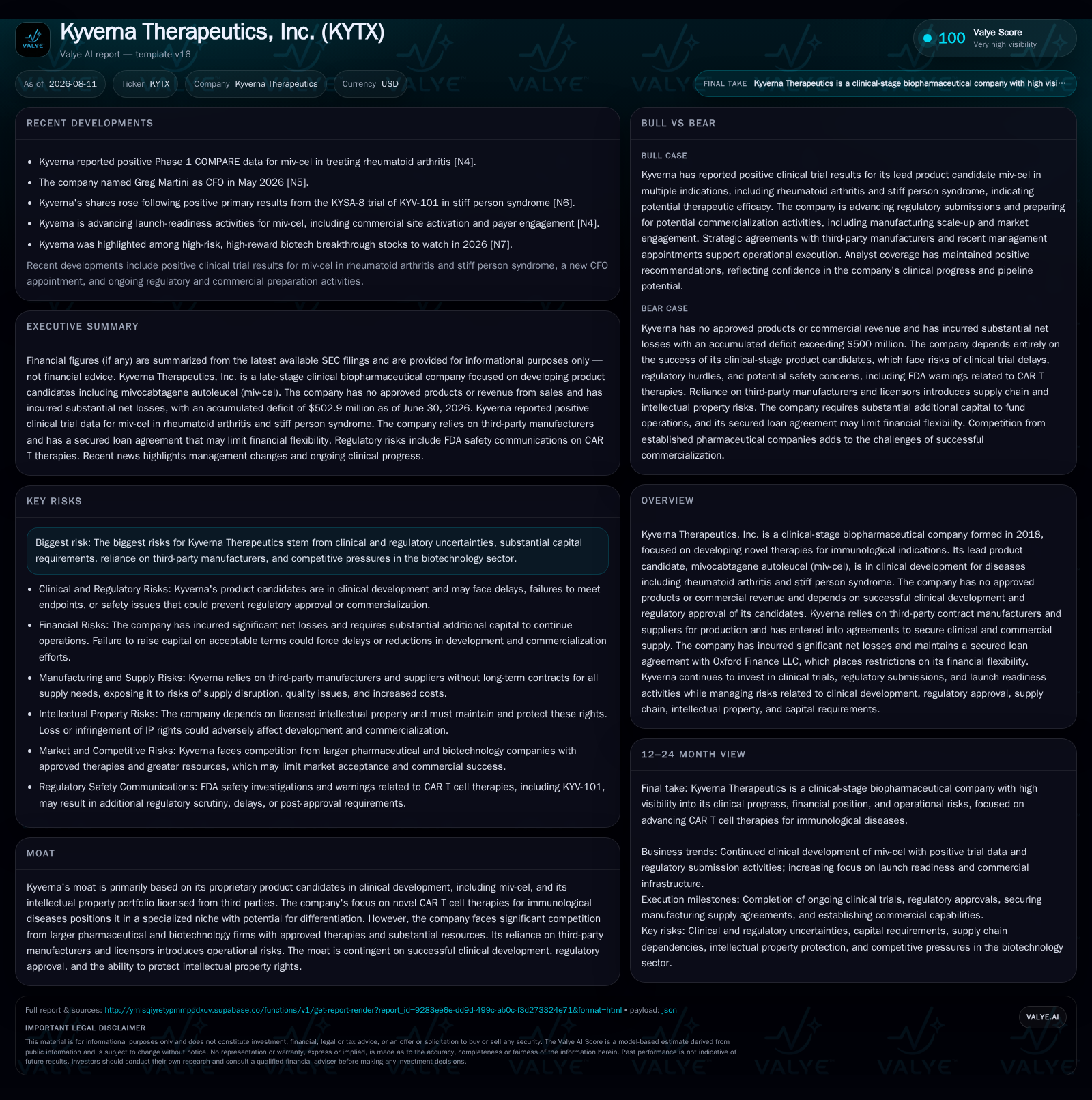
Kyverna Therapeutics, a clinical-stage biotech specializing in CAR T cell therapies for immunological indications, reported continued investment in clinical trials of its lead candidate mivocabtagene autoleucel (miv-cel) in Q2 2026. The company remains pre-revenue and dependent on successful regulatory approvals, facing typical industry risks including substantial cash burn, clinical development uncertainties, and third-party supplier dependencies. Its secured loan agreement with Oxford Finance restricts operational flexibility amid ongoing net losses. Growth hinges on advancing clinical milestones and navigating competitive immunotherapy landscapes.
Recent Operating Update
Kyverna Therapeutics disclosed in its latest quarterly filing that it continues to advance its lead CAR T cell therapy candidate, mivocabtagene autoleucel (miv-cel), targeting autoimmune diseases such as rheumatoid arthritis and stiff person syndrome [S2]. The Q2 2026 update reveals ongoing investment in multiple clinical trials without product revenue, consistent with its status as a clinical-stage firm. No definitive trial results or regulatory approvals were announced this quarter, underscoring the extended timelines typical for novel CAR T therapies addressing immunological indications [S3].
Despite mounting expenses associated with clinical activities and preparations for eventual commercialization, the company has not altered development scope but has instead reaffirmed commitment to advancing its pipeline while cautiously managing a secured loan facility that imposes operational constraints [S2]. This conservative financial posture appears necessary given the recent history of significant net losses exceeding $160 million annually [F1].
Business Model
Kyverna operates under a classical clinical-stage biotechnology model tailored to cell therapy innovation within immune-mediated diseases. Revenue streams are currently nonexistent from product sales; value creation is achieved through proprietary intellectual property assets licensed from third parties and internal R&D efforts focused on CAR T therapies [S1]. Monetization in early stages depends on successfully reaching regulatory milestones that could trigger licensing fees or milestone payments from partnerships. Eventually, if commercialized, revenues will derive from direct product sales to healthcare providers treating immunological disorders.
Key revenue drivers will be patient enrollment rates in advanced trials, pricing dynamics linked to the rare-disease and immunology markets, and scalability of manufacturing processes managed via contract manufacturing organizations (CMOs). Indirect costs such as regulatory compliance, investigator-initiated trials management, and market-launch capabilities further pressure operating margins.
Notably, Kyverna relies entirely on third-party suppliers for manufacturing both clinical trial materials and, presumptively, commercial drug substance/final product supply if approved [S1]. This dependency introduces vulnerabilities around supply chain reliability and cost structures. Given the complexity of CAR T formulations—living cells engineered ex vivo—securing scalable CMO capacity represents a critical operational requirement parallel to navigating stringent regulatory environments focused on product safety and consistency.
Industry Structure and Competitive Position
Kyverna competes in the highly specialized subsegment of CAR T cell therapies applied to autoimmune and immunological diseases—a field dominated by rapidly evolving science and major pharma/biotech competitors including companies like Novartis (Kymriah), Bristol Myers Squibb/Celgene (Abecma), and emerging biotech innovators targeting similar indications. These incumbents benefit from approved products generating revenue and extensive distribution networks.
Kyverna’s moat is defined by its proprietary pipeline centered on miv-cel's novel mechanisms aimed at modulating immune responses distinct from existing antibody-based therapies. However, the company faces an uncertain path given no previous pivotal Phase 3 trial success or regulatory wins, which limits its ability to command pricing power or secure robust partnership deals compared to larger peers.
The competitive landscape’s intensity derives from the accelerating pace of gene editing improvements (e.g., CRISPR), alternative cell-based immunotherapies entering late-stage development, and established biologics maintaining market share in rheumatoid arthritis treatments. Kyverna’s strategic focus on ultra-rare conditions like stiff person syndrome offers niche differentiation but also constrains patient populations influencing commercial scalability.
Growth Drivers
Pipeline maturation represents Kyverna’s primary growth vector. Key drivers include successful enrollment progression through mid to late-stage clinical trials demonstrating safety and clinically meaningful efficacy endpoints—a prerequisite for regulatory submissions worldwide.
Advances in manufacturing processes enabling lower-cost CAR T production could enhance future margins and reduce time-to-market hurdles. Additionally, executing new licensing or partnership deals leveraging its intellectual property could provide non-dilutive capital inflows enhancing liquidity beyond equity offerings.
Increasing prevalence or diagnosis rates of autoimmune conditions targeted by Kyverna could expand addressable markets. Moreover, positive trial results would likely propel investor confidence facilitating subsequent capital raises critical for sustained development funding.
Regulatory engagement milestones — inclusion in expedited pathways such as orphan drug designation or breakthrough therapy status — could materially accelerate approval timelines providing first-mover advantages within these niche therapeutic fields.
Risks and Watchpoints
Key risks remain entrenched across three dimensions: clinical development uncertainty, financial constraints imposed by secured loans combined with cash burn rates far exceeding operating income realities, and dependency on third-party manufacturers vulnerable to supply disruptions or cost escalations [S7][S10][S16]. Failure at any pivotal trial phase could delay progress by years while eroding investor sentiment.
Litigation risks arising from securities class actions underway may impose additional legal expenses while distracting senior management — factors that can impact execution fidelity [S21]. Regulatory delays or adverse safety events present further material downside that can curtail or permanently halt asset advancement.
Loan covenants maintained under the Oxford Finance secured credit facility significantly restrict Kyverna’s operational flexibility—including borrowing limits and asset disposal prohibitions—heightening refinancing risk if upcoming development milestones are missed [S6]. Maintaining compliance with liquidity covenants is a critical near-term challenge as cash runway tightens amid high R&D expenditure.
Competitive pressures from larger biotech/pharma entities with approved products amplify market entry challenges. Additionally, market acceptance hurdles specific to novel cell therapies for rare autoimmune indications increase commercialization complexity compared to standard small molecules or antibodies.
What To Watch Next
Industry observers should focus attention on forthcoming data releases from ongoing Phase 2/3 trials evaluating miv-cel efficacy/safety benchmarks relative to existing standards of care. Successful completion of enrollment targets will be a leading indicator of future approval viability.
Regulatory filings or updates regarding interactions with FDA/EMA regarding potential fast-track designations would signal accelerated commercialization prospects. Capital market activities—particularly equity raises or strategic partnerships announced—will be telling of management’s ability to sustain operations without compromising ownership dilution excessively.
Additionally, tracking developments within competitive pipelines in CAR T therapies for immunological diseases provides context for Kyverna’s relative advancement pace.
Financial Profile Discussion
As of June 30, 2026, Kyverna reported approximately $31.8 million in cash and equivalents alongside total debt of roughly $24.9 million facilitated through a secured credit facility with Oxford Finance LLC [F1][S6]. This positions the company with a net cash buffer but under tight liquidity given ongoing negative operating income exceeding $160 million last year [F1]. The company’s current ratio stands at approximately 9.06, indicating strong short-term asset coverage over liabilities [F1].
The Loan and Security Agreement encumbers nearly all assets including intellectual property rights—signifying a high-stakes collateralization that limits operational freedoms such as incurring additional debt or asset sales without lender consent [S4][S6]. This structure constrains capital allocation decisions amid pressing R&D needs.
Kyverna continues generating substantial net losses reflective of deep investment into clinical trials without offsetting revenues typical of early-stage biotechs where prolonged pre-revenue phases are normal but financially intensive [F1][S2]. Sustaining this trajectory requires careful cash management coupled with timely capital infusions either through equity offerings or milestone-related inflows from potential collaborations.
It does not constitute investment advice but aims to provide an informed perspective grounded in recent SEC disclosures combined with industry expertise specific to biotechnology firms developing novel CAR T therapies for immunological diseases.
Disclaimer: This is research-only, informational analysis and not investment advice. It may include AI-generated interpretation and general industry context. Always verify important details using primary sources.

Comments