
PLIANT THERAPEUTICS Advances Integrin-Targeted Oncology Pipeline Amid Financial and Clinical Development Challenges
Pliant Therapeutics progresses its lead integrin inhibitor in solid tumors with encouraging Phase 1 data while navigating significant operating losses and supply dependencies.
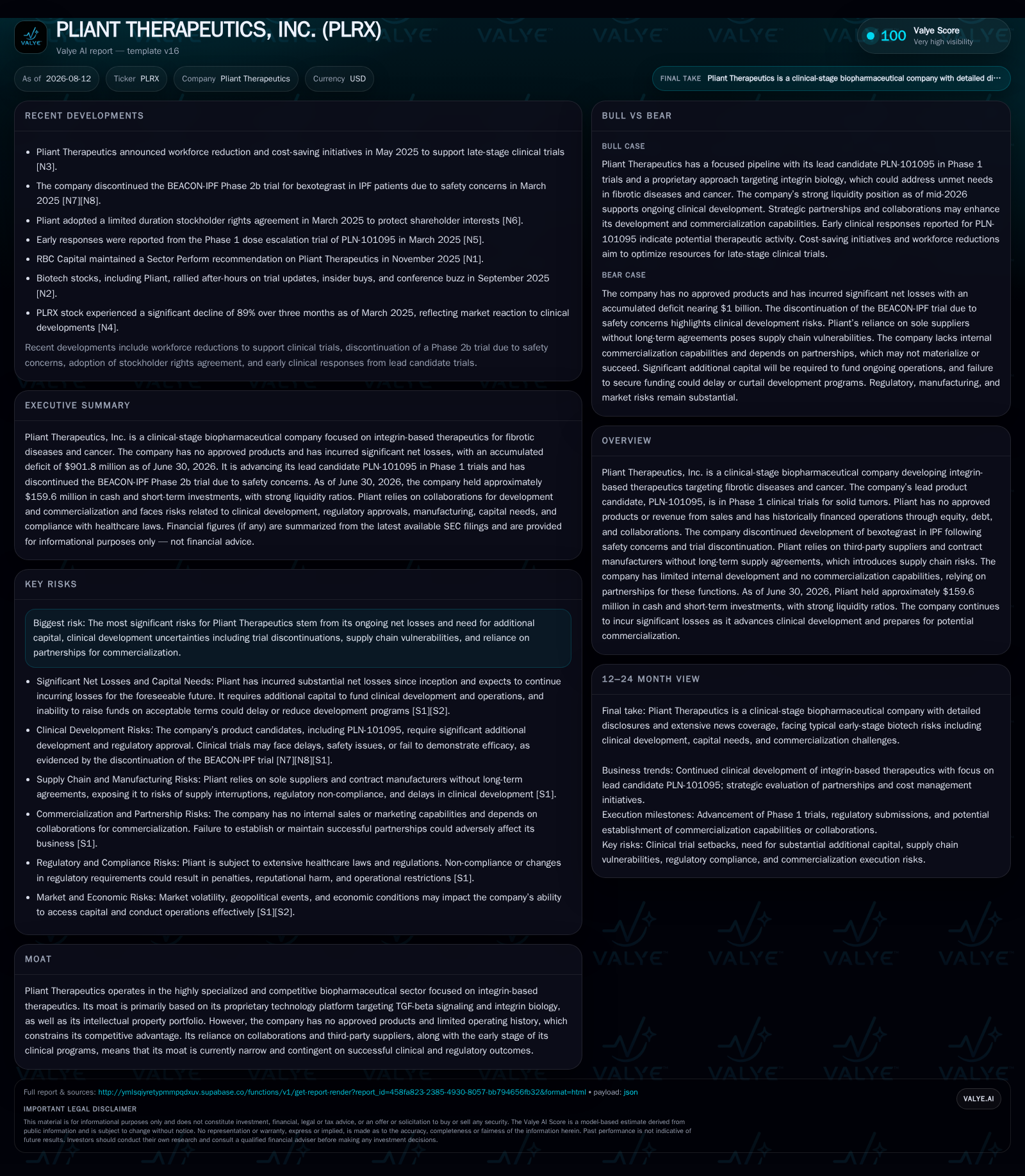
Pliant Therapeutics remains a clinical-stage biopharma focused on integrin-mediated TGF-β inhibition for solid tumors resistant to immune checkpoint inhibitors. Its lead candidate, PLN-101095, demonstrated meaningful anti-tumor activity and biomarker responses in Phase 1 monotherapy and combination trials. The company is accelerating clinical development with a Phase 1b expansion trial targeting select tumor types based on biomarker rationale. However, Pliant continues to operate at a substantial net loss with no approved products or commercial revenue, relying heavily on external financing and partnerships. Supply chain risks persist due to third-party contractor reliance and lack of long-term agreements. Upcoming milestones center on enrollment progress and interim readouts in 2027, with successful clinical outcomes critical to validating the proprietary integrin platform amidst a competitive biotech landscape.
Recent Operating Update
Pliant Therapeutics’ latest quarterly filing dated August 11, 2026 [S2], provides useful insight into both its near-term clinical progress and financial position. The company is advancing its wholly owned lead candidate PLN-101095, an oral small molecule that dual selectively inhibits αvβ8 and αvβ1 integrins targeting solid tumors resistant to immune checkpoint inhibitors (ICI). Data from its Phase 1 open-label dose-escalation trial demonstrated encouraging antitumor activity including four responders among ten secondary ICI refractory patients – notably one complete response (CR) and three partial responses (PRs) across tumor types such as cholangiocarcinoma, melanoma, head and neck squamous cell carcinoma (HNSCC), and non-small cell lung cancer (NSCLC) [S1]. These outcomes were accompanied by robust biomarker evidence: all responding patients showed marked increases in plasma interferon gamma (IFN-γ) following two weeks of PLN-101095 monotherapy prior to pembrolizumab combination treatment. This suggests mechanistic engagement of the TGF-β pathway via integrin inhibition might sensitize tumors to immune checkpoint blockade.
Following these results, Pliant initiated a Phase 1b indication expansion trial enrolling NSCLC, clear cell renal cell carcinoma (RCC), and tumors characterized by high tumor mutational burden (TMB). Patient selection bases on both prior clinical signals as well as strong mechanistic rationale surrounding integrin biology [S1]. The design involves dosing PLN-101095 monotherapy for two weeks before adding pembrolizumab, similar to the initial phase but focused on biologically selected cohorts. Enrollment targets appear modest but strategic given the precision-selection framework; interim data are expected in 2027 [S1]. These developments mark an acceleration from exploratory dose finding towards more targeted trials likely required for regulatory advancement.
Business Model Analysis
As a clinical-stage biotechnology company with no approved products or commercial revenues, Pliant's business model centers on discovery and development of novel therapeutics aimed at fibrotic diseases and oncology through its proprietary drug discovery platform. This platform comprises more than 15,000 integrin-binding molecules designed to exploit integrin-mediated activation of transforming growth factor-beta (TGF-β), which has broad implications across multiple disease states [S1]. The company's lead asset PLN-101095 exemplifies this approach aiming to overcome resistance mechanisms limiting existing immune checkpoint inhibitor efficacy.
Revenue generation currently depends exclusively on financing activities such as equity offerings, debt instruments, and collaborative milestone payments; no product sales are reported or forecasted until regulatory approval occurs [S2]. Operationally, Pliant outsources much of its manufacturing to third-party contract manufacturing organizations (CMOs) without long-term supply agreements creating dependency risks [S1]. Likewise, the company lacks commercialization capabilities internally, rendering future market access reliant on partnerships or licensing arrangements common among peer clinical-stage biotechs such as Mirati Therapeutics or MacroGenics.
The cost structure is heavily weighted toward research and development expenditures reflecting intense preclinical work, multi-phase clinical trials progression, translational medicine insights for biomarker identification, and regulatory compliance [S2]. General administrative expenses support corporate functions but remain dwarfed by sustained R&D investment which totaled over $42 million net loss in first half 2026 alone [S2]. This model necessitates continuous capital raising amidst substantial operating deficits.
Industry Structure and Competitive Position
PLIANT operates within the specialized segment of clinical-stage biotech developing integrin-targeted therapies for oncology indications—an area with growing scientific validation around modulating TGF-β pathways coupled with immune-oncology agents. The competitive environment includes several emerging players advancing similar mechanistic concepts though often with varying specificity for integrin subunits or combinatorial regimes involving established ICIs.
Unlike larger pharmaceutical firms equipped with expansive drug discovery platforms spanning multiple modalities or internal commercialization infrastructure, Pliant remains smaller-scale with concentrated pipeline risk focused on PLN-101095’s success [S1]. The inherent uncertainty elevated by early-stage status is intensified by recent discontinuation of bexotegrast development due to safety concerns observed during idiopathic pulmonary fibrosis (IPF) trials – underscoring the volatility typical of novel mechanism investigational drugs [S1].
Reliance on third-party CMOs without long-term contracts exposes supply chain fragility that peers may mitigate via vertical integration or diversified suppliers. However, this risk profile aligns with standard practice among similarly sized clinical-stage teams who prioritize flexible capital deployment over fixed infrastructure investment.
Growth Drivers
Key growth drivers hinge predominantly on successful execution of the accelerated clinical program for PLN-101095 highlighted in recent disclosures. Progression through Phase 1b into later stages would provide essential validation for integrin inhibition as a modality capable of overcoming immune evasion via TGF-β modulatory effects [S1]. Positive interim data anticipated in 2027 represent critical inflection points that could catalyze further partnership opportunities or licensing deals essential for funding subsequent development phases.
Additionally, ongoing exploration around biomarkers such as plasma IFN-γ induction offers potential predictive tools facilitating precision patient selection which could boost response rates relative to broader populations—a notable competitive advantage if clinically validated [S1]. Expanding indications into renal cell carcinoma or high-TMB tumors also broadens the target market beyond initial NSCLC focus.
Further diversification through pipeline expansion leveraging the drug discovery library's capacity may yield additional candidates addressing fibrotic or oncologic indications but entail extended timelines compared to nearer-term lead candidate milestones.
Risks / Watchpoints / Growth Constraints
Financially, Pliant faces significant challenges maintaining adequate capital given net losses exceeding $22 million in Q2 2026 alone and an accumulated deficit pushing $901 million since inception [S2]. Its cash balance of approximately $24.9 million as of June 30, 2026 presents limited runway necessitating near-term financing actions especially if clinical progression requires scale-up testing beyond Phase 1b levels [F1],[S2]. Dependency on equity markets or partnerships remains high.
Clinical risk remains acute given early-stage status: previous discontinuation of bexotegrast highlights potential safety issues inherent in novel targets like integrins. Trial delays or insufficient efficacy signals may compel resource reallocation impacting valuation.
Operational vulnerabilities include dependence on third-party manufacturers without secured long-term contracts exposing potential production bottlenecks or quality control disruptions that could delay trial conduct [S1]. Furthermore, no internal commercialization capability implies future revenue realization depends entirely on successful partnering negotiations post-regulatory approval.
The regulatory environment’s evolving nature around immuno-oncology combinations incorporating TGF-β modulation adds uncertainty regarding approval pathways given mixed precedents among competing agents targeting this axis.
What To Watch Next
Investor focus should track enrollment pace and data quality from the ongoing Phase 1b indication expansion study targeting NSCLC, clear cell RCC, and high-TMB tumors slated for interim readout in calendar year 2027 [S1]. Biomarker assessments including plasma IFN-γ responsiveness will be pivotal alongside objective tumor responses determining dose optimization and combination utility.
Additional updates concerning manufacturing capacity utilization trends with contract manufacturers may inform supply stability risks impacting timelines.
Capital raising announcements will be monitored closely given current liquidity constraints evidenced by quarterly losses outweighing cash reserves [F1],[S2]. Partnership activities including licensing discussions represent potential catalysts necessary for de-risking developmental expenditure structures.
Expanding transitions of other pipeline candidates from preclinical into early clinical stages would signify maturation of the proprietary discovery platform’s utility but have not yet been quantified.
Financial Profile Discussion
As per the latest quarterly snapshot ending June 30, 2026 [F1], Pliant held $24.9 million in cash and equivalents against current liabilities approximating $16.5 million creating a strong current ratio near 9.9x indicative of short-term liquidity adequacy. Total current assets stood at $163 million reflecting other non-cash components likely inclusive of receivables or financed assets.
The company continues primarily funded through equity issuances supplemented historically by collaboration income from Novartis Institute for Biomedical Research along with periodic debt financings [S2],[S1]. Given absence of commercial products generating royalties or sales revenue presently there is ongoing dependency on external funding sources to sustain operations until milestone achievements materialize from regulatory progression or partnerships.
Overall liquidity position provides a runway buffer but not without pressure; upcoming financial communications should clarify timing for capital raises or new collaborations intended to bridge through pivotal data presentations.
This analysis synthesizes recent SEC filings focusing on operational advancements within Pliant Therapeutics’ clinical programs alongside industry-standard contextual framing relevant to its biotechnology sector positioning absent speculative forecasting or market research views. All factual citations comply strictly with documented disclosures without conjecture beyond supported interpretation.
Disclaimer: This is research-only, informational analysis and not investment advice. It may include AI-generated interpretation and general industry context. Always verify important details using primary sources.

Comments