
Dermata Therapeutics Shifts to OTC Skincare Amid Litigation and Commercialization Challenges
The company moves from prescription acne therapeutics to DTC and B2B OTC skincare products leveraging proprietary Spongilla-derived technology, facing litigation that may impact commercialization.
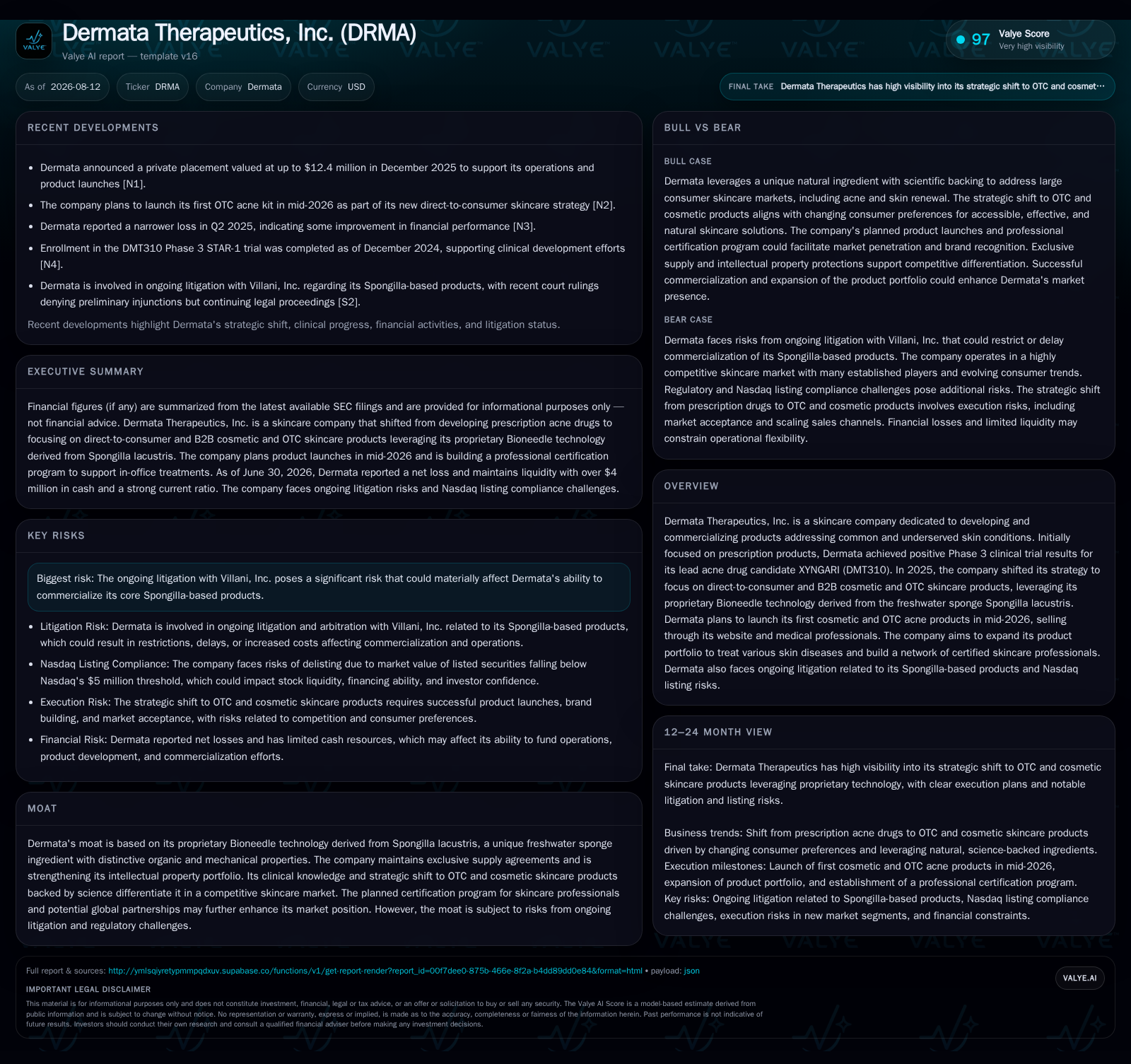
Dermata Therapeutics recently reported Q2 2026 results highlighting its strategic transition from prescription acne drug development to direct-to-consumer and professional OTC skincare products using its unique Bioneedle technology derived from Spongilla lacustris. This shift addresses longer regulatory timelines and high clinical costs associated with Rx dermatology while aiming for faster market entry through e-commerce and certified professional channels. However, ongoing litigation with Villani, Inc. over Spongilla-related intellectual property poses a material risk to commercialization timing and scale. The company maintains a strong cash position but continues to operate at a net loss while investing in product launches scheduled for mid-2026.
Recent Operating Update
The latest quarterly SEC filing covering Q2 ended June 30, 2026, reveals Dermata Therapeutics advancing its strategic pivot away from prescription drug development toward over-the-counter (OTC) and cosmetic skincare products supported by direct-to-consumer (DTC) e-commerce and professional B2B channels [S2][S3]. This shift follows the March 2025 announcement of positive Phase 3 clinical data for XYNGARI (DMT310), the company's lead acne drug candidate leveraging the proprietary Spongilla lacustris-derived Bioneedle technology [S1]. Despite meeting all primary clinical endpoints across multiple assessment weeks, management concluded that continuing down the traditional regulatory path for prescription dermatology would face prohibitive costs, protracted approval timelines, and complex launch hurdles.
Accordingly, Dermata reallocated resources toward developing OTC and cosmetic formulations based on its biologically derived ingredient platform that can capitalize on evolving consumer preferences favoring natural, multifunctional skincare solutions amenable to self-treatment without prescriptions. Mid-2026 product launches are targeted through Dermata's own e-commerce platform combined with a growing network of certified skincare professionals to drive adoption in both consumer retail and medical aesthetic settings [S3]
A significant near-term cloud over the commercialization trajectory is ongoing multi-front litigation initiated by Villani, Inc., which contends that Dermata's promotion and use of certain Spongilla-based products violate contractual obligations and constitutes false advertising under federal law. Although the court denied Villani's initial requests for extensive injunctive relief that could have halted marketing activities, the dispute remains unresolved with potential implications for Dermata's ability to freely produce or promote some core formulations pending final adjudication [S2]. The litigation introduces a nontrivial execution risk given the centrality of Spongilla lacustris to Dermata's product differentiation strategy.
Business Model Analysis
Dermata operates within the skincare biotechnology space blending biologically sourced actives with dermatological science. Its historical model focused on prescription drugs requiring FDA approval via extensive clinical trials—a capital-intensive pathway typified by development complexity and lengthy time horizons. The pivot toward OTC/cosmetic segments reflects an adaptive response to market dynamics emphasizing speed to market and broader consumer appeal without onerous regulatory burdens.
Revenue generation will primarily stem from sales of scientifically validated skincare products containing unique Bioneedle technology extracted from freshwater sponge Spongilla lacustris [S1][S3]. Dermata monetizes through multiple channels: DTC via its proprietary e-commerce platform enabling brand control over pricing and customer experience; B2B professional routes including dermatologists and licensed estheticians certified under planned training programs; plus selective third-party retail partnerships designed to broaden reach while minimizing channel conflicts
Marginal economics in this sector hinge on consistent ingredient supply secured by exclusive agreements protecting against commoditization risks, scalable cGMP manufacturing ensuring quality compliance with impending cosmetic Good Manufacturing Practice regulations (e.g., MoCRA), and effective marketing expenditure yielding sustainable customer acquisition cost (CAC) ratios in digital environments.
Leveraging clinical insights accrued during prior Rx development affords Dermata credibility in positioning products as backed by science—an important differentiation versus less substantiated OTC rivals such as Neutrogena or CeraVe. Intellectual property around Bioneedle extraction methods combined with competence in clinical endpoint design also serve defensible moats but remain vulnerable until final resolution of IP-related litigation.
Industry Structure & Competitive Position
Dermata competes at the nexus of biotechnology innovation and fast-moving consumer skincare markets which are populated by large multinational conglomerates owning legacy brands alongside nimble disruptors leveraging direct digital engagement. The dual nature of their offering—spanning clinical-grade bioactives and accessible OTC formulations—positions them uniquely against peers like DermTech or Dermira which focus more exclusively on diagnostics or Rx therapeutics.
Critical competitive levers include proven ingredient efficacy validated by human studies (clinical trials versus consumer use studies), speed-to-market enabled by regulatory pathway selection (FDA monograph compliance versus new drug applications), robust supply chains for novel botanicals or biologics, channel diversification balancing brand control with wholesale penetration, plus mastery of retention metrics among skincare professionals driving repeat purchases.
Dermata's reliance on proprietary biological ingredients extracted from Spongilla offers distinct functional benefits over synthetic actives commonly used in the mass market but opens the company to supply shocks or legal exposures if exclusivity falters. In contrast, established OTC giants enjoy economies of scale in manufacturing volume and digital marketing budgets but often lack differentiated science-backed formulations.
Growth Drivers
Several structural industry trends underpin Dermata’s growth outlook:
- Rising consumer demand for natural ingredients scientifically substantiated combines wellness trends with evidence-based efficacy aspirations.
- Expansion into multifaceted cosmetic and OTC skincare addressing conditions like acne vulgaris taps into a large patient population increasingly inclined toward self-care.
- Digital transformation propels greater penetration through owned DTC channels where conversion rates benefit from optimized site experiences reflecting user behavior data.
- Development of certification programs targeting estheticians fosters professional endorsement enhancing credibility, repeat purchases, and word-of-mouth referrals within clinical aesthetics environments.
- Regulatory environment shifts favor monograph-based approvals facilitating faster iteration cycles compared to Rx drug pathways while maintaining safety standards.
- Global market expansion opportunities emerge as regulatory harmonization advances for biologically derived cosmetics.
These drivers align with KPIs including time-to-market acceleration for new product launches relative to historical Rx drug cadence, effective CAC control within digital campaigns improving unit economics, retention rates among professional clients sustaining steady revenue streams, plus reliability in scaling cGMP manufacturing meeting shelf life guarantees critical for consumer satisfaction.
Risks & Constraints
Dermata faces several material risks that could impede growth or operational success:
- Litigation Risk: The ongoing dispute with Villani threatens product launch timetables or could impose operational constraints if permanent injunctions are granted post-trial outcomes impacting Spongilla utilization [S2].
- Regulatory Complexity: The evolving regulatory regime around cosmetics under MoCRA introduces compliance challenges including mandatory GMP adherence raising operating costs while any missteps could trigger enforcement actions harming brand reputation [S16][S17].
- Manufacturing Scale-Up: Transitioning ingredients developed at R&D scale into full commercial cGMP production entails quality control hurdles potentially limiting supply despite exclusive sourcing agreements [S1].
- Market Competition: Intense competition from both incumbents with deep retail footprints and digital-native challenger brands may pressure pricing power or increase customer acquisition costs especially if digital ad platforms alter algorithms or privacy regulations constrain targeting effectiveness [S1][S16].
- Channel Conflict: Balancing DTC sales growth with expanding third-party retail presence requires deft channel management to avoid cannibalization or dilution of brand equity.
- Financial Sustainability: Continued net losses demand prudent cash management reliant on successful capital raises absent meaningful operating income generation currently [F1].
What To Watch Next
Investors should monitor milestones including:
- Commercial Launch Execution: Confirmation of mid-2026 rollout dates across e-commerce platforms plus onboarding progress for certified skincare professionals will provide early indicators on go-to-market discipline.
- Litigation Developments: Any trial rulings or settlements relating to Villani arbitration outcomes could dramatically recalibrate risk profiles around core ingredient usage rights.
- Consumer Response Metrics: Data on customer satisfaction scores, repeat purchase rates post-launch will gauge product-market fit beyond clinical efficacy claims.
- Supply Chain Scaling: Announcements regarding expansion of cGMP manufacturing capacity or fulfillment capabilities signpost readiness to meet demand spikes without compromising quality.
- Regulatory Updates: FDA communications regarding cosmetic GMP implementation timelines or requests for additional labeling revisions may affect marketing claims scope impacting competitive positioning.
- Financial Trends: Quarterly burn rate changes reflecting SG&A efficiencies or R&D allocation post-launch indicative of operational leverage emergence.
Financial Profile Discussion
As of June 30, 2026, Dermata reported approximately $4.4 million in cash and equivalents with no outstanding debt recorded at year-end 2021 indicating a conservative capital structure supportive of near-term operating liquidity [F1]. Current assets totaled roughly $5.16 million against current liabilities near $1.52 million yielding a comfortable current ratio around 3.4 before factoring full working capital dynamics supporting short-term solvency [F1]. However, financial statements show persistent net losses exceeding $7.5 million annually tied predominantly to ongoing investment in R&D projects transitioning commercially focused initiatives as well as SG&A expenses related to sales channel development [F1]. Given these operating losses combined with capital needs for manufacturing scale-up amid commercialization rollout efforts, sustaining sufficient capital availability will be critical.
The absence of debt implies no immediate burden from interest expense but also suggests reliance on equity raises or other financing means moving forward given negative cash flow profiles inherent during early-stage industry commercialization phases common among biotech-skincare hybrids. Capital deployment prioritizes accelerating path-to-market through marketing investments balanced against cautious inventory build-up in light of uncertain litigation outcomes affecting product availability.
This analysis is based exclusively on publicly available SEC filings dated through August 11, 2026. It integrates detailed examination of Dermata Therapeutics’ filings combined with contextual industry knowledge applicable within the skincare biotechnology sector. This report does not constitute investment advice nor an endorsement of company securities.
Disclaimer: This is research-only, informational analysis and not investment advice. It may include AI-generated interpretation and general industry context. Always verify important details using primary sources.

Comments