
Gain Therapeutics Advances Parkinson’s Clinical Program Amid Capital Challenges
Q2 2026 filings highlight clinical progress with FDA clearance for Phase 2 trial of GT-02287 balanced against a shrinking cash runway and ongoing legal risks.
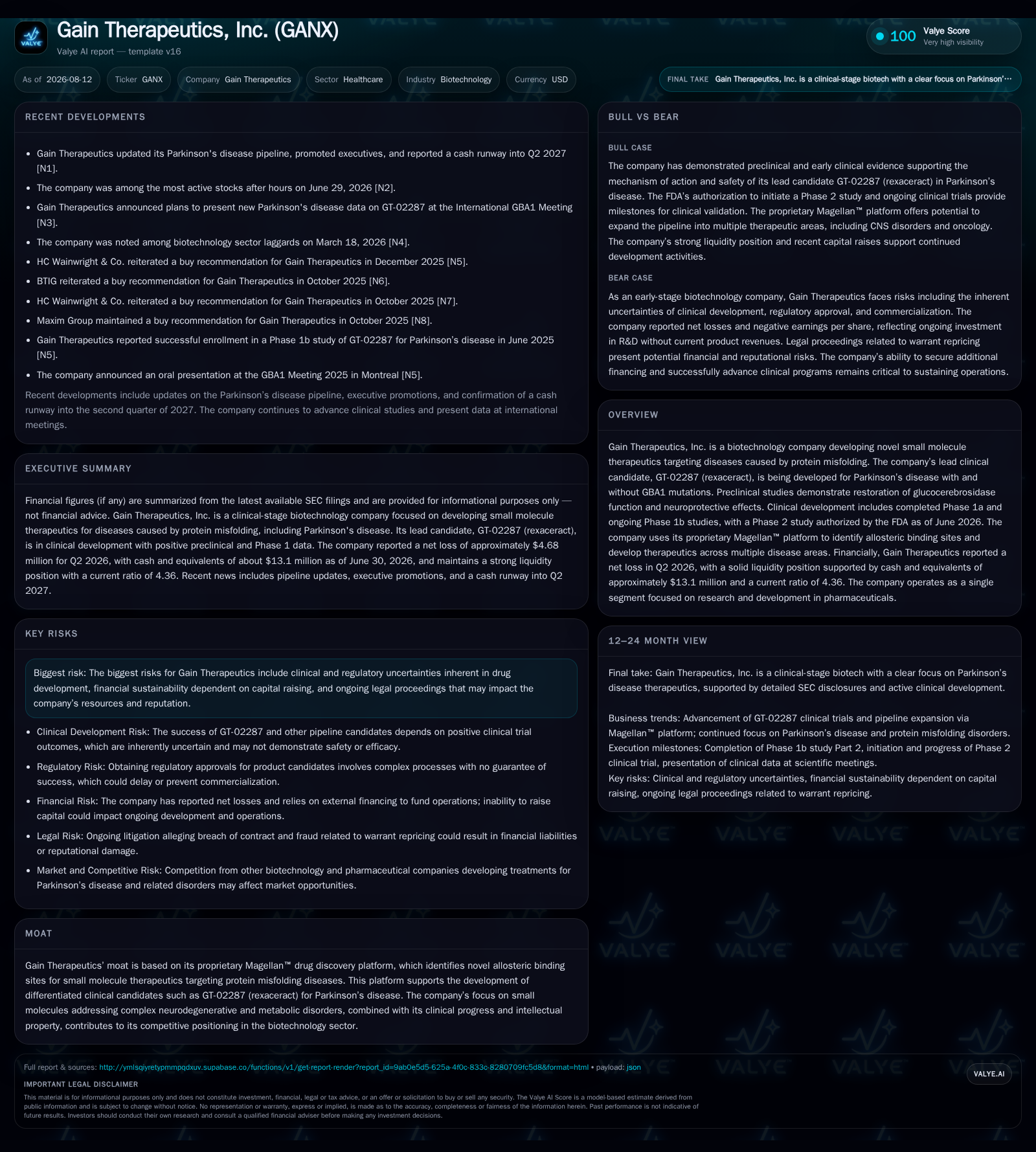
Gain Therapeutics secured FDA authorization to initiate a Phase 2 study of its lead candidate rexaceract (GT-02287) for Parkinson’s disease, marking a significant clinical milestone. This progress leverages its proprietary Magellan™ platform that identifies allosteric small molecule therapeutics targeting protein misfolding disorders. However, the company faces financial headwinds with just $13.1 million in cash and equivalents at June 2026, providing limited runway amid persistent net losses near $10 million over six months. Legal challenges concerning a warrant repricing dispute add complexity to the near-term outlook. Successful capital raises and regulatory milestones will be critical to sustain development and unlock value.
August Quarterly Filing: Clinical Milestones Collide with Capital Constraints
Gain Therapeutics’ Q2 2026 10-Q reveals pivotal clinical advancement alongside pressing liquidity concerns. The FDA granted authorization to initiate a Phase 2 clinical trial of the company’s lead candidate GT-02287, now branded rexaceract, targeting Parkinson’s disease patients both with and without GBA1 mutations [S2]. This progression from early-phase safety studies towards efficacy evaluation represents a critical value inflection reflecting regulatory confidence in the candidate's foundational data package.
Concurrently, the filing discloses substantial doubt about the company's ability to continue as a going concern within one year absent new capital [S2], driven by recurring net losses and negative cash flows typical for pre-commercial biotech firms. At quarter-end June 30, Gain held $13.1 million cash and equivalents with minimal debt ($344K), translating into a strong current ratio of 4.36 [F1], [S2].
The tension between advancing costly clinical development programs and tightening liquidity encapsulates Gain's immediate strategic challenge, underscoring the importance of imminent financing or partnership success.
GT-02287 Clinical Progress: Unlocking Parkinson’s Neurodegenerative Disease Potential
GT-02287 exploits Gain's differentiated approach addressing protein misfolding pathologies by restoring glucocerebrosidase (GCase) activity. Protein misfolding underlies neurodegeneration in Parkinson's, especially in patients harboring GBA1 mutations where deficient GCase exacerbates alpha-synuclein accumulation [S1], [S22]. Rexaceract is designed as a small molecule allosteric modulator that enhances lysosomal GCase function, reduces toxic lipids and alpha-synuclein aggregates, alleviates cellular stress markers like ER stress, as well as promoting mitochondrial health and dopaminergic neuron survival.
Preclinical models demonstrated restoration of physiological parameters including dopamine levels and locomotor behaviors back toward healthy controls—a compelling biological rationale rare among early-stage neurodegenerative therapeutics [S22]. Phase 1a safety and PK studies completed successfully by mid-2024 established tolerability across ascending dose cohorts in healthy volunteers [S22]. Follow-on Phase 1b and bioavailability studies have been ongoing with positive interim data presentations [N1], setting the stage for initiating clinical efficacy testing in Phase 2 from Q3 2026 onward.
This pathway positions GT-02287 as one of few small molecule approaches actively progressing through clinical validation for both idiopathic and mutation-associated Parkinson’s—distinguishing Gain versus peers such as Denali Therapeutics or ACADIA Pharmaceuticals who pursue alternative modalities or targets within neurodegeneration.
Magellan™ Platform as a Moat: Small Molecule Allostery in Protein Misfolding Disorders
At its core, Gain Therapeutics leverages Magellan™, a proprietary computational drug discovery platform oriented around identifying novel allosteric binding sites undetected by traditional methods [S1]. Allostery allows modulation of target proteins’ function without competing at active catalytic sites, which can minimize off-target effects and enable therapeutic action on challenging misfolded proteins implicated in complex diseases.
The platform accelerates hit-to-lead optimization cycle times while diversifying pipelines through structurally distinct candidates. Compared with leading-edge biotechnology firms like Schrödinger applying physics-based molecular modeling across broad indications, Gain focuses Magellan predominantly on neurodegenerative conditions driven by proteostasis disruption—a niche likely enhancing intellectual property defensibility.
This technological backbone supports sustainable differentiation by continually refreshing candidate quality beyond first-generation drug leads such as rexaceract. However, competitive technological advances or alternative modalities (e.g., gene therapies) pose vigilance points that could erode this moat if not countered by continuous innovation.
Biotech Industry Dynamics: Peers, Pricing Power, and Funding Environment in Focus
Gain operates within the highly capital-intensive biotechnology sector characterized by prolonged R&D timelines and inherent clinical/regulatory risk. Early-to-mid stage biotechs focused on CNS disorders typically have negligible current revenues aside from milestone-based inflows or grants prior to product commercialization.
Relative to peers like Denali Therapeutics—active in neurodegeneration with broader pipelines—and ACADIA Pharmaceuticals—known for CNS-focused indications—Gain is at an earlier exploratory-to-proof-of-concept phase but benefits from leveraging a proprietary discovery platform uncommon among peers. This confers potential cost efficiencies offsetting lower economies of scale.
Pricing power remains theoretical pending regulatory approvals; however, successful targeting of unmet needs in Parkinson's could justify premium pricing given high prevalence and rising incidence globally. Licensing agreements or partnerships represent probable near-term monetization pathways enabling non-dilutive capital without full-scale commercialization burdens.
'Cash is King': The Crucial Role of Capital Raising Amid Ongoing R&D Investment
Financially, Gain reflects classic pre-commercial biotech profiles: net loss approximated $10.3 million during H1 2026 with operating expenses largely tied to R&D activities encompassing clinical trials, regulatory compliance, staff costs, and platform maintenance [S2], [F1]. At quarter-end June 30, Gain held $13.1 million cash and equivalents with minimal debt ($344K), resulting in a current ratio of 4.36, indicating a strong liquidity position relative to short-term obligations [F1], [S2].
Prior quarters displayed similar trends with management repeatedly signaling intent to secure additional capital via equity financings or convertible debt instruments complemented by grant funding strategies [S6], [S19]. Absent timely raises or collaboration deals providing milestone payments or upfront fees, sustainable operations beyond H1 2027 face credible risk per going concern disclaimers.
Potential dilution pressures from equity issuance necessitate careful timing aligned with positive clinical readouts or partnership news flow to optimize valuation retention.
'Walking a Tightrope': Regulatory Risks and Legal Disputes Cloud Outlooks
Legal risks add another layer of complexity; ongoing litigation filed January 2026 involves allegations concerning failure to honor an agreement related to repricing executive warrants seeking over $3.1 million damages [S1]. These proceedings introduce potential reputational damage and resource diversion although the company contests the claims vigorously.
Litigation outcomes could materially impact shareholder sentiment especially considering constrained liquidity conditions amplifying sensitivity to negative events. Early-stage biotechs often encounter governance disputes; successful resolution would mitigate one source of uncertainty accompanying the company’s value trajectory.
'Stretching Growth': What Catalysts Will Influence Pipeline Expansion and Licensing?
While GT-02287 remains the headline program, Gain’s Magellan™ platform carries latent opportunity to expand indications beyond Parkinson's into other lysosomal storage disorders (LSDs), metabolic diseases, or oncology areas where aberrant protein folding plays pathogenic roles [S22]. Pipeline diversification would mitigate concentration risk endemic to single-candidate developers.
Management is actively exploring strategic collaborations licensing agreements that would provide incremental non-dilutive funding plus validation of technology utility across therapeutic areas [S2]. Forward catalysts include further IND submissions for new candidates derived from Magellan outputs or announcements quantifying deal progress reflecting third-party endorsement.
Maintaining disciplined R&D expenditure aligned with clear milestone schedules will be essential to avoid operational overstretch given finite resources.
Financial Profile Discussion
As of June 30, 2026, Gain’s balance sheet shows $13.1 million cash against nominal debt ($344K), yielding a favorable liquidity buffer relative to current liabilities totaling approximately $3.4 million which supports short-term operational obligations comfortably [F1], [S2]. Nevertheless, recurring operating losses near $10 million per half year reflect intense investment phase typical for an R&D-centric biotech prior to revenue generation.
The going concern note attached to recent financial statements explicitly states that without additional funding within the next twelve months continuation viability is doubtful emphasizing dependence on capital markets or partnership monetization successes [S2]. This dynamic is consistent with comparable biotech firms at analogous developmental stages requiring frequent fundraises until commercial product launches materialize.
Therefore, investors should monitor quarterly cash burn rates alongside announcements relating to new financings or business development transactions serving as key indicators softening immediate liquidity risk.
Disclaimer: This is research-only, informational analysis and not investment advice. It may include AI-generated interpretation and general industry context. Always verify important details using primary sources.

Comments