
INNEOVA’s Engineering and Parts Distribution Business Navigates Margin Pressure and Nasdaq Compliance Challenges
June 2026 filings highlight INNEOVA’s sustained segment revenues amid cost and liquidity pressures, alongside a critical Nasdaq listing extension.
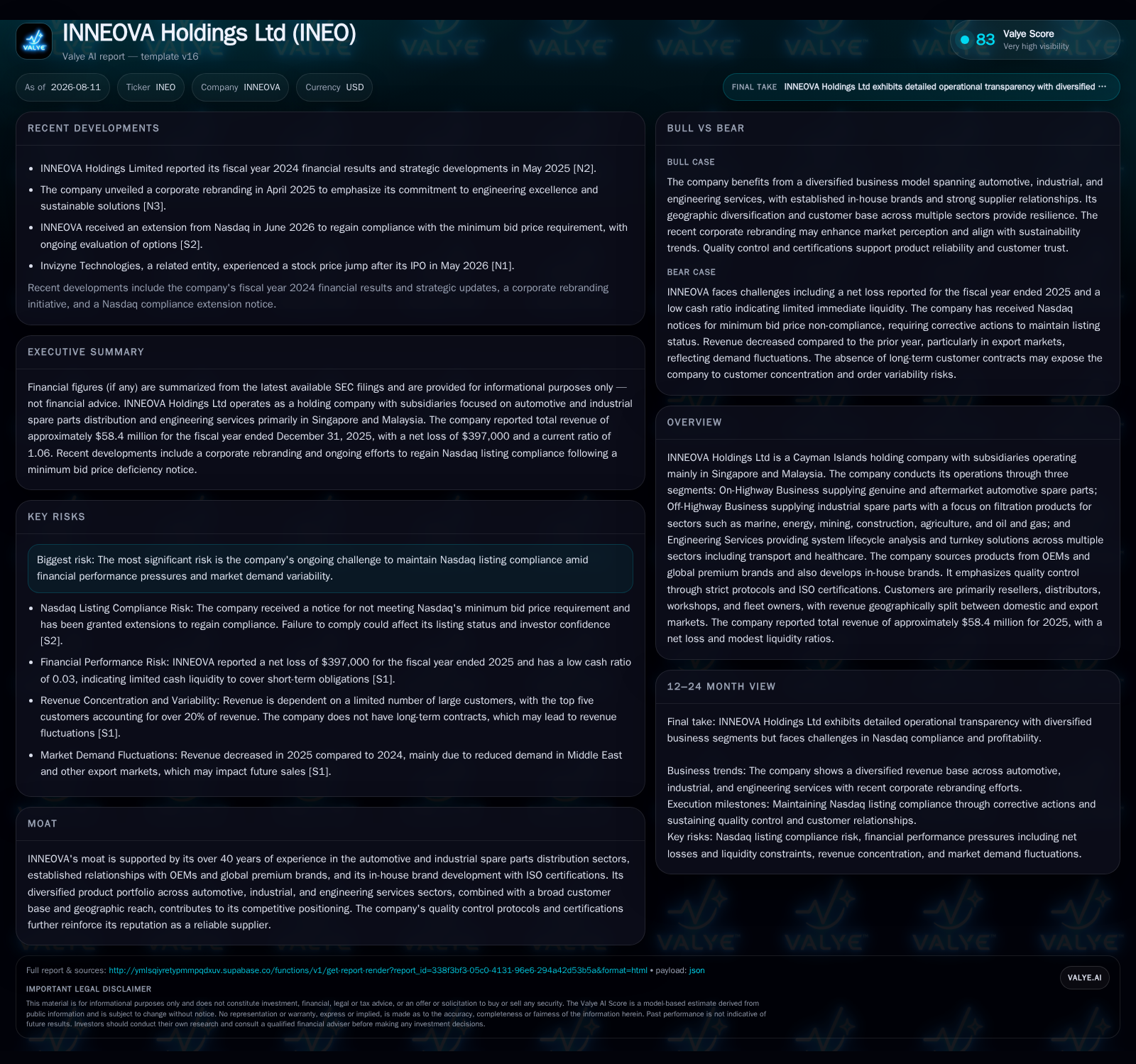
INNEOVA Holdings Ltd’s latest quarterly disclosures reveal stable yet slightly pressured revenues across its On-Highway automotive, Off-Highway industrial parts, and Engineering Services segments. The company’s diversified model balances genuine OEM and aftermarket parts distribution with emerging engineering lifecycle solutions. Operating margins remain challenged by inflationary cost pressures and cash constraints from prepaid inventory purchases. Concurrently, INNEOVA faces regulatory risk due to non-compliance with Nasdaq’s minimum bid price rule, having secured a second extension but with uncertain resolution prospects.
Recent Quarterly Update Reflects Revenue Resilience Amid Challenges
INNEOVA Holdings’ latest quarterly filings indicate stable overall revenue generation despite modest declines in the On-Highway automotive parts and Off-Highway industrial components segments [S2][S3][S1]. This suggests continuing demand from core B2B customers—distributors, workshops, fleet operators—who rely on INNEOVA’s supply chain network. However, ongoing supply chain disruptions coupled with competitive pricing pressures have compressed margins and complicated inventory management
Diversified Business Model Balancing Parts Distribution with Engineering Services
INNEOVA’s operations are segmented into three complementary areas: the On-Highway segment supplies genuine OEM and aftermarket automotive spare parts primarily for passenger and commercial vehicles; the Off-Highway segment focuses on industrial filtration products serving marine, energy, mining, construction, agriculture, and oil & gas sectors; finally, the Engineering Services arm delivers turnkey system lifecycle analysis and asset uptime solutions across transport, healthcare, defence, utilities, and facility management sectors [S1][F1].
This mix positions the company to leverage steady aftermarket parts demand driven by vehicle aging trends while tapping into higher-margin engineering services that target total cost of ownership optimization for industrial clients [S16]. Genuine OEM parts benefit from brand recognition and quality certifications such as ISO that support premium pricing; aftermarket components provide volume but face intense competition requiring operational scale efficiencies
Competitive Positioning in Regional Industrial Distribution Networks
With operations concentrated in Singapore and Malaysia but serving broader Asia-Pacific and Middle East markets [S14], INNEOVA acts as an intermediary between global OEMs/premium brands and regional resellers or end-users. The company’s extensive supplier relationships combined with rigorous quality control protocols help maintain product integrity—a critical differentiator given the technical specifications demanded in filtration products.
Margin Pressures from Cost Inflation and Working Capital Constraints
Finished goods constitute roughly 80% of INNEOVA’s cost of revenue; prices fluctuate due to raw material costs, labor expenses, and logistics challenges faced by suppliers [S1]. Prepayment terms amplify cash flow timing mismatches between outlays for inventory procurement and inflows from sales.
While management has not reported significant margin deterioration yet attributable to inflationary pressures, sustained increases could compress operating income further if passing costs onto customers proves difficult amid vigorous price competition [S22]
Engineering Services Segment: Growth Potential Amid Scale Limitations
The engineering services division generated approximately $4.6 million in revenue in 2025 (~8% of total group revenues), offering integrated solutions like cooling system management and fleet maintenance designed to maximize asset uptime across multiple sectors [S1]
Though smaller than distribution segments currently, this segment carries potential for higher margins through multi-year service contracts emphasizing predictive maintenance and turnkey project delivery. Success depends on scaling skilled personnel deployment effectively while growing backlog orders that enhance revenue visibility.
Customer Concentration Heightens Exposure to Market Dynamics
Sales from INNEOVA’s top five customers comprised about 21.3% of total revenue in the latest reported year, highlighting material dependence on a limited client base largely composed of distributors and fleet operators [S1]. The largest single customer accounted for approximately 7% of revenues.
This concentration exposes INNEOVA to pricing pressure risks as these customers negotiate aggressively or seek alternative suppliers amidst supply volatility. Maintaining strong supplier relationships backed by ISO-certified quality controls is vital but may not fully insulate against margin erosion.
Nasdaq Listing Compliance: Regulatory Risk Requires Strategic Action
A significant corporate governance risk emerged as INNEOVA failed to meet Nasdaq’s minimum bid price rule ($1 per share) by June 8, 2026 [S2]. The exchange granted a second 180-day extension after the company requested additional time contingent on remedial steps—such as effecting a reverse stock split—to regain compliance.
These metrics will illuminate whether INNEOVA can sustain revenue momentum while managing margin compression within tight liquidity parameters.
Liquidity Under Pressure Despite Operational Cash Flow Support
As disclosed in the unaudited balance sheet dated March 31, 2026 incorporated into recent filings, INNEOVA holds approximately $1.06 million in cash against $1.24 million total debt resulting in modest net debt around $182 thousand with a compressed current ratio near 1.06 [F1][S3]
Debt maturities weighted toward the near term necessitate careful refinancing planning which could be complicated by uncertainties surrounding Nasdaq listing status.
INNEOVA Holdings stands at an inflection point balancing stable yet pressured parts distribution businesses alongside nascent engineering services growth opportunities under challenging liquidity conditions intensified by regulatory compliance risks. Progress on backlog growth in engineering services, customer retention amid pricing competition, supply chain recovery indicators, plus successful Nasdaq compliance maneuvers will critically shape medium-term viability.
Disclaimer: This is research-only, informational analysis and not investment advice. It may include AI-generated interpretation and general industry context. Always verify important details using primary sources.

Comments