
Pixelworks Focuses on Cinematic Visualization Post-Semiconductor Divestiture Amid Licensing Model Transition
After divesting its semiconductor business, Pixelworks now centers exclusively on its TrueCut Motion platform to capture growing demand in cinematic visualization and motion grading.
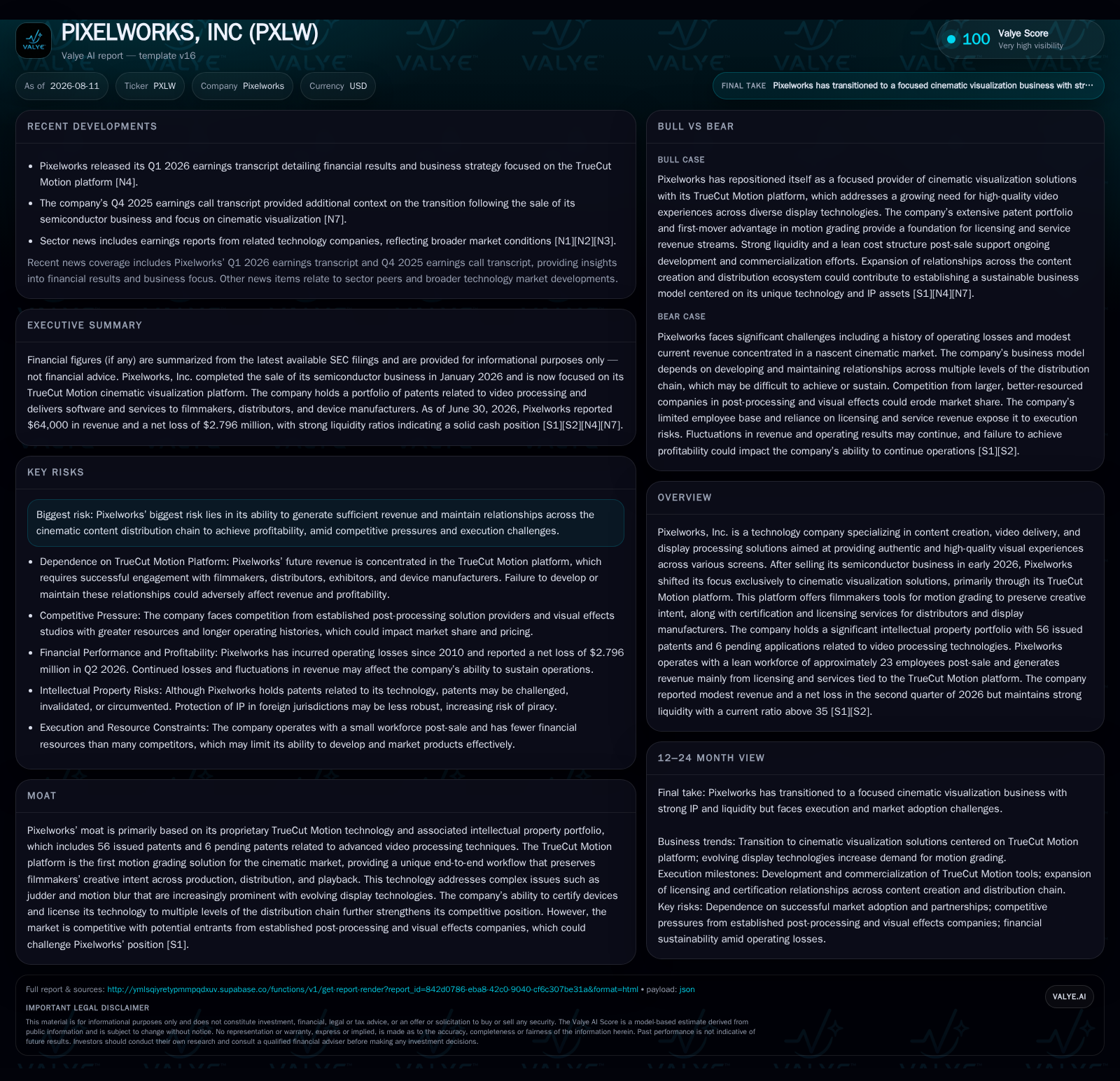
Pixelworks has completed a strategic pivot following the sale of its semiconductor segment in early 2026, concentrating solely on cinematic visualization software and services. Its proprietary TrueCut Motion platform offers an integrated workflow to preserve filmmakers' creative intent across production, distribution, and display through licensing and certification. Despite a lean workforce and operating losses, the company benefits from a strong patent portfolio and positioning within a complex industry value chain. Success depends on expanding licensing adoption across content creators and distributors amid competition from established post-production players. Near-term growth hinges on broadening certification services and deepening market penetration.
Recent Operating Update: Semiconductor Exit Completed and Focus Shifted
In January 2026, Pixelworks finalized the sale of its semiconductor business segment—Pixelworks Semiconductor Technology (Shanghai) Co., Ltd.—to Tiansui Xinyuan Technology (Shanghai) Co., Ltd., receiving approximately $51 million net of transaction costs [S1]. This divestiture marked a definitive exit from the mobile and home enterprise markets centered on IC products. Consequently, Pixelworks redefined its strategic focus exclusively toward cinematic visualization solutions anchored by its proprietary TrueCut Motion platform [S1].
Business Model: Licensing and Service Revenue Derived from Proprietary Video Processing Software
Pixelworks generates revenue through licensing its TrueCut Motion platform—a suite of software tools designed for motion grading—and providing certification services validating visual quality standards across display devices used throughout cinematic content distribution chains [S1]. Unlike traditional product sales tied to chipsets or hardware units sold to consumer electronics manufacturers (a business Pixelworks exited), monetization now rests heavily on recurring or contracted licensing fees paid by digital content creators (filmmakers), streaming operators, distributors, and device manufacturers who benefit from ensuring artistic intent is faithfully preserved.
The TrueCut Motion offering addresses critical pain points such as judder correction and motion blur reduction—key issues amplified with evolving high-frame-rate displays and streaming platforms. By integrating tools directly into workflows spanning production studios through to exhibition devices (cinema projectors or smart TVs), Pixelworks aims to embed itself deeply within the end-to-end video pipeline [S1]. Certification fees tied to validating partner devices represent an additional revenue stream that leverages the company’s intellectual property portfolio totaling 56 issued patents plus six pending applications centered on advanced video processing technologies
Revenue growth hence depends on expanding license issuance volumes to filmmakers adopting the platform for post-production work or production pipelines employing TrueCut tools. Simultaneously, licensing agreements extend along several levels of the digital distribution ecosystem—from studios downstream to streaming providers—reinforcing multi-tiered monetization potential but requiring sophisticated relationship management across diverse customer bases.
Industry Structure and Competitive Position
Pixelworks operates within a niche software segment serving cinematic visualization needs—a sector characterized by rapid technological innovation requirements coupled with complex value chains involving content creators, distributors, device manufacturers, and finally consumers viewing digital video content.
The company's peer set includes post-production software providers such as Autodesk offering CGI tools; Dolby Laboratories known for premium video/audio processing technologies; streaming-optimization firms like Brightcove; as well as patent-focused IP licensors specializing in video processing algorithms. Pixelworks differentiates itself primarily through its early-mover advantage in motion grading workflows tailored explicitly for cinematic markets rather than generalized video enhancements. This specificity grants some defensibility via proprietary technology embodied in its patents.
However, the market remains competitive with threats from visual effects companies potentially encroaching into adjacent cinematic visualization domains by developing comparable or substitute solutions. Furthermore, maintaining relevancy requires continual R&D investment amid evolving display standards (e.g., HDR frame rates), creating pressure for sustained innovation cycles [S1].
Growth Drivers in Cinematic Visualization Licensing & Services
Several structural trends underpin demand for Pixelworks’ offerings. Firstly, streaming platforms continue investing heavily in original high-quality cinematic content generation worldwide. This drives up needs for advanced post-production tools mitigating artifacts like judder often exacerbated by varied playback devices.
Secondly, new-generation displays increasingly employ higher refresh rates or novel panel technologies that can introduce perceptible motion issues unless corrected via sophisticated video processing—a gap addressed by TrueCut Motion's capabilities.
Thirdly, digital content remastering efforts aimed at restoring legacy films for modern screen formats are expanding markets where Pixelworks' motion grading tools serve end-to-end workflows.
Lastly, licensing scalability benefits from Pixelworks’ model targeting multiple distribution levels—not only the creatives but also streaming operators and device makers through certification programs—allowing diversified revenue streams that potentially stabilize income volatility inherent in media production cycles.
KPIs crucial to tracking future growth include license counts issued annually (indicating adoption breadth), service contract volume expansion (depth of client engagement), certification service uptake among hardware vendors (visual quality assurance footprint), patent filings enhancing technology leadership (innovation pipeline), retention rates reflecting customer satisfaction, alongside platform uptime reliability metrics essential for integration into professional workflows.
Risks and Growth Constraints
Despite strengths in proprietary technology and IP assets, Pixelworks confronts notable execution risks primarily due to its lean operational scale following semiconductor business divestiture [S1]. Generating sufficient licensing revenue requires not only attracting new users but also nurturing entrenched relationships across fragmented content creation-distribution ecosystems—a process subject to lengthy negotiation cycles.
Competitive dynamics present risks from established VFX/post-production houses expanding their toolsets into motion grading arenas with larger R&D budgets. Pricing pressures may emerge if alternatives gain traction accelerating downward fee compression.
Moreover, evolving industry standards or format shifts could render current video processing algorithms obsolete without timely updates—a vulnerability mitigated only by continuous investment disproportionate relative to current revenue size.
Dependency on a relatively narrow customer base intensifies financial volatility risks should any key licenses fail to renew or scale as anticipated. Finally, scaling the certification services while maintaining quality assurance demands skilled personnel—challenging under a streamlined headcount regime post-divestiture.
What To Watch Next
The critical next milestones for assessing Pixelworks’ progress include quarterly disclosures showing increases in license issuance figures indicative of market adoption momentum. Announcements detailing new partnerships or expansions in device certification programs will signal traction beyond initial filmmakers toward securing downstream distributor/device revenues.
Further insight will come from R&D spend trends correlated against patent filings or updates showcasing sustained innovation within TrueCut Motion technology enhancing competitive differentiation.
Finally, any updates communicating strategic alliances within broader streaming or device ecosystems may indicate improved positioning inside multi-level distribution chains essential for long-term sustainability.
Financial Profile Discussion
Pixelworks maintains a solid balance sheet bolstered by approximately $53 million in cash & equivalents as of June 30, 2026 without any outstanding debt obligations recorded since at least 2018 [F1]. Such liquidity provides operational runway during this transition period focused solely on software/services ramp-up.
Operating income remains negative—with reported losses around $11.5 million at year-end 2025 reflecting continued investments aligned with product development and market cultivation initiatives [F1]. Net losses were wider at nearly $22.5 million due in part to non-operating expenses but expected given investment phase dynamics [F1].
High current ratio (approximate 35.56x) underscores strong short-term liquidity coverage relative to liabilities predominantly composed of small current accounts payable balances [F1]. The absence of debt reduces financial risk but underscores reliance on equity capital infusions or positive cash flow generation eventuality.
Measures such as gross margin progression on licensing services versus legacy product lines would be insightful though data remains sparse publicly; however SaaS-like recurring revenue streams typically deliver higher margin profiles once scale is achieved if churn remains contained.
In sum, financial health is stable but reflects an early-stage pivot where expenses outpace revenues underscoring importance of accelerating license sales volume while controlling costs tightly given limited human resources [S2][F1]
This analysis synthesizes SEC filing disclosures up to August 2026 alongside sector context relevant to cinematic visualization software players focused on proprietary motion grading technologies. It avoids extrapolating unconfirmed specifics about exact contract terms or precise market share absent direct evidence. The evolving strategy highlights strengths anchored in IP-based differentiation but reflects interim challenges typical of transition phases common among niche tech solution providers navigating competitive media ecosystems.
Disclaimer: This is research-only, informational analysis and not investment advice. It may include AI-generated interpretation and general industry context. Always verify important details using primary sources.

Comments