
Rithm Acquisition Corp.’s Trust Assets and Sponsor Dynamics Shape De-SPAC Prospects
Rithm Acquisition Corp. maintains a robust trust account and sponsor governance while facing timing pressures to complete its initial business combination.
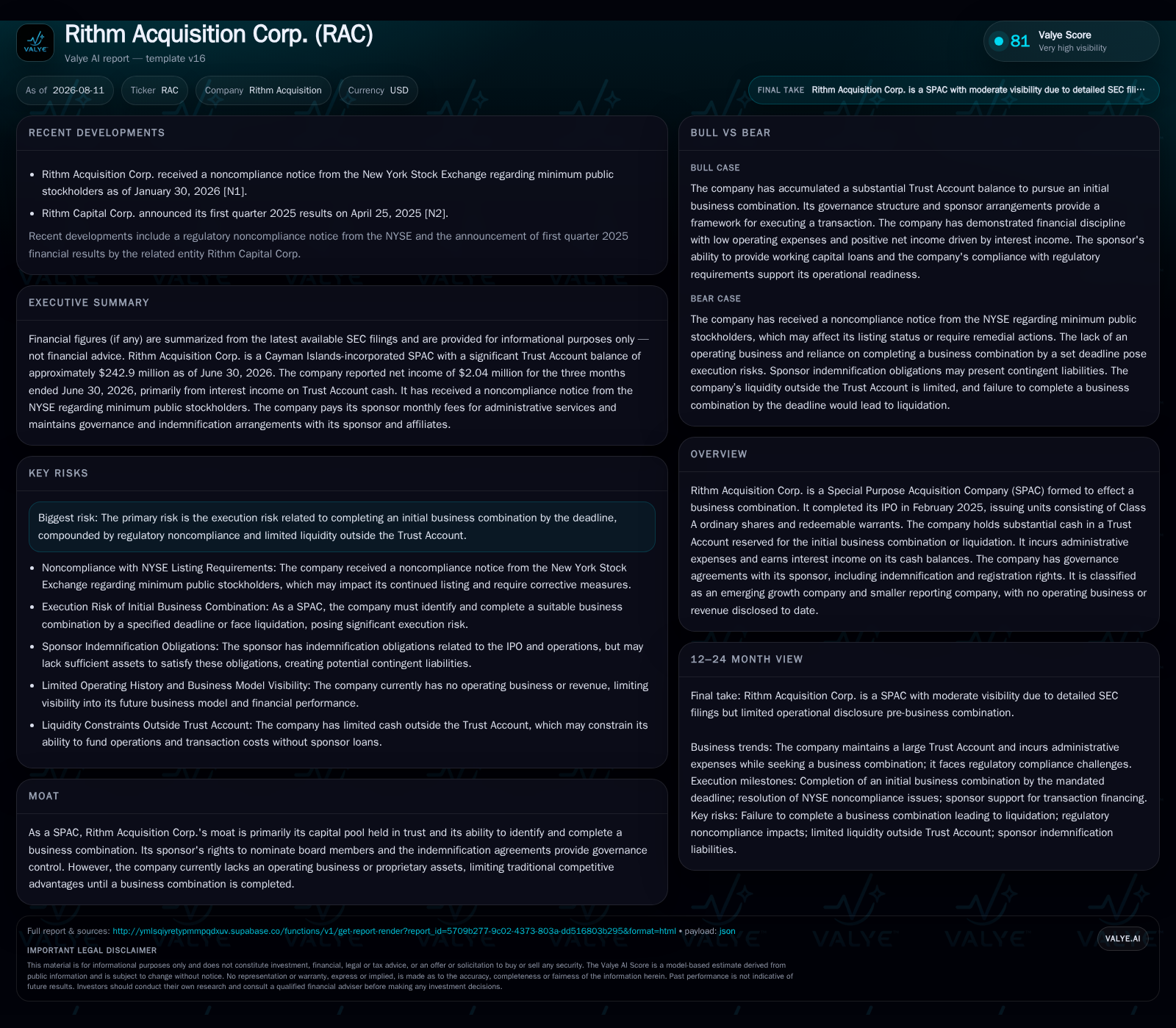
Rithm Acquisition Corp. (RAC) remains a classic special purpose acquisition company (SPAC) with no operating business but substantial capital held in trust from its February 2025 IPO. Its latest quarterly filing confirms a stable trust balance of approximately $243 million as of June 30, 2026, alongside minimal working capital outside the trust. Sponsor arrangements include founder share waivers and potential working capital loans to finance transaction costs. The company must complete its de-SPAC merger by February 28, 2027, or liquidate, imposing material execution risk. Administrative expenses continue at modest levels relative to the trust assets, consistent with industry norms. While no target has been publicly announced, governance control and sponsor incentives position Rithm to pursue a meaningful business combination in a market environment that favors alternative public listing vehicles.
Recent Operating Update
Rithm Acquisition Corp.'s most recent quarterly report filed on August 11, 2026, affirms its status as a SPAC holding substantial cash reserves for an initial business combination [S2]. The Trust Account balance stood at approximately $242.9 million as of June 30, 2026, representing net proceeds from its February 2025 IPO along with accrued interest earnings [S2], [F1]. Outside this trust, the company reported just $8,764 in unrestricted cash and equivalents [F1], underscoring the commitment to capital preservation until a suitable private entity is merged successfully.
Administrative expenses remained limited at around $198,000 for the three months ended June 30, primarily consisting of rent and administrative services paid monthly to the sponsor at a rate of $20,000 [S1], [S22]. This level aligns reasonably with peer SPAC structures which emphasize minimized overhead during the search phase. The absence of ongoing operational revenues is typical for SPACs prior to consummating their de-SPAC transactions.
Importantly, the sponsor has conveyed Founders Shares (5.75 million Class B ordinary shares) to three independent directors as part of governance arrangements; these are accounted for under ASC Topic 718 as share-based compensation with vesting contingent on board service [S2]. This transfer signals enhanced oversight and aligns interests beyond pure financial sponsorship.
Additionally, related-party working capital loans remain available but unused as of quarter-end [S2], affording optional liquidity support for transaction costs or working capital needs without diluting public shareholders prematurely.
The next material timeline milestone is the statutory deadline of February 28, 2027 by which Rithm must complete a qualifying business combination or face mandatory liquidation and distribution of Trust Account proceeds net of fees [S2]. Failure to execute within this window represents the primary operational risk vector.
Business Model
Rithm Acquisition Corp operates under the archetypal SPAC model: it raised funds through an initial public offering by selling units combining Class A ordinary shares with redeemable warrants at $10 per unit in February 2025 [S1], [S18]. The proceeds were placed into a restricted Trust Account earning interest over time. Revenue generation prior to merger activity is negligible except interest income on the trust balance.
The company’s sponsor holds significant Founder Shares creating alignment and fee structures contingent upon completing a de-SPAC transaction successfully [S1]. It also benefits from registration rights affecting post-merger liquidity options for insiders. Shareholders hold redemption rights allowing them to withdraw their pro rata proportion of Trust Account funds if dissatisfied with proposed merger terms or uncertain about deal approval.
Monetization hinges on successfully identifying and closing an acquisition that meets or exceeds regulatory thresholds—typically at least 80% of net assets must be deployed in the combination [S1]. Post-merger operations depend entirely on the private target’s business model; thus RAC’s primary strategic function is capital facilitation and deal-making rather than product or service provision.
Industry Structure and Competitive Position
The broader SPAC ecosystem serves as an alternative pathway for private companies seeking accelerated access to capital markets compared to traditional IPOs. Rithm Acquisition Corp sits upstream in this value chain as a capital vehicle sourcing targets and proposing combinations downsteam for investor approval.
Peers include marquee names such as Pershing Square Tontine Holdings and Churchill Capital which have demonstrated varying degrees of deal sophistication and complexities post-merger integration. Rithm's roughly $243 million Trust Account size positions it mid-tier relative to larger marquee SUVs but sufficiently large for substantial middle-market deals.
Its governance framework—delegated founder shares with associated board responsibilities—and structured indemnification agreements align it slightly favorably among SPAC sponsors who often face scrutiny over potential conflicts between sponsor incentives and public shareholders’ interests [S1], [S2]. However, like many peers, its fate will ultimately depend on execution success amid evolving regulatory scrutiny and market conditions impacting investor sentiment on SPAC securities.
Growth Drivers
While RAC's growth is event-driven rather than organic, broader industry tailwinds support continued investor interest:
- Rising private company demand for streamlined public listing options.
- Capital markets favorable toward alternative financing vehicles amid volatility in traditional IPO channels.
- Increased experience among sponsors improving sourcing quality alongside enhancements in due diligence rigor.
- Innovations in PIPE financing expanding deal structuring flexibility.
- Regulatory clarifications setting clearer paths for deal disclosures and accounting methods.
These factors may enhance Rithm’s ability to negotiate favorable terms with high-quality targets within its remaining combination period.
Risks and Constraints
Execution risk remains paramount given the limited timeframe—the February 28, 2027 deadline imposes material pressure [S2]. Failure forces wind-down leading to potential loss of economic upside for public shareholders beyond liquidation value.
Additionally, liquidity risks exist due to thin operational cash outside trust accounts ($8.8k), requiring continued sponsor cooperation via optional working capital loans if needed [S2]. Regulatory risks also loom around compliance failures in disclosures or accounting standards adherence that could delay or derail approvals.
Dilution emerges from warrant exercises and potential PIPE financings negotiated during de-SPAC efforts affecting shareholder returns post-combination. Conflicts between sponsor interests (founder shares) versus public investors over deal pricing introduce governance challenges despite indemnification provisions designed to mitigate liability exposure.
At June 30, 2026, cash and equivalents stood minimal outside trust at approximately $8.8 thousand [F1], with current assets totaling $185 thousand against $24 thousand current liabilities yielding a strong current ratio near 7.7x indicating ample short-term liquidity relative to operating obligations [F1]. The lion's share resides in the Trust Account valued near $243 million serving as fulcrum for shareholder redemption values and potential deal funding [S2], [F1].
Net income measures primarily reflect interest accrued on trust investments offset by administrative costs which hovered around $198K per quarter recently—a moderate burn rate when benchmarked against similar SPACs managing comparable trust sizes [S2], [F1], [S22]. This expense discipline suggests efficient use of shelf period resources extending runway toward deal completion deadlines.
Sponsor equity stake via Founder Shares remains substantial at 5.75 million Class B shares initially valued nominally but carrying significant upside contingent on post-combination equity performance; accounting treatment under ASC Topic 718 acknowledges compensation expense linked with director service vesting milestones enhancing alignment transparency [S2]
Working Capital Loans remain unused but available up to $1.5 million for transaction cost bridging if needed [S2], providing contingency liquidity without immediate drag on shareholder dilution absent usage.
Overall liquidity metrics signal stability through mid-2026 but hinge critically on timely de-SPAC execution within mandated windows risking forced dissolution if unmet [S2], emphasizing categorical event risk inherent across SPAC peer group spectra.
This analysis synthesizes information solely disclosed by Rithm Acquisition Corp through SEC filings dated August 11, 2026 ([S2]) and December 19, 2025 ([S1]), alongside related XBRL metrics ([F1]). Industry context reflects commonly understood characteristics of Special Purpose Acquisition Companies without speculation on unidentified target entities or unannounced transaction terms. This report does not provide investment advice but aims to elucidate operating dynamics relevant to understanding RAC’s financial structure and strategic outlook pending its initial business combination.
Disclaimer: This is research-only, informational analysis and not investment advice. It may include AI-generated interpretation and general industry context. Always verify important details using primary sources.

Comments