
Sanara MedTech Focuses Solely on Surgical Products Amid Merger Uncertainty and Segment Discontinuation
Sanara MedTech narrows its business to surgical soft tissue repair and bone fusion devices while managing merger complexities and operational restructuring.
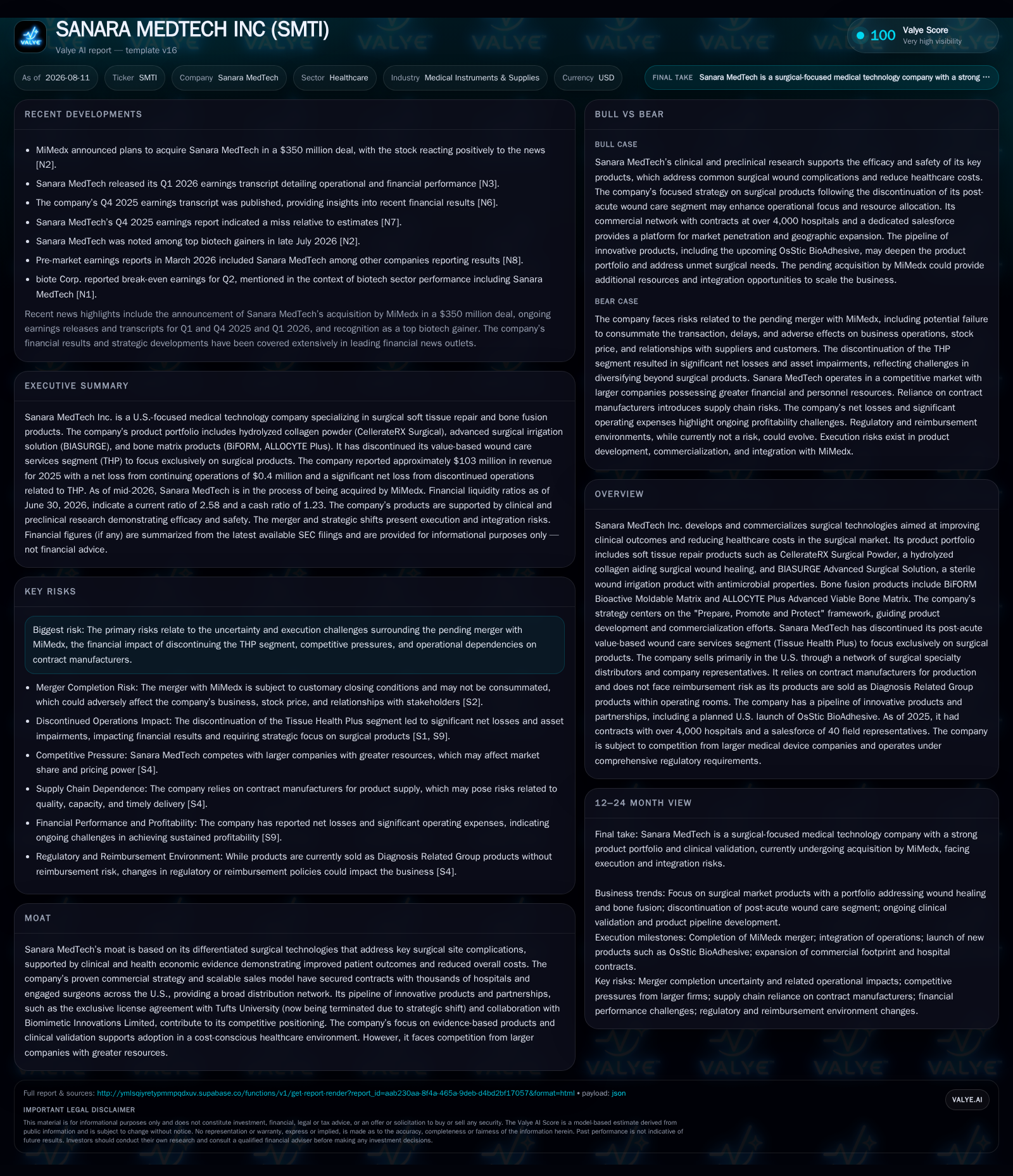
In its latest quarter, Sanara MedTech has discontinued its Tissue Health Plus (THP) post-acute wound care segment to concentrate on its core surgical product portfolio consisting of soft tissue repair and bone fusion technologies. The company faces execution risks related to an impending merger with MiMedx, which introduces uncertainty in strategic decision-making and potential disruption in stakeholder relationships. Despite these challenges, Sanara MedTech reports solid progress in its surgical product revenue, driven by clinical validation and an expanding hospital customer base. Ongoing contract manufacturing partnerships and capital structure considerations remain pivotal as Sanara prioritizes scalable commercialization for its advanced surgical solutions.
Recent Operating Update
Sanara MedTech's most recent quarterly report, filed August 11, 2026, underscores a strategic pivot that culminated in the complete discontinuation of its Tissue Health Plus (THP) post-acute wound care services segment as of September 2025 [S2][S1]. This decisive move ends persistent losses related to THP and concentrates the company’s resources solely on its surgical product lines encompassing soft tissue repair and bone fusion devices. Concurrently, Sanara announced ongoing engagement with MiMedx on a $350 million merger deal that remains subject to regulatory, shareholder approvals, and closing conditions. The pending merger elevates near-term uncertainty, potentially affecting supplier contracts, customer relationships, employee retention, and overall operational focus [S2].
Business Model and Product Portfolio
Sanara MedTech operates within the Medical Instruments and Supplies industry by developing innovative surgical technologies designed to improve patient outcomes while reducing total healthcare expenditures. The company’s primary revenue derives from sales to hospitals and surgical centers across the U.S., leveraging a direct sales approach supplemented by specialty distributors [S1]. Central products include CellerateRX Surgical Powder—a hydrolyzed collagen biomaterial facilitating surgical wound healing—and BIASURGE Advanced Surgical Solution for sterile no-rinse wound irrigation.
In parallel, Sanara commercializes bone fusion implants such as BiFORM Bioactive Moldable Matrix—an osteoconductive porous scaffold promoting bony ingrowth—and ALLOCYTE Plus Advanced Viable Bone Matrix containing progenitor cells that enhance bone regeneration [S1]. These offerings address critical operating room needs for soft tissue repair and bone grafting with a focus on clinical evidence-backed performance. The proprietary "Prepare, Promote and Protect" framework underpins Sanara’s product development pipeline managed by its internal R&D group Rochal Technologies.
Revenue recognition stems from direct shipments against purchase orders or procedure-time deliveries by sales reps. Revenue growth hinges on product adoption rates in hospitals, number of hospital accounts under contract, and repeat usage tied to demonstrated clinical benefits [S1]. As typical in this segment, gross margin depends heavily on cost-effective manufacturing—largely outsourced via contract manufacturers—and efficient distribution.
Industry Structure and Competitive Positioning
The medical devices sector related to surgical consumables is marked by stringent regulatory oversight demanding robust clinical validation. Market adoption is influenced not only by product efficacy but also cost-effectiveness amidst value-based care initiatives emphasizing reduced surgical site infections and complications. Sanara's moat resides in its differentiated product profiles substantiated by health economic evidence indicating better outcomes at lower system costs.
Compared with large diversified peers like Medtronic or Stryker Corporation—which deliver broader product portfolios—Sanara’s focused scope allows nimble innovation but leaves it vulnerable to competitive pressures from better-capitalized firms deploying scale advantages in pricing or expansive marketing networks. However, securing contracts with thousands of U.S. hospitals confers notable distribution strength in a sector where switching costs can be meaningful due to surgeon preference patterns and institutional purchasing policies.
Significantly, Sanara's exit from THP removes exposure to post-acute care complexities but also narrows diversification contrary to some competitors offering integrated continuum solutions. The company maintains strategic partnerships enhancing pipeline potential yet must navigate intellectual property challenges alongside reimbursement reform trends impacting adoption dynamics.
Growth Drivers
Demand drivers for Sanara center around increasing volume of minimally invasive surgeries driven by an aging population requiring more orthopedic treatments and wound repairs. Advances in biomaterials like hydrolyzed collagen powders and viable bone matrices enhance surgeon acceptance by facilitating faster healing with fewer complications. Hospitals’ financial incentives under value-based care programs favor products demonstrably reducing re-hospitalization rates due to surgical site infections or graft failures.
Investment in R&D to evolve existing product lines—as well as launch next-generation technologies aligned with "Prepare, Promote & Protect" protocols—underpins medium-term growth prospects [S1]. Expanding geographic footprint across U.S. hospital networks remains vital while maintaining high customer retention through reliable supply chains facilitated by contract manufacturers.
Risks and Watchpoints
Key risks revolve around the pending MiMedx merger whose failure or delay could disrupt current business momentum given constraints imposed under the merger agreement limiting alternative transactions or investments during negotiation periods [S2]. Relatedly, employee attrition risk increases amid merger-related uncertainty potentially diluting talent critical to commercialization efforts.
Operational dependency on third-party contract manufacturers introduces supply chain vulnerabilities exacerbated by current market-wide logistical constraints; any disruption could impair production capacity utilization thus affecting fulfillment timelines impacting gross margins [S1][S2]. Furthermore, continuing pressure on pricing within cost-conscious healthcare systems heightens competitive risk against larger players wielding stronger negotiating leverage.
The discontinued THP segment resulted not only in termination costs but material impairment charges against related intangible assets diminishing net income comparability and reflecting strategic refocus costs [S16][S17]. Regulatory approval hurdles remain inherent given device classification requiring continuous compliance vigilance.
What to Watch Next
Key near-term milestones include approval and closing progress of the MiMedx merger which will dictate strategic direction post-combination [N2][S2]. Monitoring updates on clinical trial outcomes validating product innovations will provide crucial signals for adoption rate acceleration especially in new hospital accounts [S1]. Financial metrics such as sequential growth in soft tissue repair revenues alongside gross margin expansion will indicate improving operating leverage as fixed costs spread over higher volumes.
Maintaining healthy relationships with contract manufacturers ensuring capacity scalability amid anticipated demand surges will be another operational marker. Finally, R&D spend relative to sales offers insight into commitment towards sustaining technological leadership amidst intense competition in surgical device innovation.
Financial Profile Discussion
As of June 30, 2026, Sanara MedTech reported cash and equivalents of $15.4 million against total debt approximating $47.3 million resulting in net debt around $31.9 million with a current ratio of approximately 2.58 reflecting adequate short-term liquidity support [F1]. The company’s senior secured CRG Term Loan facility of up to $55 million accrues interest at 13.25%, comprising cash pay components plus potential paid-in-kind interest contributing materially to finance expenses witnessed in recent periods [S5][S6].
Adjusted EBITDA improved significantly from $9.1 million in 2024 to $17 million for 2025 evidencing operational scalability from top-line growth mainly stemming from core surgical products despite elevated SG&A linked partly to acquisition integration efforts and R&D investments [S19][S16]. Net loss narrowed owing to higher revenues offsetting increased interest expense connected with prior borrowings used for acquisitions like CarePICS prior to THP discontinuation [S16][S18].
This analysis is based solely on publicly available information as of August 11, 2026. It reflects an institutional analyst perspective aimed at understanding fundamental business dynamics without providing investment advice or research views.
Disclaimer: This is research-only, informational analysis and not investment advice. It may include AI-generated interpretation and general industry context. Always verify important details using primary sources.

Comments