
Immunome Advances Targeted Oncology Pipeline Ahead of NDA Submission for Varegacestat
Clinical-stage biotech Immunome strengthens its ADC-focused pipeline with pivotal Phase 3 success and key regulatory milestones.
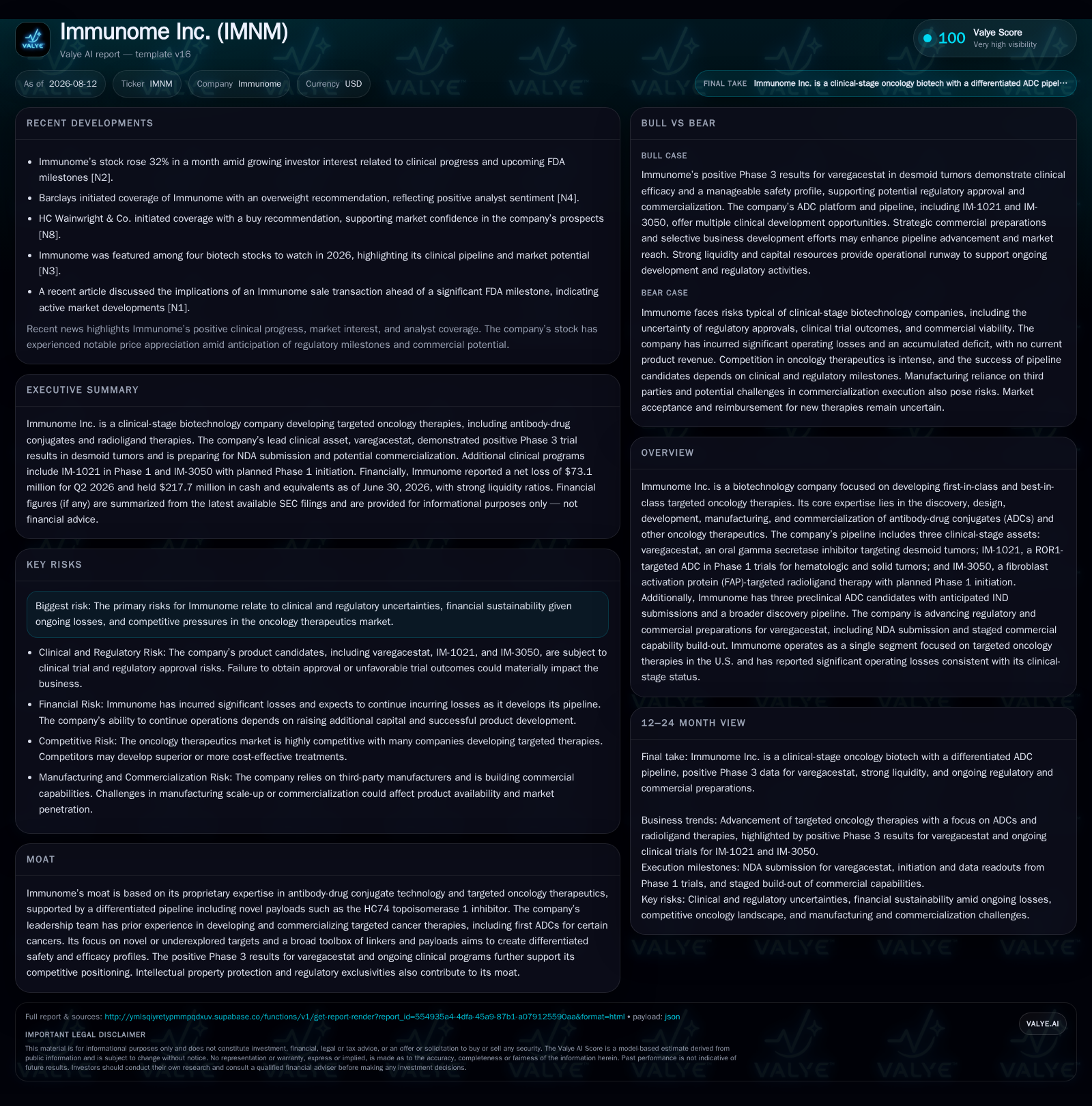
Immunome Inc. reported progress in its targeted oncology therapeutic development, highlighted by positive Phase 3 results for varegacestat in desmoid tumors and an upcoming NDA submission. The company’s diversified clinical-stage pipeline includes an ROR1-targeted ADC and a FAP-targeted radioligand therapy, alongside multiple preclinical ADC candidates. Adequate capital resources underpin ongoing clinical and commercial preparations, while risks remain around regulatory approval timing and competitive dynamics in antibody-drug conjugates.
Recent Operating Update: Phase 3 Success and Progress to NDA
Immunome's latest quarterly filing for Q2 2026 confirms the company’s critical advance with positive topline results from the global pivotal Phase 3 RINGSIDE trial of varegacestat — an oral gamma secretase inhibitor targeting progressing desmoid tumors [S2][S1]. This milestone underpins an anticipated New Drug Application (NDA) submission scheduled for Q2 2026. The significance lies not only in clinical validation but also because it pivots Immunome from pure research dependent on equity financing to a near-commercial stage biotechnology entity.
Additionally, Immunome continues advancing its pipeline with IM-1021 (a ROR1-targeted antibody-drug conjugate now in Phase 1) showing observed objective responses in B-cell lymphoma patients across multiple dose cohorts [S1]. IM-3050, their fibroblast activation protein (FAP)-targeted radioligand therapy, received investigational new drug (IND) clearance in April 2025 with Phase 1 initiation planned imminently pending delivery of diagnostic radiotracers [S1]. Coupled with three preclinical ADC candidates slated for IND submissions during 2026, these developments reflect a broad diversification strategy across complementary targeted oncology modalities.
Business Model: Proprietary ADC Development Paired with Regulatory Preparation
Immunome operates primarily as a clinical-stage targeted oncology biotech company concentrating on antibody-drug conjugates (ADCs) — monoclonal antibodies linked to cytotoxic payloads — designed to deliver potent anti-cancer agents selectively to tumor cells while minimizing systemic toxicity [S1]. Their revenue model is currently non-revenue generating but anticipates future cash inflows via product sales post-commercialization and milestone/licensing payments from collaborations such as that with AbbVie [S2].
The company’s approach emphasizes proprietary payload design (notably their HC74 novel topoisomerase I inhibitor) and linker technologies intended to improve the therapeutic window compared to competitors' ADCs. Clinical differentiation is sought both through selecting novel or underexplored targets (ROR1, FAP) and leveraging platform innovation to modulate pharmacokinetics and tolerability profiles [S1]. This positions Immunome to potentially capture niche indications or compete effectively against established ADC players by addressing unmet medical needs or reducing adverse events that limit current therapies.
Commercial preparations are staged ahead of the varegacestat NDA submission, including regulatory engagement and building an operational infrastructure comprising patient identification programs and market education efforts around desmoid tumors — a rare but challenging fibrous tumor indication [S1][N1][N2].
Industry Context: Competitive Space Centered on ADC Innovation
Within the biotechnology sector focused on oncology therapeutics, companies like Seagen and ImmunoGen serve as benchmark peers specializing in ADCs. Seagen notably commercializes well-established ADCs such as Adcetris (brentuximab vedotin), reflecting pathway challenges including manufacturing scale-up complexity, intellectual property protection around payload-linker technologies, regulatory scrutiny on safety profiles, and payer negotiation dynamics under U.S. healthcare reforms affecting pricing power.
Immunome's moat arises largely from its differentiated payload-linker toolbox supported by intellectual property protections covering compositions of matter, methods of treatment via novel antibodies targeting receptors such as ROR1 or fibroblast activation protein [S10][S22]. Ongoing regulatory exclusivities and orphan drug designations may further shield potential launches against competitive encroachment.
The firm’s collaboration with AbbVie creates additional value through upfront payments ($30 million) as well as milestone opportunities linked to discovery platform outputs targeting specific tumor types — enhancing Immunome’s financial runway indirectly while validating its technological platform relevance beyond internal asset advancement [S2]
Growth Drivers: Clinical Milestones Fuel Pipeline Expansion
Primary growth levers stem from successful advancement of late-stage candidates to approval status. The RINGSIDE trial success propels varegacestat into regulatory review imminently. Positive NDA outcomes would unlock first product revenues while validating the platform’s potential.
Parallel efforts on IM-1021’s ongoing Phase 1 trial provide early proof-of-concept data crucial for subsequent dose escalation, broader indication exploration, or partnership discussions based on clinical responsiveness in hematologic malignancies. Similarly, IM-3050’s Phase 1 start signals entry into radioligand therapeutics — a growing modality within oncology entailing unique delivery mechanisms that complement immunotherapies or chemotherapy agents.
Preclinical advances featuring three solid tumor ADCs aim to replenish mid-term pipeline staging through IND submissions planned over the coming year. Broad discovery initiatives leveraging novel linkers/payloads feed into sustainable pipeline renewal critical given high attrition rates typical in biotech R&D.
Risk Factors and Execution Considerations
Significant uncertainties persist regarding timing of regulatory approvals across all candidates due to FDA review variability or unexpected safety/efficacy findings during confirmatory studies. The competitive ADC market features rapid innovation cycles; thus early entrants or better-tolerated therapies could challenge Immunome’s market positioning post-launch.
Financial sustainability beyond current cash reserves requires monitoring. Despite robust liquidity totaling approximately $520 million combining cash/equivalents ($217.7 million) plus marketable securities ($302.3 million), the company's burn rate tied mainly to R&D expenses implies eventual needs for further equity offerings or deal-making [S2][F1]. Patient enrollment rates in pivotal studies will also influence timelines considerably.
Healthcare legislative changes impacting drug pricing—such as Medicare negotiation policies enacted recently—introduce reimbursement risks that can reduce pricing power even upon approval. Operationally, scaling commercialization capabilities amid relatively rare indications demands precise patient identification strategies and provider engagement.
What to Watch Next
Key near-term milestones include:
- NDA submission for varegacestat anticipated Q2 2026 following FDA guidance compliance.
- Initial clinical data releases from IM-1021 Phase 1 trials evaluating safety/tolerability signals across dosage levels.
- Launch initiation of IM-3050 Phase 1 trial pending diagnostic component supply chain fulfillment.
- IND filings for preclinical ADC candidates expanding therapeutic reach beyond current assets.
- Updates on partnership expansions or licensing agreements that could help distribute development risk or accelerate commercialization scale.
Successful navigation of these checkpoints will validate management's execution capacity amid industry-standard risks associated with clinical development progression.
Financial Profile Discussion
As of June 30, 2026, Immunome reported cash and cash equivalents of $217.7 million alongside $302.3 million in marketable securities — both predominantly short-term investments with maturities between five to eleven months — reflecting strong liquidity sufficient for at least twelve months of planned operating expenses without immediate need for external financing [S2][F1]. The company's accumulated deficit grew reflecting sustained R&D investment characteristic of clinical-stage biotechs aspiring toward product commercialization [$855.1 million accumulated deficit as of Q2 2026] [S4].
Current liabilities stood modestly at $35.7 million versus current assets exceeding $538 million resulting in a current ratio indicative of solid short-term financial health at approximately 15x coverage [F1]. Total debt remained de minimis at roughly $500 thousand last reported several years prior [F1], signifying minimal leverage significance.
Operational losses continue driven principally by clinical trial costs including manufacturing scale-up efforts ahead of expected commercial launch pending approvals. Collaboration revenues derive solely from upfront payments such as AbbVie's $30 million agreement signed in January 2023 rather than product sales presently [S2]. Capital raise history through equity markets sustains developmental funding but underscores dependency on financing markets moving forward absent product-derived revenue streams.
In conclusion, Immunome exhibits a resilient balance sheet buffering development risks while advancing toward transformative milestones potentially altering its revenue trajectory through targeted oncology drug commercialization.
Disclaimer: This is research-only, informational analysis and not investment advice. It may include AI-generated interpretation and general industry context. Always verify important details using primary sources.

Comments