
Energy Vault Accelerates Integrated Energy Storage Ownership Amid Capital and Execution Challenges
Energy Vault strengthens its build-own-operate model with diversified storage technologies and software-driven optimization, navigating capital intensity and regulatory complexity as it scales.
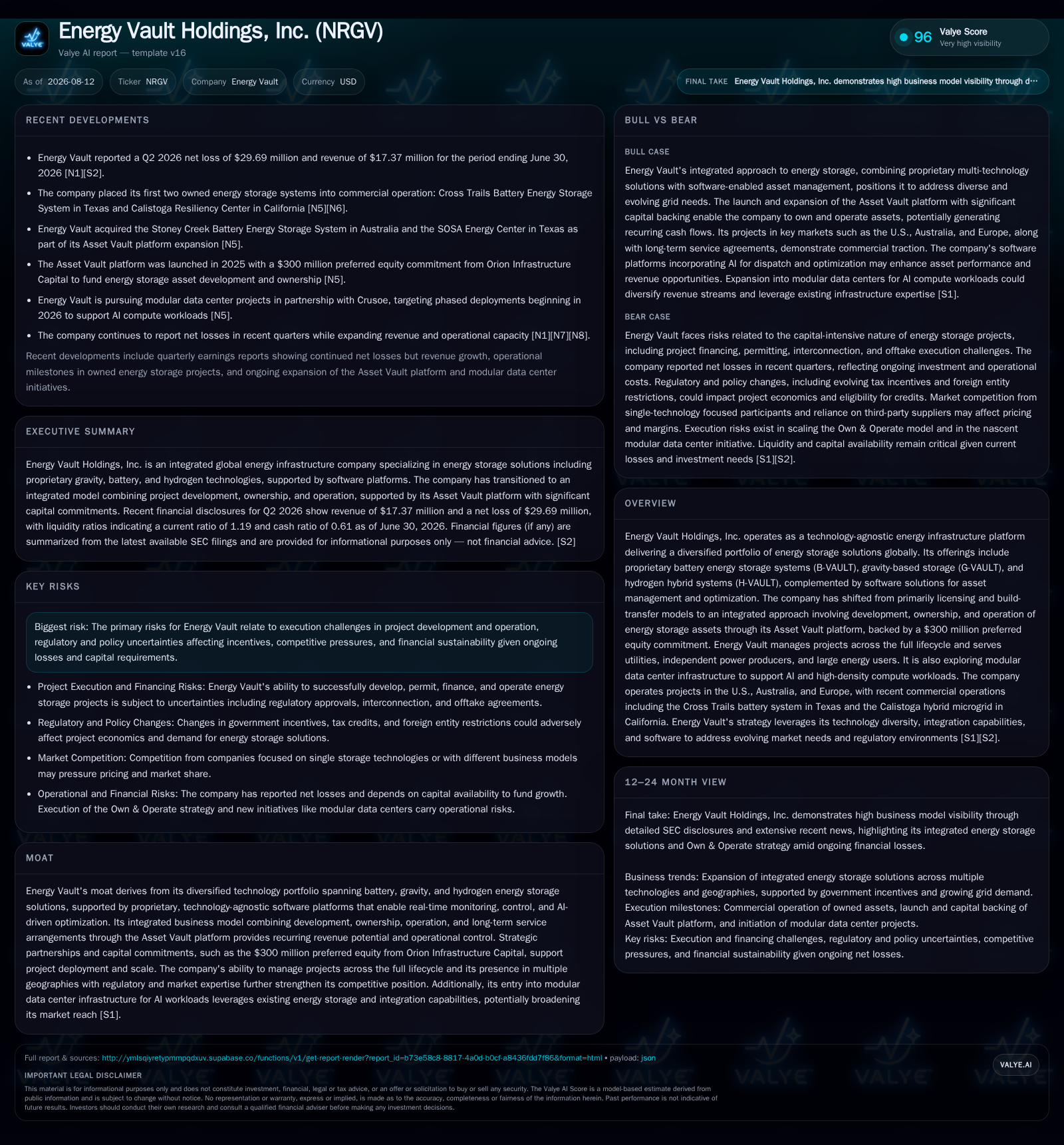
Energy Vault Holdings, Inc. has advanced its integrated energy storage platform by placing owned assets into commercial operation and leveraging a $300 million preferred equity commitment to support targeted deployments. The company’s strategy combines proprietary gravity, battery, and hydrogen storage technologies managed via a technology-agnostic software platform, allowing it to serve utilities, independent power producers, and large industrial customers globally. Despite growing revenue and project backlog, Energy Vault faces challenges including ongoing operating losses, debt service covenant pressures on owned projects, supply chain risks, competition from diversified storage providers and software platforms, and regulatory uncertainties. Monitoring project commissioning milestones, asset-level cash flows, and pipeline conversion rates will be critical for assessing execution momentum.
Recent Operating Update
Energy Vault's latest quarterly filing dated August 11, 2026 reveals continued advancement of its integrated build-own-operate strategy for energy storage assets [S2]. Revenue increased notably to $21.9 million for the three months ended June 30, 2026 from $8.5 million year over year, driven primarily by higher energy storage product sales tied to Australian EPC projects as well as tolling and PPA revenue from its first two owned energy storage systems placed in service during 2025 [S14]. This growth demonstrates tangible progress transitioning from a primarily transactional licensing or EPC model toward owning operational assets that generate recurring revenues.
At the core of this transformation is Energy Vault’s Asset Vault platform, launched in 2025 with a $300 million preferred equity backstop from Orion Infrastructure Capital [S1], underpinning targeted deployment of approximately 1.5 GW of storage capacity across U.S., Australia, and European markets [S1]. Key commercial operations milestones include the Cross Trails Battery Energy Storage System in Texas (57 MW /114 MWh) which began operations in Q2 2025 under a pioneering 10-year offtake agreement with an AI-enabled power marketer in ERCOT [S1], as well as the Calistoga Resiliency Center, a hybrid microgrid integrating hydrogen fuel cells with lithium-ion batteries [S1].
Business Model Overview
Energy Vault operates a technology-agnostic energy infrastructure platform delivering diversified energy storage solutions including proprietary battery energy storage systems (B-VAULT), gravity-based storage (G-VAULT), and hydrogen hybrid systems (H-VAULT) [S1]. Their product offerings combine physical storage technologies with advanced software—VaultOS Energy Management System—that provides real-time monitoring, control, AI-driven optimization, supporting enhanced asset availability and operational efficiency throughout project lifecycles.
The company historically relied on build-and-transfer contracts alongside IP licensing models but since 2024 initiated a strategic pivot towards selectively developing, owning, and operating energy storage facilities while continuing to provide technology integration and long-term services such as maintenance and performance support [S1]. This shift allows them to capture higher-margin recurring revenues via long-term service agreements and enable upside from asset cash flows versus one-time project sales.
Customers include utilities, independent power producers (IPPs), large industrial consumers requiring reliable dispatchable capacity for grid services or resilience applications. Monetization hinges on multiple revenue streams: upfront sale or EPC contract payments; ongoing tolling fees or power purchase agreement revenues linked to dispatch of stored energy; software licensing fees; alongside recurring maintenance/service contracts. This blend softens revenue seasonality common in EPC-heavy peers.
Industry Structure and Competitive Position
Energy Vault operates within the global energy storage infrastructure sector that spans several technology modalities — lithium-ion batteries dominate short-to-medium duration markets while emerging gravity-based systems offer potential long-duration benefits; hydrogen hybrids address multi-day or seasonal storage needs.
Competitive peers include Fluence Energy known for battery plus software integration; AES Corporation which combines IPP renewables with asset ownership; Stem Inc. specializing in energy storage coupled with AI-powered asset management; Tesla Energy integrating BESS with customer-side solutions; and Bloom Energy exploring hybrid fuel cell systems.
Energy Vault’s technological diversification enhances competitive resilience by allowing tailored solutions across duration profiles—short-duration batteries via B-VAULT suited for fast response applications; gravity-based G-VAULT targeting cost-effective longer-duration bulk storage; H-VAULT combining green hydrogen production/storage enabling seasonal load balancing capabilities [S1]. Moreover, their proprietary VaultOS platform extends differentiation via centralized control spanning heterogeneous energy resources boosting overall system performance.
Their fully integrated build-own-operate business model contrasts traditional technology licensors or pure EPC providers by capturing value across development financing, construction management through post-commissioning operations—a complex value chain requiring capital access (via Asset Vault subsidiary) plus strong regulatory navigation skills. Competing on this front demands deep cross-functional expertise as well as robust project pipelines given financing risk sensitivity inherent to infrastructure investments.
Growth Drivers
The escalating global push towards decarbonization accelerates renewable penetration necessitating flexible grid-scale energy storage that can provide dispatchable capacity over durations aligned with intermittent wind/solar generation. Regulatory frameworks incentivizing clean energy infrastructure foster demand growth via subsidies/tax credits influencing project economics.
Technological advances lowering component costs combined with expanding software intelligence improving asset utilization create pathways for enhanced margin profiles over time [S1]. The advent of new market segments such as data centers seeking resilient power delivery for AI workloads further supplements traditional utility-focused demand
Energy Vault’s differentiated portfolio positions it to benefit across these vectors: its long-term contracts exemplified by the 14-year AusEnergy Services agreement underpinning the Ebor Battery Energy Storage System project in New South Wales signify traction in international markets beyond North America [S1]. Additionally, pipeline expansion through developed projects awaiting contract signing points to sustainable opportunity funnel growth though conversion remains contingent on external factors like permitting timelines and market conditions.
Risks and Constraints
Execution risks dominate given the high technical complexity embedded in novel gravity and hybrid hydrogen storage solutions which are yet unproven at scale compared to incumbent lithium-ion battery systems [S15]. Project development delays caused by permitting hurdles or supply chain disruptions could defer revenue recognition adversely impacting liquidity.
Ongoing operating losses reflect early-stage commercialization expenses coupled with significant R&D investment required to refine system efficiencies underscoring profitability challenges ahead [S14]. Counterparty credit risk associated with customers under long-term offtake or tolling agreements bears watchfulness especially where contract enforcement may hinge on volatile energy market economics.
Financial constraints also loom large—Energy Vault carries over $264 million total debt against roughly $93 million cash on hand as of June 30, 2026 resulting in net leverage exceeding $170 million with a modest current ratio near 1.19 indicating tight working capital headroom [F1]
Competition is intensifying not only among battery ESS incumbents but increasingly involving integrated energy infrastructure providers offering bundled generation-storage-data center solutions seeking analogous customer sets which may pressure pricing concessions or delay customer adoption cycles [S19]. Regulatory shifts impacting eligibility for tax credits or import tariffs on critical components create additional uncertainty.
What To Watch Next
Key upcoming milestones include expected commissioning dates for marquee projects such as the Ebor Battery Energy Storage System slated for commencement in 2028 pending approvals—a development testbed for scaling the Asset Vault own-and-operate framework internationally [S1]. Progression along project development cycle times down to executed contracts will indicate firmness behind the multiple gigawatts pipeline currently reported internally.
Monitor changes in reported backlog levels alongside actual converted booked projects providing insight into sales funnel health versus contingent options subject to market fluctuations. Adoption rates of VaultOS asset management software will be an early barometer for recurring revenue durability.
Any further capital raises through equity issuance or refinancing deals will influence financial flexibility important given current net leverage metrics documented at mid-year 2026 [F1]. Relatedly observing gross margin trends as mix shifts toward owned assets generating tolling/operating income versus one-time EPC sales will clarify margin improvement trajectory over time.
Financial Profile Discussion
As of June 30, 2026 balance sheet snapshots show Energy Vault holding approximately $93 million in cash and equivalents against total debt approximating $264 million resulting in net debt around $171 million with a current ratio at 1.19 reflecting restrained liquidity cushions at the corporate level [F1]. Operating income remains negative consistent with prior quarters evidencing ongoing investment demands outpacing revenues during early growth phases.[F1]
Despite accelerating revenues ($203 million full year ended December 31, 2025) fueled by increased product sales and emerging owned-asset operational income streams,[F1] continued reported operating losses near $74 million annually point to structural profitability work needed potentially through scale economies unlocked via wider asset deployment combined with stabilized recurring revenues including service contracts.[F1]
Financial risk features prominently due to project-level secured debt arrangements incorporating coverage covenants that have not yet been met at Cross Trails prompting negotiations with lenders to avoid default events.[S16] The company's ability to secure additional non-dilutive capital or restructure existing obligations will be pivotal alongside keeping working capital balanced amid extended development durations.[F1]
Overall Energy Vault's financial profile underscores typical early-stage capital intensity characteristic within the energy infrastructure space where front-loaded deployment costs gradually give way to more stable cash inflows upon full system commissioning paired with mature service agreement portfolios.
This analysis synthesizes public filings through August 11, 2026 without investment advice or speculative forward projections beyond documented evidence. It contextualizes Energy Vault Holdings’ current operational status within broader industry dynamics emphasizing key competitive differentiators alongside material risks inherent in scaling next-generation energy storage infrastructure platforms.
Disclaimer: This is research-only, informational analysis and not investment advice. It may include AI-generated interpretation and general industry context. Always verify important details using primary sources.

Comments