
Brookfield Oaktree Holdings Anchored by Fund Commitments Amid Preferred Unit Distribution Dependencies
Brookfield Oaktree acts as a holding vehicle primarily invested in Oaktree Capital-managed funds, with preferred unit distributions relying heavily on related entity cash flows.
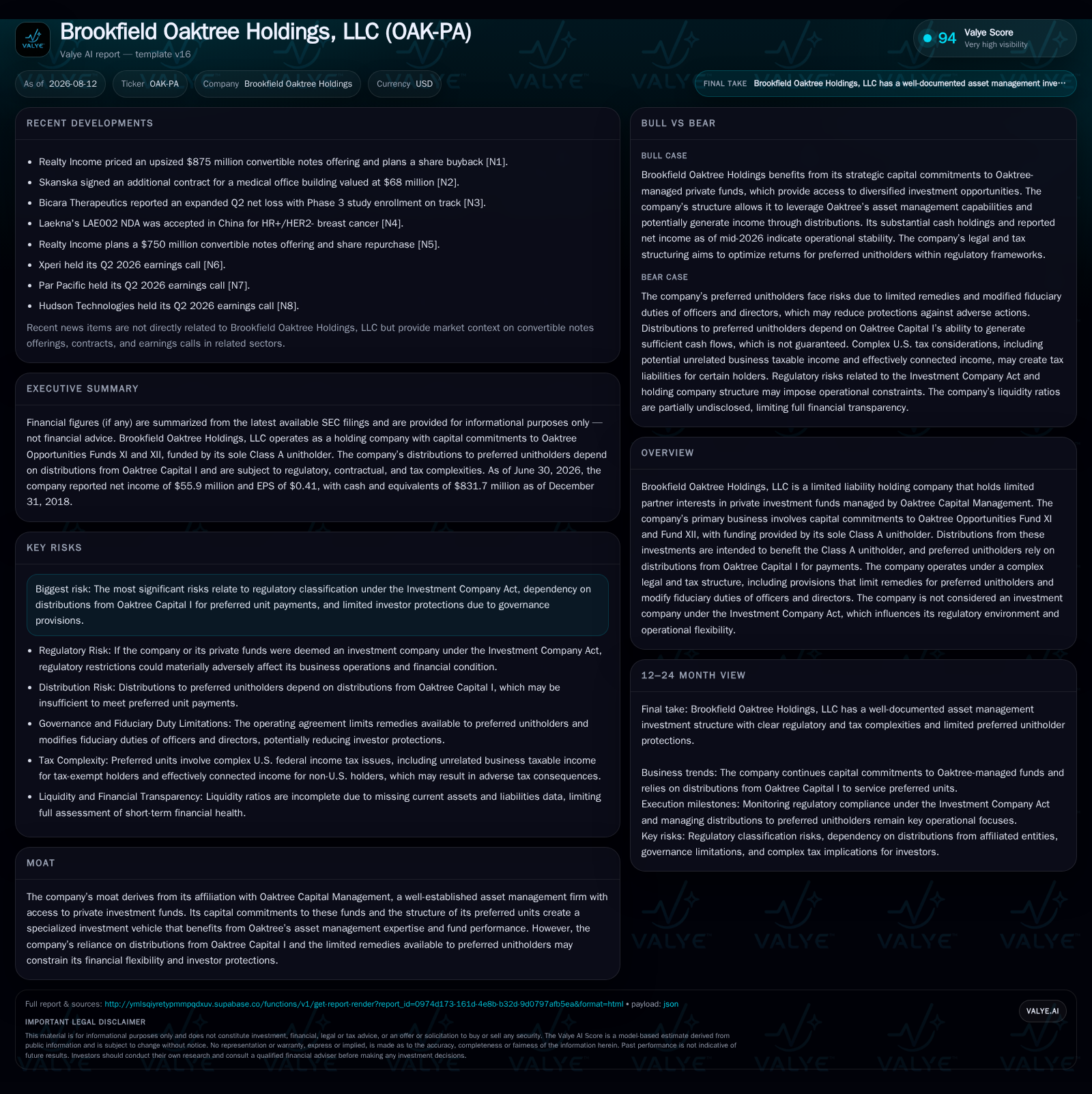
Brookfield Oaktree Holdings, LLC operates as a limited liability holding company possessing limited partner interests in private investment funds managed by Oaktree Capital Management. Its core business hinges on capital commitments to Oaktree Opportunities Funds XI and XII, funded through its sole Class A unitholder. The company's preferred units depend materially on distributions from a related entity, Oaktree Capital I, for servicing preferred unit payments. While its structure benefits from Oaktree’s asset management platform and fund performance, limitations inherent in legal provisions and regulatory classifications present constraints on financial flexibility and investor protections. Key operational updates confirm no material changes to risk factors, but significant board resignations occurred during mid-2026, suggesting governance transitions.
Recent Operating Update
Brookfield Oaktree Holdings’ most recent quarterly report for Q2 2026 confirms stability in the risk landscape relative to its last annual disclosure, with management affirming no material changes in risk factors [S2]. However, a significant corporate governance event occurred shortly before quarter-end: effective July 31, 2026, ten members of its board of directors resigned simultaneously [S3]. This exodus included key founding figures tied closely to Oaktree Capital Management’s legacy. The departures were not precipitated by any disagreements over company operations or strategy but signal a substantial governance transition phase. How this reshuffling will influence oversight or strategic decision-making remains to be observed.
Operationally, Brookfield Oaktree’s business fundamentals remain centered on its capital commitments to two primary private investment vehicles managed by Oaktree Capital: Opportunities Funds XI and XII. These vehicles represent parallel investment funds targeting opportunistic asset classes within private equity and credit domains [S1]. As of December 31, 2025, the company had funded approximately $637.5 million of a $750 million commitment to Fund XI and roughly $218.9 million of nearly $800 million committed capital to Fund XII [S1]. Importantly, these contributions are sourced exclusively from the company’s sole Class A unitholder or affiliates thereof through direct capital contributions earmarked solely for fund investments.
Business Model Specifics
Brookfield Oaktree Holdings functions fundamentally as an investment holding entity rather than an active asset manager. It holds limited partner interests derived from capital commitments to its managed private funds but does not engage in client-facing asset management or fee generation activities. Its revenue stream largely consists of investment income—principally distributions from fund operations—and it issues preferred units whose payment obligations are expectedly serviced via these cash flows.
A critical nuance in the monetization conduit is that preferred unitholders should not expect distribution payments directly sourced from proceeds arising out of the company’s limited partner interests in Opps XI or XII funds. Instead, payments are principally serviced by distributions received from a separate but related entity—Oaktree Capital I—which itself manages other fund assets generating sufficient cash flow to meet these obligations [S1]
This separation underscores a structural complexity where risks associated with underlying fund performance do not translate straightforwardly into preferred unit distribution coverage. Investors should monitor how distributions from Oaktree Capital I maintain sufficiency over time.
The company also employs leverage techniques—most notably pledging approximately $379 million of its Opps XI investment interest as collateral for two non-recourse credit facilities arranged through an affiliate party [S1]. The recourse-limited structure confines potential creditor claims strictly to the collateralized fund interest assets rather than broader corporate assets or cash flows. While this arrangement preserves balance sheet integrity elsewhere, it introduces collateral-dependent leverage risk linked directly to underlying fund asset valuation volatility.
Industry Structure and Competitive Positioning
Within alternative asset management and investment holding industry frameworks, Brookfield Oaktree occupies a niche position similar to other holding companies that invest indirectly through partnerships managed by well-established asset managers (e.g., Blackstone's holding entities or Apollo's investment vehicles). Such firms often benefit from alignment with large-scale asset managers controlling both operational execution and fundraising activities.
Unlike publicly traded pure asset managers earning distinct management fees or carried interest streams recognized in their income statements, Brookfield Oaktree derives returns solely on net investment income generated downstream by fund performance and capital appreciation.
Importantly, Brookfield Oaktree has structured itself explicitly to avoid classification as an "investment company" under the Investment Company Act—a pivotal regulatory consideration given stringent compliance regimes governing mutual funds or registered investment companies. This status affords significant operational latitude but also comes with intricate structural legal covenants that limit investor protections.
These legal structures include provisions that limit remedies available to preferred unitholders (e.g., restricting claims against officers/directors) and modify fiduciary duties typically applicable in more standard corporate environments [S1]. Such constructs reflect attempts within alternative asset vehicles to balance rewarding capital providers while preserving managerial agility—a tradeoff common across peer vehicles issuing preferred equity within complex private fund ecosystems.
Growth Drivers
The company’s growth prospects link closely to broader industry trends favoring increased institutional allocations toward private markets’ opportunistic strategies. Heightened demand for diversification away from public markets coupled with potential dislocations creates an environment conducive for new capital commitments into future iterations of Opportunity Funds or parallel structures aligned with Oaktree’s investment philosophy.
Brookfield Oaktree’s ability to leverage its existing relationship with a reputable established manager like Oaktree Capital Management positions it well for continued participation in subsequent fundraising cycles. Further capital calls ultimately fueling funded commitments may drive incremental investment income growth if underlying portfolio performance remains robust.
Investors should closely follow reported distributions coverage metrics (when available), changes in pledged collateral valuations, governance developments post-board resignations, and any regulatory filings signaling modifications in classification status.
What To Watch Next
Key near-term indicators encompass:
- Updates on capital call pacing versus commitments for Opps XI and XII funds, indicating timing of additional funded investments
- Distributions reported from Oaktree Capital I serving preferred unit payments providing clarity on sustainable yield coverage
- Material governance disclosures following recent board transitions signaling strategic shifts
- Regulatory statements or actions related to Investment Company Act status affecting structuring norms
- Changes in leverage terms associated with pledged collateral including renewal or refinancing conditions
Monitoring these variables will provide insight into operational continuity soundness and financial flexibility trajectory.
Financial Profile Discussion
An essential ratio for future monitoring includes preferred unit dividend coverage—dependent heavily on external distribution inflows—and capital call versus commitment levels reflecting funding discipline exhibited by managing parties.
This analysis synthesizes Brookfield Oaktree Holdings’ latest SEC disclosures alongside general industry knowledge pertinent to alternative asset management investment holdings. It refrains from speculative performance claims outside documented facts while emphasizing structural context vital for understanding operating mechanics and associated investor implications.
Disclaimer: This is research-only, informational analysis and not investment advice. It may include AI-generated interpretation and general industry context. Always verify important details using primary sources.

Comments