
Neutron Holdings Strengthens Liquidity and Scales Fleet Amid Stable Micromobility Demand
Neutron Holdings reports robust second-quarter results supported by fleet expansion and subscription adoption, balancing operational costs with capital investments.
In its latest quarterly filing, Neutron Holdings, Inc. (Nasdaq: LIME) showcased 24% revenue growth driven by a 22% increase in average operational fleet size and rising monthly active users as of Q2 2026. The company enhanced its recurring revenue through the rollout of LimePrime subscription offerings, complementing traditional pay-as-you-go fees. Its strong liquidity position following an IPO-funded debt repayment underpins ongoing investments amid elevated capital expenditures resulting in negative free cash flow. Permitting risks remain inherent given regulatory dependencies typical in shared micromobility.
Recent Operating Update
Significantly, management highlighted the introduction of LimePrime — a subscription service launched in early 2026 that offers unlimited flat-rate rides capped at twenty minutes per trip. This product complements existing minute-bundle packages (LimePass), collectively propelling recurring revenue streams that mitigate reliance on variable ride volume alone [S2]. Revenue recognition aligns with usage patterns: per-minute bundles are realized upon consumption while LimePrime subscriptions are recognized ratably over the contractual period. This evolving revenue mix is essential to fostering predictable billing cycles in what remains a usage-dependent business.
Cost of revenue advanced by more than one-quarter (+27%) relative to the prior year half due to increasing vehicle operating costs linked to fleet growth as well as enhanced spending on maintenance personnel and battery swapping logistics designed to improve fleet reliability [S2]. The company also invests materially in warehouse infrastructure supporting vehicle deployment and retrieval efforts. Vehicle depreciation remained a notable cost center reflective of high asset turnover and the wear typical of micromobility fleets operating daily in harsh urban environments.
Business Model Overview
Neutron Holdings monetizes urban shared micromobility primarily through the rental of electric scooters and bikes via two complementary payment models: pay-as-you-go unlock plus usage fees charged per minute, and subscription plans providing discounted or unlimited access [S2]. Customers interact through mobile applications facilitating vehicle unlocking and real-time ride tracking. The operator centrally manages fleet procurement, deployment logistics, maintenance including battery swapping, and customer support.
Subscription offerings like LimePrime enhance revenue predictability while incentivizing higher ride frequency and customer retention; this model mirrors industry trends at peers such as Bird Global or Spin aiming for deeper customer wallet share beyond marginal ride surcharges. Incremental returns hinge critically on achieving robust fleet utilization—maximizing rides per day per vehicle—and controlling maintenance costs which can erode margins drastically if downtime or depreciation acceleration rises.
The company’s capital-intensive nature is evident from elevated ongoing capital expenditures totaling approximately $133 million over the first half of 2026 as it scales its asset base to meet growing urban mobility demand [S2]. Despite significant capex spend driving negative free cash flow reported at -$83 million for six months ending June 30, this investment underpins potential network effects from denser service coverage that can sustain premium pricing power or boost overall ride volume.
Industry Structure and Competitive Position
Neutron Holdings operates within the shared micromobility industry characterized by a fragmented set of operators focused on deploying fleets across congested metropolitan areas. The business requires close cooperation with municipal regulators to maintain permits authorizing fleet placement and rider access—permits which carry renewal uncertainty posing continuous regulatory risk [S2]. Operators also compete for finite urban curb space and infrastructure accommodations.
Peers include Bird Global (publicly traded) holding comparable rideshare-focused micro-vehicle fleets; Spin (subsidiary of Ford) with hybrid corporate backing; and Tier Mobility active in European markets. These players similarly balance expanding operational fleets with subscription product adoption while managing erosion from depreciation, vandalism risk, permit compliance costs, and weather-driven seasonality impacting ride volumes.
Lime’s deliberate roll-out of tiered subscription services follows sector patterns targeting recurring revenue growth—a key differentiator from pure pay-per-use models vulnerable to demand fluctuations. Nonetheless, without explicit disclosures on precise market share or geographic spread from public filings, comparative positioning remains informed but tentative.
Growth Drivers
Key drivers supporting Neutron’s prospective growth lie primarily in urbanization trends boosting demand for last-mile transport solutions supplementing public transit networks. The company’s expansion of its operational fleet (+22%) evidences capacity scaling crucial to capture larger ride volumes and extend market coverage [S2]
Increasing subscription penetration via LimePrime also signals growing acceptance among customers valuing convenience and cost efficiency over episodic charges. Technological improvements enhancing battery life or reducing maintenance downtime can materially elevate fleet utilization rates—a fundamental margin lever.
Partnerships with municipalities not only facilitate permit renewals but potentially integrate Neutron’s mobility services with broader transit platforms, enhancing user value proposition through multimodal connectivity. Continued innovation around software platform capabilities optimizes dispatch algorithms improving vehicle availability correlating directly with user satisfaction metrics like average ride duration and service reliability.
Risks and Growth Constraints
The company faces intrinsic regulatory risks tightly coupled with its requirement for operating permits across jurisdictions—failure or delays in renewals could force reductions or suspensions impairing revenue continuity [S2]. High capital intensity imposes pressure on free cash flow as substantial upfront investment is needed for vehicle procurement followed by rapid depreciation necessitating continuous reinvestment.
Operational challenges include mitigating theft, vandalism, or unexpected vehicle downtime which respectively reduce effective fleet size impacting yield per ride metrics. Seasonal weather variability introduces ridership volatility complicating short-term forecasting.
Competitive risk arises from both overlapping micromobility operators vying for limited usership within the same urban footprints as well as alternative transport modes like ride-hailing or public transit expansions potentially dampening demand elasticity.
Cybersecurity concerns regarding payment processing platforms also pose reputational risk that may disrupt service continuity or undermine customer trust if not rigorously managed [S2].
What To Watch Next
Critical milestones encompass sustained subscriber base expansion trends evaluating LimePrime uptake metrics alongside detailed monthly active users growth confirming deepening customer engagement. Monitoring gross profit margin progression will reveal how effectively cost control offsets scaling expenses particularly around maintenance costs per ride amidst expanding fleets.
Renewal status updates regarding municipal permits represent external gating factors heavily influencing scalability timelines. Capital expenditure pacing aligned with vehicle additions evidences investment rigor supporting strategic growth.
Upcoming quarterly disclosures should clarify whether net income normalizes away from anomalous spikes elucidated herein while reconciling adjusted EBITDA progress against revenue gains offering purer operational profitability insights.
Financial Profile Discussion
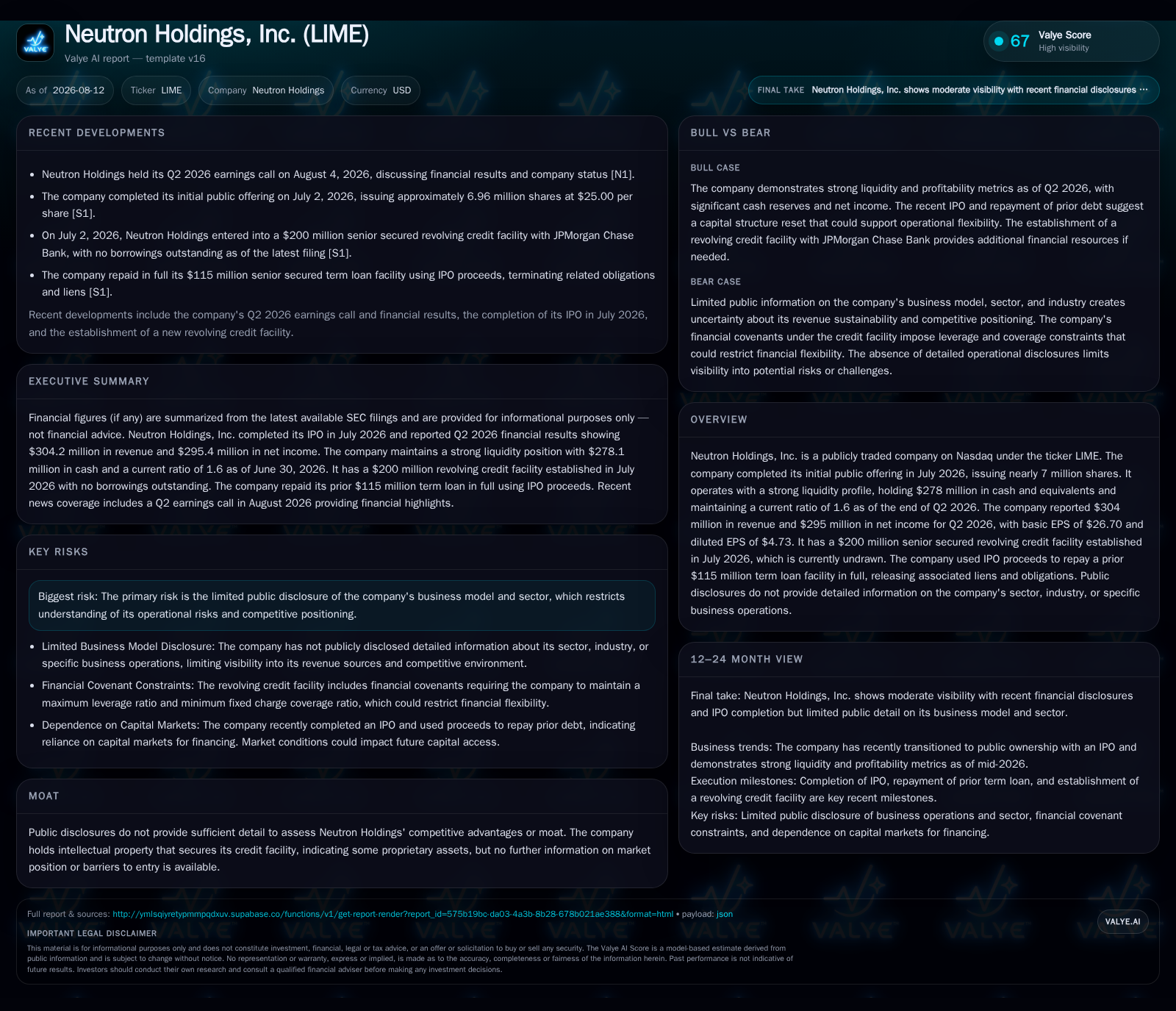
Neutron Holdings maintains a strong liquidity position with approximately $278 million in cash and equivalents against total debt of about $115 million as of June 30, 2026, resulting in a net cash positive position near $163 million [F1]. This balance sheet strength supports ongoing capital expenditures necessary for fleet replenishment and working capital needs during cyclical ridership fluctuations [F1], [S2].
Free cash flow remained negative at $(83) million over the six months ended June 30, 2026, reflecting substantial reinvestment consistent with industry dynamics where depreciation and maintenance heavily influence cash conversion ratios [S2]. Tracking this metric over coming quarters will be critical to assessing improvements in operational efficiency and financial sustainability.
This analysis reflects information available as of August 2026 extracted primarily from official SEC filings including the latest Form 10-Q dated August 11 and related event reports on file. It incorporates sector-specific knowledge about shared micromobility services contextualized against common industry risks and growth drivers but does not constitute investment advice. Market conditions may evolve affecting future company performance beyond discussed factors.
Disclaimer: This is research-only, informational analysis and not investment advice. It may include AI-generated interpretation and general industry context. Always verify important details using primary sources.

Comments