
Tron Inc. Advances Hybrid Blockchain Treasury and Licensed Merchandise Strategy under Token Volatility Constraints
Tron Inc. blends large-scale TRX token holdings with licensed theme park merchandise, navigating a volatile digital asset landscape alongside consumer product dynamics.
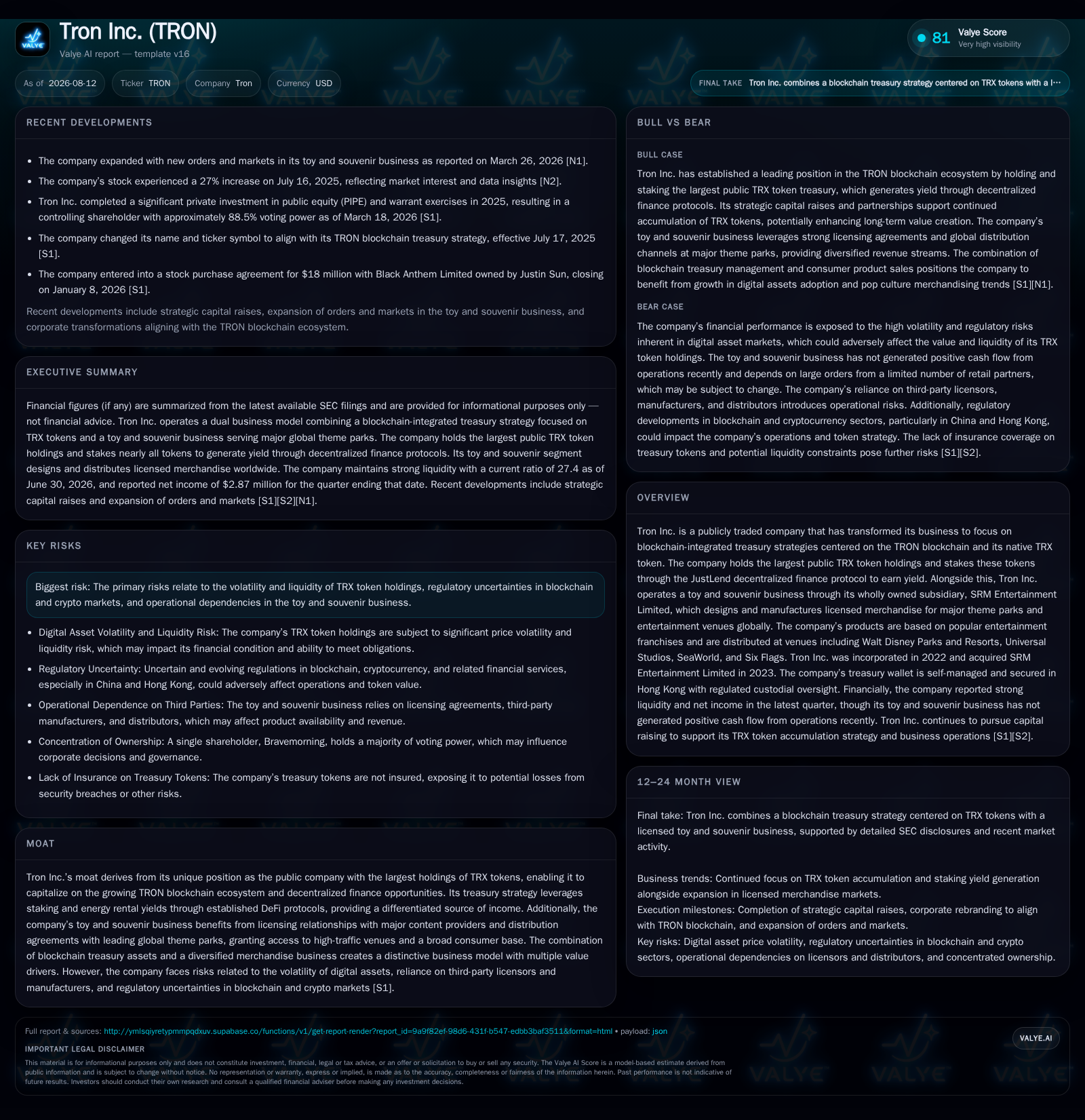
Tron Inc. has recently solidified its position as the largest public holder of TRON (TRX) tokens, leveraging decentralized finance protocols such as JustLend to generate staking yield and energy rental income, forming the core of its blockchain treasury strategy. In parallel, its wholly owned subsidiary SRM Entertainment Limited operates a toy and souvenir business supplying licensed merchandise to major global theme parks, including Disney and Universal. The company’s hybrid model offers diversified revenue streams but faces significant risks from token price volatility, regulatory uncertainties surrounding cryptocurrencies, and operational challenges in merchandise distribution. Recent quarterly disclosures confirm steady accumulation of TRX tokens via dollar cost averaging while highlighting the impact of protocol changes dampening energy rental yields. Monitoring token staking yields, licensing arrangements, and merchandise sell-through are critical to assessing Tron Inc.’s growth trajectory.
Recent Operating Update
Tron Inc.'s latest quarterly filing dated August 11, 2026 highlights continued execution on its dual business model centered around blockchain treasury management and licensed entertainment merchandise operations [S2]. The company now holds over 677 million TRX tokens in its treasury wallet following structured acquisitions completed early in 2026 using a dollar cost averaging mechanism designed to moderate exposure to price swings [S5]. These tokens are staked principally through the JustLend DeFi protocol producing yield primarily via standard staking rewards augmented by income from energy renting on the TRON blockchain network [S13]. The recent community-approved reduction in transaction energy fees effective August 29, 2025 notably decreased the cost of energy rental from 0.00021 TRX per unit to 0.0001 TRX per unit, impacting demand for energy rental services and compressing yield on this component [S13].
Meanwhile, Tron continues operating its wholly owned subsidiary SRM Entertainment Limited acquired in mid-2023 that designs and manufactures licensed toys and souvenirs sold globally at leading theme parks such as Walt Disney Parks & Resorts and Universal Studios [S1][S4]. This segment benefits from strategic licensing agreements anchored by multi-billion-dollar entertainment IP franchises familiar across consumer demographics. Notwithstanding this strength, seasonal fluctuations in theme park attendance and supply chain constraints create variability in quarterly results typical of consumer products aligned with pop culture trends.
Business Model Analysis
Tron's business uniquely combines two revenue streams: income generation through blockchain asset holdings focused on native TRX tokens and wholesale sales/licensing fees from branded merchandise delivered through high-traffic theme park distribution channels. The blockchain treasury strategy involves acquiring substantial TRX token holdings expected to appreciate over time while generating recurring income via staking rewards and energy rental yield realized through derivative sTRX tokens representing staked positions [S1][S13]. Monetization here depends heavily on token volumes held, staking yield rates offered by DeFi platforms like JustLend, protocol economics (e.g., transaction fees), and market acceptance of tokenized financial instruments.
Simultaneously, Tron leverages longstanding content licensing partnerships enabling design-to-market agility for toys and souvenirs tied to popular franchises such as Harry Potter or Star Wars. Distribution is predominantly wholesale B2B into venue operators running theme parks worldwide including Six Flags and SeaWorld. Revenue mechanics rely on shipment volumes through retail channel partners with product sell-through rates affected by royalities or licensing terms negotiated with IP owners [S1][F1]. Gross margins can be influenced notably by manufacturing costs (impacted by vendor relationships), shipping expenses sensitive to air freight market conditions, inventory turns driven by seasonal demand shifts, and markdown pressures due to pop culture trends evolution
Financially, Tron’s approach enables diversification between volatile digital asset returns—subject to market-driven price changes—and relatively stable albeit seasonal consumer merchandise sales anchored by contractual licensing rights.
Industry Structure and Competitive Position
The intersection of blockchain asset management with licensed entertainment merchandising places Tron within a niche hybrid sector characterized by distinct competitive sets each facing unique operational factors.
Within blockchain treasury management firms focusing on native token holdings and DeFi staking income streams, Tron differentiates itself as the largest public holder specifically aligned with the TRON ecosystem—endorsed partly through corporate branding changes including ticker symbol alteration to "TRON"—which may enhance investor confidence around ecosystem engagement [S4]. This focus contrasts with broader crypto asset holders or DeFi yield aggregators who typically maintain more diversified token portfolios without exclusive protocol concentration.
In licensed toy manufacturing for major theme parks—a mature yet evolving segment—peer groups consist of companies supplying globally recognized franchises with scale advantages rooted in deep content licensing expertise, manufacturing partnerships optimized for inventory turns, seasonal demand forecasting capabilities, and favorable distribution agreements with venue operators [S1]. Tron's subsidiary benefits from strategically diversified IP coverage reducing reliance on single-content releases while maintaining agile new product development cycles responding quickly to emerging pop culture trends.
Investment Company Act frameworks [S10][S16][S23].
- Lowering of transaction fees reducing energy rental income exemplifies how blockchain protocol governance decisions directly affect Tron’s yield income sustainability [S13].
- Dependency on third-party licensors introduces exposure to contract renewal risks or changes in royalty terms adversely affecting merchandise revenue stability.
- Supply chain disruptions—including vendor operational failures or transportation delays—pose risks to timely product delivery especially when fulfilling seasonally concentrated demand windows [S1].
- Inventory management complexities foster risk of excess stock accumulation leading to markdowns that pressure gross margins.
- Exposure to foreign currency exchange movements given international distribution footprint adds earnings variability.
- Counterparty risks within staking protocols represent potential loss fronts if underlying smart contracts or platform operators face insolvency or cyberattacks.
- Geopolitical uncertainties affecting subsidiary operations based in Hong Kong amid evolving PRC regulations might introduce compliance costs or operational interruptions [S15][S26].
What To Watch Next
Key milestone indicators that will provide clarity on Tron’s execution include:
- Reporting updates on total TRX token holdings growth trajectories alongside realized staking yield percentages which should reveal effectiveness of treasury risk management amid volatile crypto pricing.
- Quarterly segment disclosure sufficient to parse operating income contributions from blockchain yield activities versus licensed merchandise sales allowing analysis of margin durability across businesses.
- New announcements concerning additional licensing agreements or entry into emerging franchise categories signaling expansion within the consumer products domain.
- Progress metrics on product development cycle times supporting agility claims crucial for capitalizing on pop culture trend shifts.
- Developments around DeFi protocol enhancements potentially expanding staple sources of staking yield beyond JustLend.
- Monitoring regulatory actions particularly SEC commentary regarding digital asset classification together with PRC government statements impacting Hong Kong subsidiary operations.
Financial Profile Discussion
[S27].
Going forward careful monitoring is warranted regarding how fluctuations in TRX market prices influence reported fair value adjustments along with assessment of expense control related to scaled merchandising operations which traditionally require significant upfront working capital allocation for production cycles.
Disclaimer: This analysis is based solely on publicly available information as sourced from SEC filings dated up to August 2026. It does not constitute investment advice or research views regarding Tron Inc.'s securities.
Disclaimer: This is research-only, informational analysis and not investment advice. It may include AI-generated interpretation and general industry context. Always verify important details using primary sources.

Comments