
BridgeBio Oncology Advances Precision Oncology Pipeline Focused on KRAS and PI3Kα Targets
Clinical-stage biotech BridgeBio Oncology Therapeutics reports ongoing phase 1 trials targeting RAS-driven cancers with differentiated small molecules amid solid financial runway.
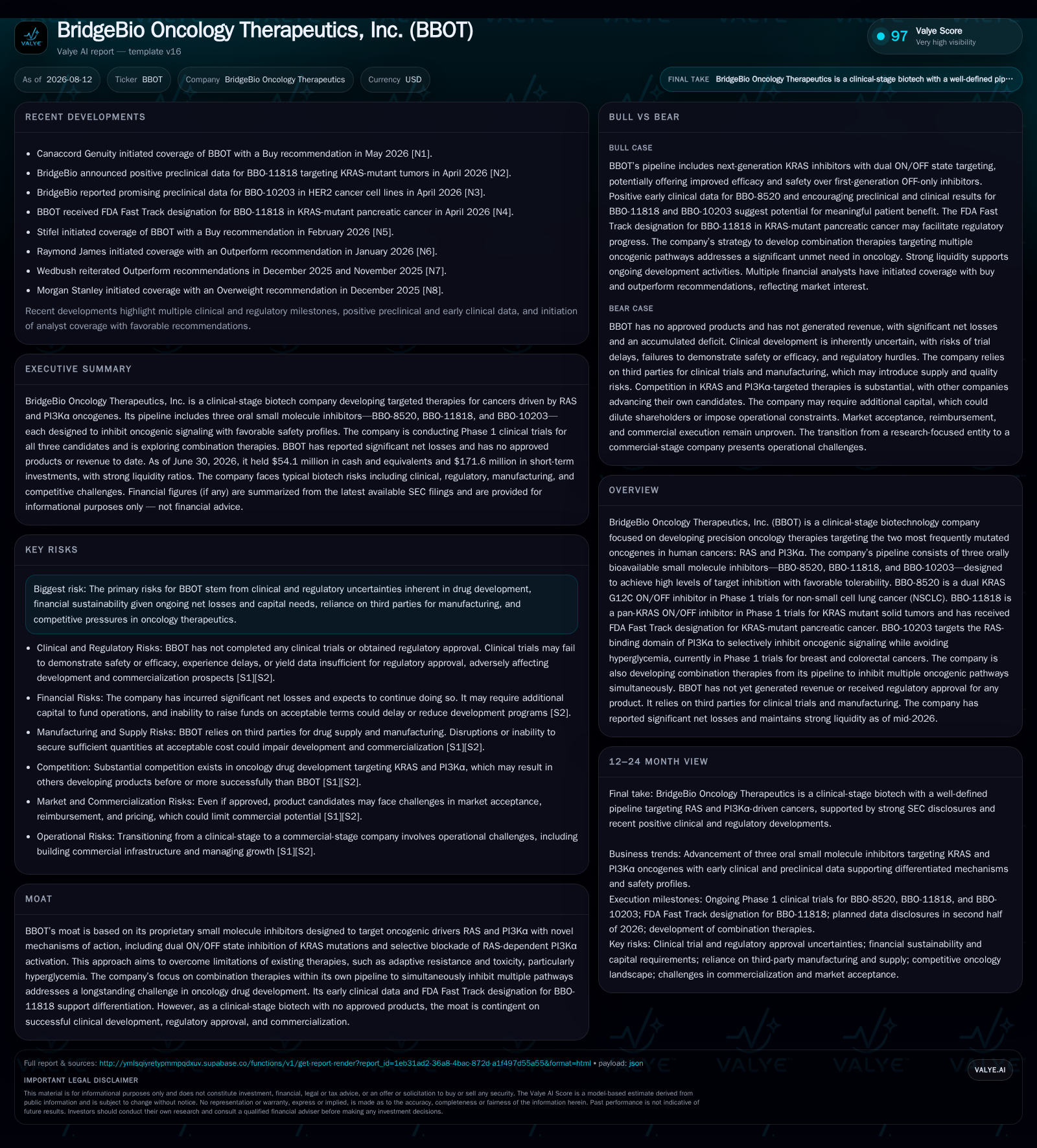
BridgeBio Oncology Therapeutics, Inc. (BBOT) is progressing its pipeline of oral small molecule inhibitors aimed at KRAS and PI3Kα oncogenes with three candidates in phase 1 trials as of mid-2026. The company’s latest quarterly filing highlights continued investment into clinical development targeting non-small cell lung cancer, pancreatic, breast, and colorectal cancers, with a key FDA Fast Track designation for BBO-11818 enhancing regulatory leverage. With no approved products yet, BBOT remains dependent on advancing clinical milestones to unlock value and mitigate inherent biotech risks, while maintaining a cash balance sufficient to fund operations into early 2028 without material debt burden. Key challenges include trial enrollment pace, manufacturing scale-up readiness, and competitive pressures in precision oncology therapeutics.
Recent Operating Update
BridgeBio Oncology Therapeutics' latest quarterly filing dated August 11, 2026 outlines continued clinical advancement of its three lead investigational compounds: BBO-8520 targeting dual KRAS G12C states for non-small cell lung cancer; BBO-11818 as a pan-KRAS inhibitor focusing on KRAS-mutant solid tumors including pancreatic cancer; and BBO-10203 designed to selectively inhibit RAS-dependent PI3Kα signaling implicated in breast and colorectal cancers [S2], [S3]. All compounds remain in phase 1 trials evaluating safety, tolerability, pharmacokinetics/pharmacodynamics, and early efficacy signals. The FDA has granted Fast Track designation to BBO-11818 for pancreatic cancer indication which might facilitate accelerated review if clinical data substantiate benefit [S1]. This regulatory milestone reflects the compound’s differentiated dual ON/OFF state inhibition mechanism aimed at overcoming adaptive resistance encountered by existing KRAS-targeted therapies.
Crucially, BridgeBio reports a solid liquidity position with roughly $54.1 million in cash equivalents as of June 30, 2026 coupled with negligible outstanding debt near $0.7 million reported earlier in the year, yielding a strong current ratio of about 4.7 which indicates ample short-term financial flexibility to support continued R&D spend through early 2028 absent unexpected capital needs or delays [F1], [S16]. However, the company remains pre-revenue reflecting the typical stage profile for biotechs transitioning from research intensive phases toward demonstrating proof-of-concept data needed for later-stage investment or partnership.
Business Model
BridgeBio Oncology operates within the high-risk/high-reward clinical stage oncology biopharmaceutical segment focused exclusively on developing orally bioavailable precision oncology therapies that target two of the most frequently mutated oncogenes implicated in human cancers: RAS (KRAS isoforms) and PI3Kα pathways. The business model entails discovery and design of small molecule inhibitors leveraging proprietary chemistries aiming to achieve potent target inhibition with minimized off-target toxicities such as hyperglycemia noted historically with nonselective PI3K inhibitors.
Revenue generation is deferred until successful regulatory approval and commercialization or licensing deals occur. Until then, funding derives primarily from equity financing rounds supplemented potentially by strategic alliances though no material partnerships were disclosed as of the latest filings [S1], [S2]. The monetization mechanics ultimately will depend on securing marketing approvals across multiple indications—which could span lung, pancreatic, breast, colorectal cancers—and then commercializing either independently or via pharma collaborations. As an internally integrated developer relying on outsourced manufacturing by specialized CMOs with novel processes for these compounds’ unique chemistries, successful scale-up represents another critical operational assumption underlying future revenue scaling.
Industry Structure and Competitive Position
BridgeBio Oncology sits within a concentrated niche of clinical-stage companies targeting KRAS mutations—a historically challenging oncogene—using targeted small molecule approaches that are gaining validation from recent approvals such as Amgen's Lumakras for KRAS G12C-mutant NSCLC but remain far from saturation. Peers include Mirati Therapeutics and Revolution Medicines which similarly develop KRAS inhibitors but often differ in binding modalities; BBOT emphasizes its pan-KRAS ON/OFF state dual inhibition strategy plus selective PI3Kα blockade as distinctive therapeutic levers addressing adaptive resistance mechanisms limiting monotherapy durability.
The FDA Fast Track status awarded to BBO-11818 enhances its competitive runway by providing potential rolling NDA reviews and priority interactions with regulators accelerating timelines relative to competitors lacking such designations. However, robust demonstration of favorable safety/tolerability profiles relative to peer candidates remains essential given R&D attrition typically high in this biotech subsector.
Moreover, manufacturing complexity weighs heavily in competitive positioning since novel molecular designs require significant process validation at contract manufacturers who have experienced capacity strains or operational disturbances before—risks shared across similar biotech firms employing outsourced production models dependent on sophisticated synthetic chemistry.
Growth Drivers
Key growth drivers are anchored on successful progression through clinical trial phases marked by incremental enrollment pacing meeting protocol targets and achievement of safety/efficacy endpoints relevant for proceeding toward pivotal studies. Regulatory milestones including additional designations like Breakthrough Therapy or Priority Review would further de-risk approval pathways and shorten commercialization timing.
Pipeline expansion through internal discovery programs may yield next-generation candidates enhancing addressable market coverage especially if allowing synergistic combination therapy regimens leveraging mechanistic complementarity among BBOT’s own proprietary molecules combating multiple downstream nodes within oncogenic signaling cascades.
Strategic alliance formation particularly partnering with global pharmaceutical firms possessing commercialization expertise also constitute significant upside catalysts enabling broader geographical penetration post-launch while mitigating capital expenditure burdens commonly observed in standalone launches.
Furthermore, ongoing advances in precision oncology biomarker identification promise enhanced patient stratification boosting therapeutic index evidence essential for payer reimbursement discussions ultimately underpinning commercial uptake trajectories.
Risks and Growth Constraints
Persistent risks stem chiefly from uncertainties inherent throughout clinical development where any adverse event incidence or failure to meet primary endpoints can materially delay or halt programs imposing high opportunity costs given intense competition for investor capital allocations among oncology biotechs.
Regulatory unpredictability coupled with prolonged approval cycles elongates time-to-market while imposing substantial ongoing regulatory compliance costs impacting net loss profiles significantly until approved products generate revenues.
Financially, despite a sound near-term cash runway extending into early 2028 based on current burn rates ([F1]), BBOT will likely require additional equity raises or partnership-generated milestone payments to advance all three clinical assets through later stages leading to commercialization—a common bottleneck risking dilution or program contraction if financing hurdles arise unexpectedly.
Dependence on third-party manufacturers using relatively new production methods complicates scale-up plans whereby interruptions caused by equipment failures or supply chain constraints could cascade into critical program delays [S21]
Market dynamics also pose headwinds from competing therapies achieving approvals earlier potentially limiting BBOT’s addressable patient population unless differentiating factors such as improved tolerability translate into clear clinical advantages justifying premium pricing amidst healthcare cost containment pressures globally.
Legal/regulatory compliance burdens include exposure under anti-bribery laws such as FCPA particular to drug promotion channels plus evolving privacy/data security requirements influencing clinical trial data handling practices—all areas requiring vigilant governance controls minimizing reputational damage risks should infractions arise inadvertently [S20], [S22], [S23].
What To Watch Next
Investors and analysts monitoring BridgeBio Oncology should focus keenly on:
- Enrollment progress updates within ongoing Phase 1 trials for BBO-8520, BBO-11818 (especially pancreatic cancer cohorts), and BBO-10203 including any published interim safety/tolerability data releases.
- Regulatory announcements concerning label expansions or additional Fast Track/Breakthrough Therapy designations which may signal accelerated approval prospects.
- Manufacturing scale-up milestones validating ability of CMOs to meet projected commercial volume demands without quality lapses or material delays.
- Capital deployment strategies outlined during upcoming earnings calls including any announced collaborations providing non-dilutive funding sources improving financial flexibility beyond current cash reservers (~$54M).
- Competitive responses by peer companies targeting overlapping indications impacting market share assumptions post-launch scenarios.
Financial Profile Discussion
BridgeBio Oncology’s financial standing as of the second quarter ended June 30, 2026 reflects typical early-stage biotech attributes: no product revenues yet; sustained net operating losses reported at approximately -$145.8 million for calendar year-end 2025 underscoring heavy R&D expenditure commitments; however a robust cash balance exceeding $54 million paired with minimal debt (~$716 thousand) yields a strong liquidity buffer evidenced by a current ratio near 4.69 suggesting ability to fund near-term operational requirements without immediate refinancing pressure [F1], [S16].
While no milestone or royalty income presently offsets expenses due to absence of approved therapies or advanced partnerships generating such revenues according to filings reviewed thus far [S2], BBOT’s ability to leverage Fast Track status might reduce time-to-market thereby optimizing capital efficiency compared with peers lacking comparable regulatory incentives.
In sum, the financial profile today supports current developmental objectives adequately but underscores persistent dependency on successful clinical advancement combined with external capital access essential to sustaining growth trajectory over medium term horizons.
Disclaimer: This is research-only, informational analysis and not investment advice. It may include AI-generated interpretation and general industry context. Always verify important details using primary sources.

Comments