
Siebert Financial's Multi-Sector Platform Balances Brokerage Stability and Media Expansion
Siebert Financial Corp leverages its diversified financial services portfolio alongside emerging media ventures, navigating complex regulatory and competitive dynamics.
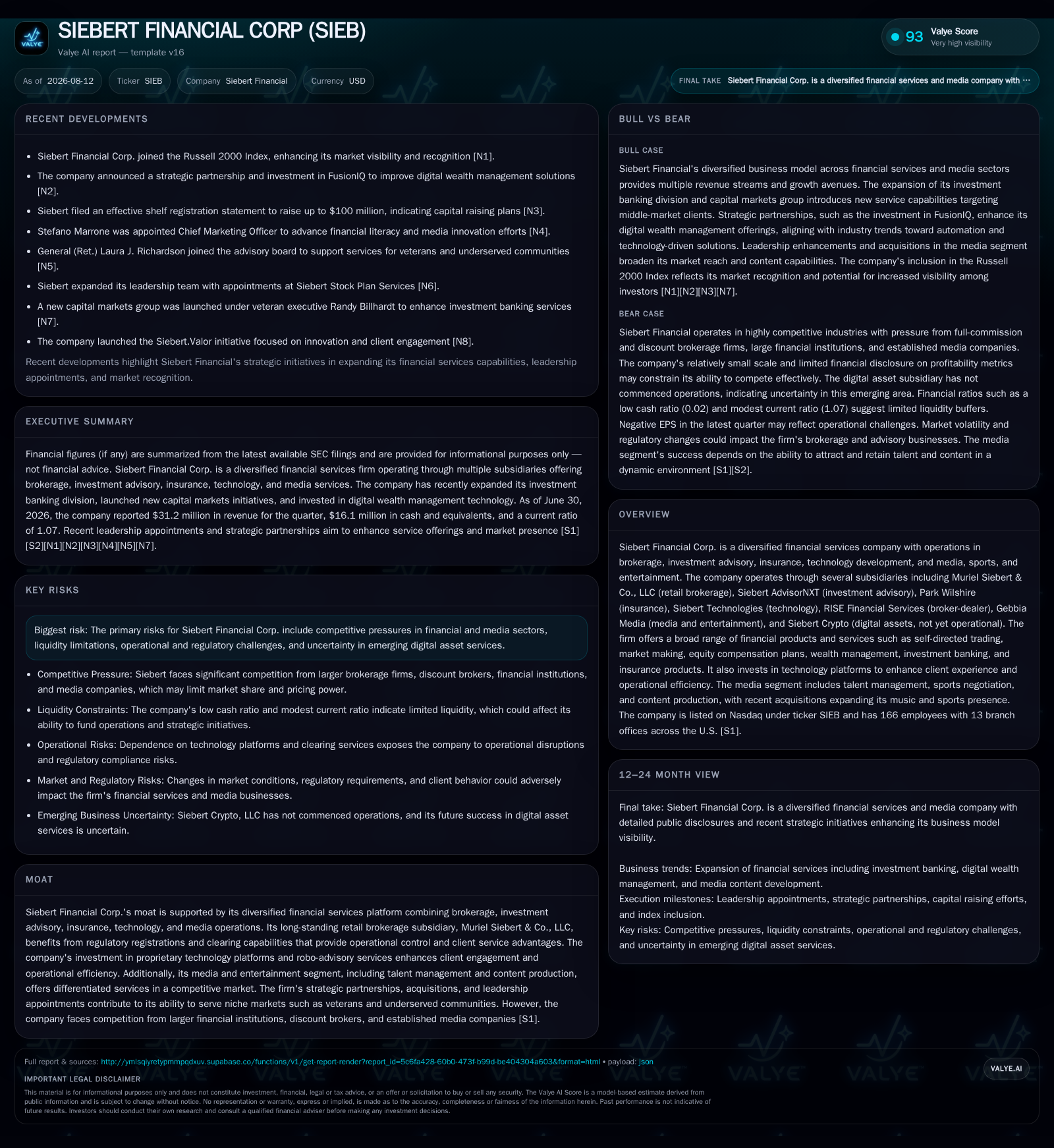
Siebert Financial Corp operates a diversified platform including retail brokerage, investment advisory, and insurance, complemented by technology development and a growing media segment. Its core brokerage subsidiary, Muriel Siebert & Co., LLC, remains central to revenue through self-directed trading and clearing services, while investments in proprietary technology aim to support client engagement growth. The recent full ownership consolidation of RISE Financial Services signals strategic focus on expanding broker-dealer operations. Regulatory pressures from Dodd-Frank and Regulation Best Interest elevate compliance costs but also reinforce industry entry barriers. Meanwhile, the media segment diversifies revenue sources but remains nascent compared to established competitors. Siebert's liquidity and capital position remain stable, yet low trading volumes and a limited public float contribute to share price volatility.
Recent Operating Update
Siebert Financial Corp’s latest quarterly filing as of August 11, 2026, confirms no material changes in risk factors or near-term operating disruptions compared to prior periods, maintaining consistency in its diversified financial services approach [S2]. This stability suggests steady execution against a backdrop of evolving regulatory complexity that continues to shape industry practices.
The company’s principal subsidiary, Muriel Siebert & Co., LLC (MSCO), functions as a Delaware-registered broker-dealer with robust clearing and custody capabilities granted by registrations across all U.S. states plus territories [S1],[S10]. MSCO plays a key role in generating transactional revenues through self-directed trading, market making, equity compensation plans, wealth management advisory fees, and capital markets activities including investment banking. Notably, MSCO received regulatory approval in 2022 to expand correspondent clearing services for other brokerages and RIAs — a move that enhances its revenue diversification and strengthens client service integration [S10].
Investment advisory services are carried out primarily by Siebert AdvisorNXT (SNXT), a separately registered Investment Advisor leveraging proprietary robo-advisory technology grounded in Modern Portfolio Theory (MPT) principles to tailor cost-effective portfolio management aligned with client risk profiles. This technology-driven offering aims to attract digitally savvy investors seeking algorithmic wealth management solutions at scale while representing a forward-looking shift in client onboarding dynamics within the company’s advisory channel [S12],[S16].
Park Wilshire Companies provide an insurance product suite including fixed annuities, personal insurance policies spanning property/casualty lines, natural disaster coverage, as well as life and disability insurance. This segment broadens cross-selling potential within core financial services assets underwriting fee-based recurring revenue flows through policy premiums rather than variable transactional revenue typical of brokerage businesses [S12]
Siebert Technologies serves as the innovation engine behind the firm’s digital expansion efforts. Investments have centered on building the "Retail Platform" — comprising mobile trading applications and online portals designed for both retail clients and corporate services users. These advancements target improved client experience efficiency gains which are critical amid heightened competition from fintech firms with disruptive digital offerings. Continued upgrades aim to facilitate future growth by supporting broader demographics and new product introductions through scalable technology infrastructure [S12],[S16].
A noteworthy restructuring event occurred with RISE Financial Services becoming wholly owned following an acquisition of the remaining minority interests in late 2025 at book value terms. Given RISE’s status as a fully licensed broker-dealer registered with multiple regulators but currently limited operating activity, this consolidation reflects a strategic initiative to reposition or expand its role within Siebert's broader broker-dealer framework as market opportunities arise [S9],[S1].
Complementing financial services is Gebbia Media LLC — an arm devoted to music talent management, sports negotiation services, marketing initiatives, and content production across film, TV, podcasts, and digital platforms [S7]. The acquisition of Big Machine Rock (BMR) in May 2025 brought established artists such as Daughtry and Sammy Hagar into the roster, marking it as a distinctive diversification albeit one still adjacent to core financial services lines with uncertain scalability against entrenched competitors like Live Nation or Endeavor
Business Model Analysis
Siebert operates a multi-entity platform generating revenue from diverse sources: commission-based brokerage transactions driven by retail customer trades handled by MSCO; asset management fees from its registered investment advisor SNXT’s advisory mandates including robo-advisory portfolios; insurance premiums underwritten through Park Wilshire; licensing or fee income associated with proprietary technology developments; plus emerging media content monetization via Gebbia Media.
Transactional volumes notably drive brokerage commissions — influenced by market volatility and investor behavior — while advisory fees provide steadier income streams linked to assets under management (AUM). Insurance offerings rely on policy counts and premium retention metrics common in that sector. Meanwhile technology investments underpin user acquisition costs for digital platform participants which can impact margin profiles until scaling efficiencies materialize.
The broker-dealer subsidiaries manage clearing functions internally or through partnerships (such as with National Financial Services Corp.). This grants control over custody processes contributing both operating margin benefits versus outsourcing alternatives but also necessitates compliance with stringent net capital requirements imposed by SEC/FINRA ensuring sufficient liquid assets buffer operational risks [S10],[S11],[S26].
Media operations pivot toward talent representation commissions combined with intellectual property exploitation revenues from content production — business economics here differ markedly from finance but offer potential synergy benefits through cross-branding or sponsorship alignments.
Regulatory licenses across securities exchange acts (Exchange Act), commodities futures acts (Commodity Exchange Act), multiple FINRA memberships, NFA registration for futures activities underline an extensive compliance infrastructure reflecting high regulatory barriers to entry supporting competitive moat elements principally within brokerage channels [S10],[S11],[S22]. However this also increases complexity-induced compliance costs impacting expense ratios.
Industry Structure & Competitive Position
Siebert is positioned among diversified financial intermediaries alongside larger integrated competitors such as Charles Schwab or Raymond James that pair full-service retail brokerage with advisory capabilities. While firms like Schwab benefit from scale advantages enabling lower client acquisition costs and platform investments reaching millions of accounts, Siebert serves more niche or underserved segments leveraging personalized service credentials inherited from founder Muriel Siebert’s legacy.
The company confronts intense competition from zero-commission discount brokers who erode transactional pricing power coupled with fintech entrants offering seamless account opening and robo-advisory products threatening traditional advisory margins. Regulatory reforms such as Regulation Best Interest (implemented since June 2019) impel Siebert toward heightened disclosure obligations limiting certain product sales incentives but reinforcing fiduciary conduct standards potentially benefiting firms emphasizing trustworthy advice models over volume-driven sales tactics [S6],[S8],[S11].
Insurance operations compete broadly with agencies like Aon or Marsh McLennan in distribution models but operate at smaller scale focused on certain regional or product niches which may sustain productive cross-sell prospects relative to standalone agents.
Compliance cost inflation could pressure operating leverage especially if technological revisions lag competitor pace.
Industry-wide margin compression due to zero-commission competitive norms erodes traditional transactional profitability challenging sustainability absent offsetting volume gains or ancillary fee income growth.
Market volatility introduces revenue cyclicality given dependency on transactional brokerage commissions which fluctuate materially quarter-to-quarter creating earnings variability hard to smooth via fixed fees alone.
Technology development risks include execution delays or insufficient adoption impairing intended customer acquisition acceleration threatening ROI on digital platform expenditures [S27].
Media segment nascent state coupled with longer brand-building timelines creates uncertainty about meaningful contribution emergence amidst well-entrenched entertainment firms holding scale advantages.
Dependence on key personnel presents retention risks given leadership concentration notably around family ownership controlling ~42% voting shares limiting governance flexibility possibly deterring some institutional partnership interest – liquidity events involving Kakaopay shareholdings add stock price volatility unrelated directly to fundamental operations [S18],[S25].
What To Watch Next
Investors and analysts should track:
- Uptake metrics of newly deployed mobile trading app users indicating traction among core retail customers expanding account counts and transaction frequencies.
- Asset inflows into SNXT managed portfolios reflecting scaling efficacy amid increasing robo-advisory competition.
- Integration progress at RISE Financial Services signaling readiness for enhanced business activity measurable via active account openings or executed transactions reports.
- Insurance policy growth trends particularly new sales mix shifts towards higher-premium products providing margin expansion potential.
- Quarterly regulatory examination outcomes impacting compliance cost guidance or accruals revealing operational risk prudence adjustments.
- Media content production milestones including talent signings or distribution deals validating pipeline strength assessing contribution scalability over medium term.
- Public float share turnover rates influencing share price stability monitoring given thinly traded stock narratives documented previously.
Financial Profile Discussion
As of 2026-06-30, Siebert reported approximately $16.1 million in cash and equivalents against current liabilities near $872 million along with current assets around $935 million, yielding a current ratio of approximately 1.07 which suggests sufficient short-term liquidity coverage although large absolute liability levels warrant ongoing monitoring for working capital efficiency [F1]. Operating income totaled $5.57 million at the end of fiscal 2025 with trailing revenues near $94 million highlighting modest scale relative to larger peers but consistent positive operating returns imply operational discipline amid competitive pressures [F1]. The net income figure last available is dated end of 2023 at $7.83 million constraining more recent profitability trend assessment.
Overall solvency appears stable but cautious observation around counterparty credit exposures inherent in brokerage operations alongside continued investment demands for technology upgrade remain pivotal going forward.
This analysis synthesizes publicly available filings without providing investment advice. Readers should consider company disclosures alongside broader market conditions before forming conclusions regarding business prospects or valuation judgments.
Disclaimer: This is research-only, informational analysis and not investment advice. It may include AI-generated interpretation and general industry context. Always verify important details using primary sources.

Comments