
Neurogene Advances Phase 3 Rett Syndrome Therapy While Strengthening In-House Manufacturing
Neurogene reports advancing Phase 3 dosing for NGN-401 alongside ongoing scale-up of its proprietary gene therapy manufacturing operations.
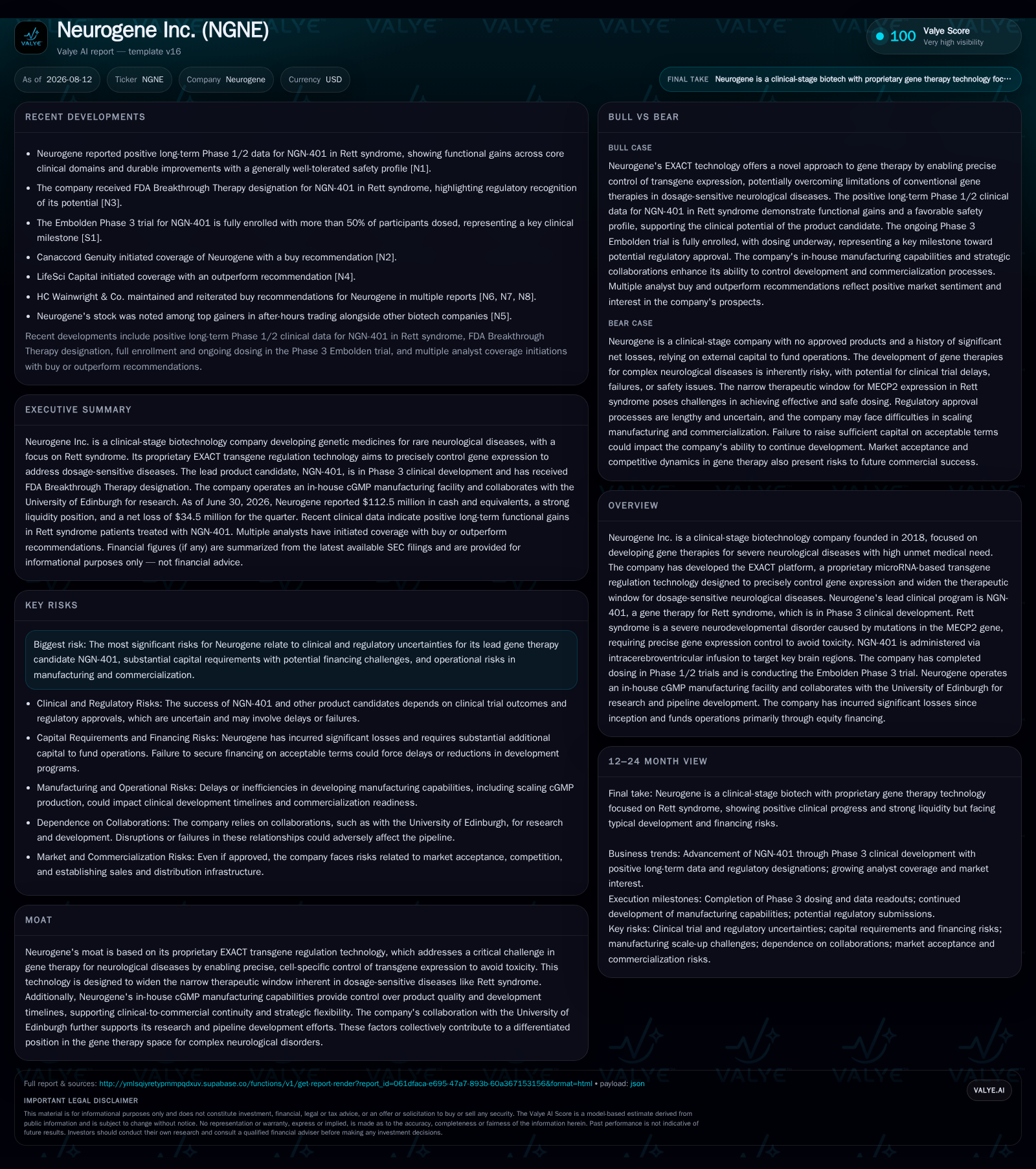
Neurogene Inc. continues to progress its NGN-401 gene therapy candidate for Rett syndrome, with full enrollment and over half of the Phase 3 Embolden trial participants dosed, marking a key near-term operational milestone. The company’s microRNA-based EXACT platform enables precise transgene expression control crucial for dosage-sensitive neurological diseases. Its in-house cGMP manufacturing facility supports clinical-to-commercial continuity and quality control. With cash reserves exceeding $112 million as of mid-2026, Neurogene is positioned to sustain its capital-intensive development while navigating typical sector risks such as regulatory uncertainty and manufacturing scale-up challenges.
Phase 3 Clinical Progress Signals Near-Term Operational Milestone
Neurogene’s latest quarterly filing confirms full enrollment of the Embolden Phase 3 trial evaluating NGN-401 gene therapy for Rett syndrome in 20 females aged three years and older. More than half of these participants have been dosed as of mid-2026, with dosing completion targeted by the second quarter of 2026 [S2]. This operational milestone is critical because it sets the stage for subsequent interim data readouts that will inform potential regulatory submissions. The single-arm, open-label baseline-controlled design reflects a pragmatic approach tailored to the rarity and severity of Rett syndrome, aiming to support a broad indication label within one study framework. This progress validates both Neurogene’s clinical execution capabilities and the therapeutic hypothesis underpinning NGN-401 [S1]. Encouraging Phase 1/2 data showed durable functional gains across key developmental domains including motor skills, language, and communication [N1].
EXACT Platform Enables Precision Transgene Expression Control Essential for Dosage-Sensitive Neurological Disorders
NGN-401 incorporates Neurogene’s proprietary EXACT (Expression Attenuation via Construct Tuning) platform, which employs microRNA-based genetic circuits to precisely modulate transgene expression in target neuronal populations [S1]. This fine-tuned regulation addresses a fundamental challenge in CNS gene therapies: achieving therapeutic efficacy without toxicity from overexpression. Given that Rett syndrome pathology involves MECP2 mutations where both deficiency and excess protein levels are deleterious, controlling the therapeutic window is paramount.
Delivery via adeno-associated virus (AAV) vectors combined with intracerebroventricular (ICV) infusion facilitates widespread biodistribution within critical brain regions implicated in disease pathology [S1]. This mechanistic sophistication distinguishes Neurogene’s approach from competitors lacking comparable microRNA-mediated expression modulation platforms, aligning it competitively within the neurological gene therapy sub-sector.
Strategic Advantage Through Fully Integrated In-House cGMP Manufacturing Facility
Neurogene operates a fully functional current good manufacturing practices (cGMP) facility in Houston that produces clinical-grade NGN-401 used in both completed Phase 1/2 trials and ongoing Phase 3 dosing [S1]. This vertically integrated manufacturing capability enhances control over product quality and development timelines relative to peers reliant on contract manufacturers.
Importantly, Neurogene confirmed that commercial-scale manufacturing will match current clinical production scale, obviating the need for comparability studies—a common hurdle during clinical-to-commercial transitions in gene therapy development [S1]. While scaling viral vector production remains complex due to yield consistency and regulatory scrutiny challenges, this infrastructure underpins smoother advancement toward commercialization upon regulatory approval.
Competitive Landscape: Differentiation Within Rare Neurological Gene Therapy Developers
Neurogene competes alongside established clinical-stage gene therapy firms such as uniQure and AveXis (Novartis), which also develop AAV-based CNS-targeted treatments. Its differentiation lies in the EXACT platform’s microRNA-based transgene expression control versus competitors’ approaches that may lack similar dosage precision.
Furthermore, Neurogene’s use of ICV delivery targets broad CNS distribution suited to multifocal disease manifestations like Rett syndrome. Regulatory progress milestones—such as FDA IND clearance achieved in January 2023—reflect alignment on clinical design and potency assays consistent with leading industry practices [S1]
Growth Drivers: Clinical Trial Advancement, Pipeline Expansion, and Regulatory Engagement
Primary growth catalysts include completing Phase 3 dosing followed by interim efficacy and safety data disclosures expected within approximately one year per trial timeline [S2]. Positive signals would materially enhance prospects for accelerated regulatory filings.
Beyond NGN-401, collaborations with academic partners like the University of Edinburgh fuel early-stage discovery efforts expanding pipeline breadth into other rare neurological diseases [S1]. Such partnerships help mitigate early R&D risks while accelerating innovation.
Continued productive engagement with regulatory agencies underpins expedited review pathways; for example, EMA PRIME designation attained in March 2025 supports faster evaluation [S1]. Thus, sustained scientific execution combined with regulatory compliance will drive value creation.
Risks: Clinical Development Uncertainty, Capital Intensity, Manufacturing Scale-Up Challenges
Key risks include potential late-stage clinical trial delays or failures given reliance on NGN-401 as lead candidate [S2,S4]. The dosage sensitivity inherent to Rett syndrome demands vigilant safety monitoring.
Financially, although cash & equivalents totaled $112.5 million at June 30, 2026 with a strong current ratio above 10 indicating solid liquidity [F1], substantial operating losses are expected throughout advanced development stages [S2]. Additional financing rounds may be necessary amid volatile biotech funding environments.
Operational challenges related to scaling viral vector cGMP production remain significant due to technical complexity impacting yield consistency and potency assurance. Geographic concentration of manufacturing facilities also poses localized operational risk exposure [S18]. Regulatory setbacks or evolving approval requirements could further delay commercialization timelines.
What To Watch: Completion of Dosing, Interim Data Releases, Regulatory Feedback,
Cash Flow Management
Near-term focus centers on completing dosing imminently given over half participants treated by mid-2026 [S2], followed by interim data releases that will validate therapeutic benefit signals crucial for regulatory path advancement.
Monitoring FDA communications regarding potential filing readiness and assay or labeling guidance changes will be essential. Additionally, tracking cash burn relative to clinical progress will inform timing for potential capital raises.
Updates on pipeline candidates emerging from academic collaborations may signal longer-term opportunities beyond NGN-401’s pivotal readout horizon.
Financial Profile Discussion: Robust Liquidity Supports Ongoing Clinical Development
As of June 30, 2026, Neurogene reported cash & equivalents of approximately $112.5 million against current liabilities near $21.5 million resulting in a strong current ratio above 10 [F1]. This liquidity supports continued investment in costly Phase 3 dosing activities alongside organizational growth.
Operating losses remain sizable—reflecting typical biotech sector patterns—as no commercial revenues have been realized; operating income was negative $103 million at year-end 2025 [F1]. Sustained reliance on equity financing or strategic partnerships is anticipated to fund ongoing R&D expenditures [S5,S12].
Management’s ability to balance development spending against cost controls will influence cash runway duration; existing resources provide meaningful operational continuity absent unforeseen acceleration or setbacks.
This analysis integrates evidence from Neurogene's SEC filings through August 11th, 2026 together with recent corporate disclosures. It focuses on factual synthesis without extrapolating beyond documented information. No investment research views are offered herein.
Disclaimer: This is research-only, informational analysis and not investment advice. It may include AI-generated interpretation and general industry context. Always verify important details using primary sources.

Comments