
Intrusion Inc. Faces Liquidity Constraints and Revenue Challenges Despite Proprietary Cybersecurity Moat
Intrusion Inc.’s Q2 2026 results reveal continued financial strain amid government-focused cybersecurity SaaS market dynamics.
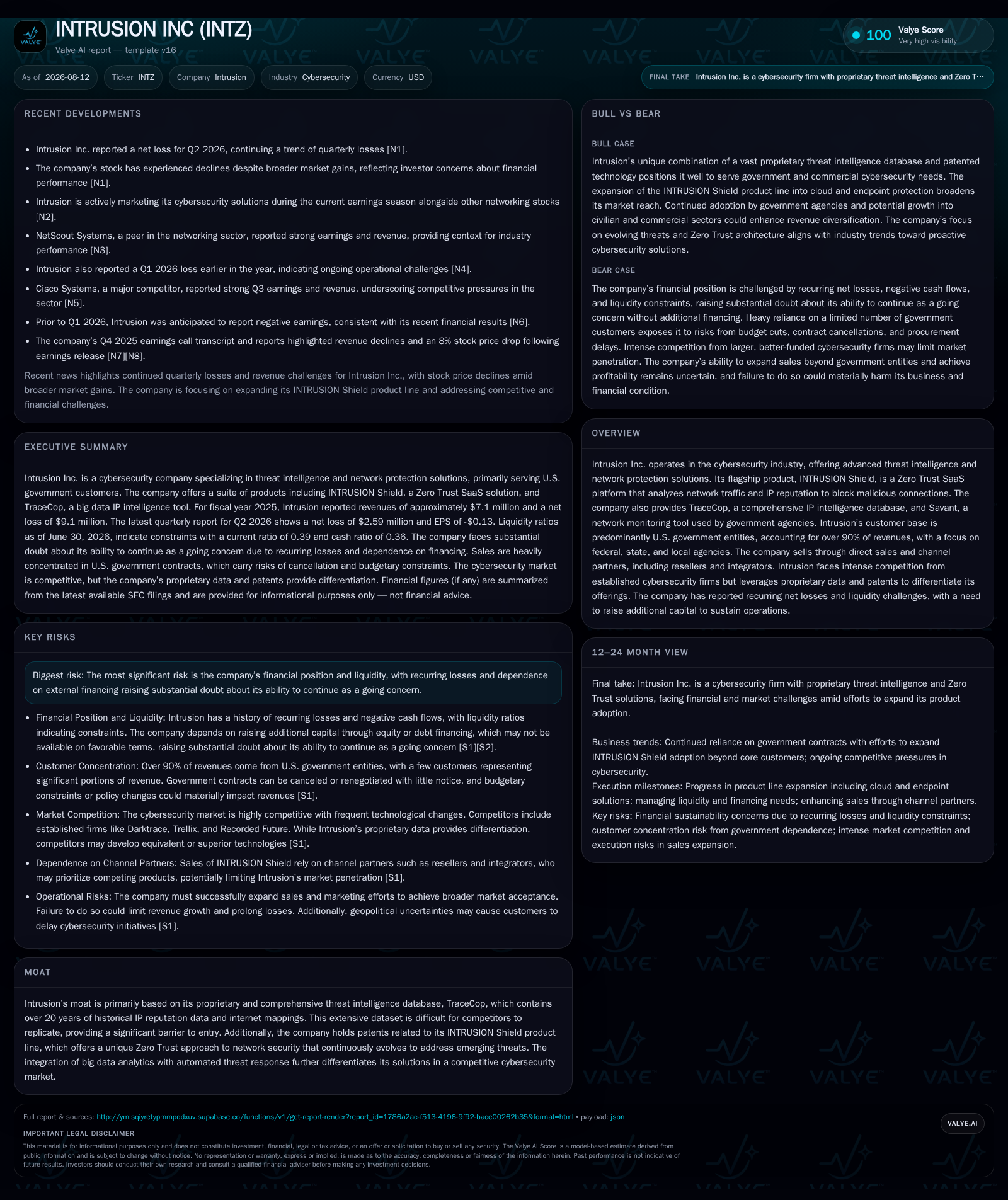
Intrusion Inc., a cybersecurity firm specializing in government-secured Zero Trust SaaS solutions, reported Q2 2026 revenue shortfalls and mounting liquidity pressures. With over 90% of revenue derived from U.S. governmental entities, the company’s heavy customer concentration combined with recurring net losses complicates its path to profitability. Intrusion’s proprietary threat intelligence database and patented IP provide a strong moat in a competitive industry, but ongoing cash burn and balance sheet weakness present significant execution risks. Future growth hinges on expanding government contracts and improving recurring revenue metrics alongside managing financial sustainability.
Recent Operating Update: Q2 2026 Financial Results and Their Implications
Intrusion Inc.’s latest quarterly filing dated August 11, 2026, highlights ongoing operational challenges that frame the near-term outlook for this niche cybersecurity SaaS provider [S2][N1][S3]. The company reported revenues below analyst expectations amid persistent net losses characteristic of its growth stage [N1]. Recent quarterly trends suggest difficulties in accelerating top-line growth sufficiently to reverse loss-making patterns. Operating expenses continued to outpace revenues, causing cash burn that has markedly strained liquidity.
The Q2 balance sheet snapshot reveals only $182,000 in cash and equivalents as of June 30, 2026 [F1], sharply down from prior periods. Concurrently, total debt stands near $2.24 million [F1], with current liabilities exceeding $6 million against modest current assets of roughly $2.3 million resulting in a current ratio of about 0.39 [F1]. This level signals pronounced short-term funding pressure and challenges meeting near-term obligations without additional capital raisings or operational improvement.
Business Model Analysis: Government-Centric Zero Trust SaaS with Proprietary Data Assets
Intrusion operates a SaaS-focused business model centered on its flagship INTRUSION Shield platform — a Zero Trust reputation-based security solution that proactively analyzes network traffic and IP reputation information to block malicious connections [S1]. This platform extends beyond traditional firewall or endpoint defenses by inspecting every packet bi-directionally using an evolving threat intelligence feed derived from the company's TraceCop database comprising over 20 years of IP reputation data and internet mapping [S1]. This comprehensive threat intelligence underpins much of Intrusion's competitive differentiation.
Revenue is primarily subscription-based tied to INTRUSION Shield usage along with sales of additional modules like TraceCop itself (an IP intelligence service) and Savant (a network monitoring tool used notably by government agencies) [S1]. Customers are predominantly federal, state, and local U.S. government entities — accounting for more than 90% of revenues as per the latest filings (94.6% for year-end 2025) [S1]. The company sells mainly through direct governmental sales efforts supplemented by channel partners including reseller and integrator networks.
The heavy reliance on a limited customer base focused within government segments imposes demand cyclicality tied to government budget cycles and contracting processes — often lengthy sales cycles typical in highly regulated environments. This customer concentration magnifies revenue volatility risks despite typically lower churn rates within government contracts.
Industry Structure and Competitive Positioning
Within the broader Cybersecurity Software and SaaS industry, Intrusion occupies the niche segment of threat intelligence-driven Zero Trust network protection targeted almost exclusively at public sector customers. Peers such as CrowdStrike and Palo Alto Networks compete across broader enterprise markets with integrated endpoint protection suites or multi-vector cloud security platforms; by comparison Intrusion’s narrower product portfolio centers on specialized IP reputation analytics combined with automated threat blocking.
The firm’s moat is anchored in its proprietary TraceCop database—arguably difficult for competitors to replicate given its scale (>8 billion IP addresses tracked historically) and depth—and coupled with patents protecting aspects of the INTRUSION Shield platform [S1]. These assets enable advanced detection capabilities that continuously evolve alongside emerging threats without heavy reliance on traditional signature-based systems.
However, high competition prevails from both established multinational cybersecurity vendors possessing deeper sales networks and newer startups innovating threat detection algorithms across the security stack [S1]. Intrusion’s comparatively smaller size (52 employees as of end-2025) restricts scale economies while prolonging sales cycle length further impeding rapid market penetration necessary to achieve sustainable profitability
Growth Drivers Supporting Future Opportunity
Despite near-term headwinds, several structural dynamics underpin demand growth for Intrusion's solutions:
- Escalating frequency and sophistication of cyberattacks focusing heavily on public sector networks drive greater urgency around advanced threat intelligence capabilities.
- Increasing adoption of Zero Trust architecture models in federal/state agencies aligns directly with INTRUSION Shield’s continuous evaluation framework.
- Expansion of endpoints due to remote work arrangements enlarges attack surfaces requiring enhanced automated network protection tools.
- Compliance mandates relating to data privacy/security compel governments to invest more heavily in cutting-edge cybersecurity offerings.
- Growing preference for SaaS delivery models facilitates scalability advantages relative to legacy appliance-based deployments.
- Channel partner expansion initiatives aim at broadening access beyond entrenched governmental customers into adjacent civilian agency segments [S1].
If successfully executed alongside improving sales execution metrics such as shortened sales cycle lengths or higher net retention rates, these factors could materially enhance top-line momentum going forward.
Risks & Watchpoints Highlighting Growth Constraints
Intrusion’s business is encumbered by notable risks that must be actively managed:
processes combined with limited internal resources heighten risks around scaling sales run rate efficiently.
- Regulatory & Compliance: Evolving legal regimes governing cybersecurity solutions procurement may affect contract terms or necessitate costly compliance implementations.
- Liquidity Risks: Current liabilities far exceed liquid assets creating urgent requirements for capital infusions or operational restructuring to avoid insolvency risk [F1].
- Talent Retention: Intense competition for specialized security engineering talent could constrain product development velocity or increase costs [S1].
What To Watch Next: Milestones And Demand Markers
Investors tracking Intrusion should focus on several key developments that would indicate trajectory shifts:
- Quarterly top-line trends reflecting stabilization or acceleration above historical growth rates (~20% annualized pre-Q2) would confirm success penetrating additional government segments [N1][S2].
- Improvements in net retention rates or reduction in customer churn among long-standing contracts illustrating sustained product value realization.
- Cash flow trajectory improvements including reduced operating expenses or margin enhancements contributing toward breakeven outcomes.
- Progress on tapping non-traditional administrative/civilian governmental units signaling diversification beyond core defense/military-oriented clientele per corporate commentary [S1].
- Execution efficacy around channel expansion evidenced by partner contract additions or increased indirect sales contribution mixes.
- Material equity or debt financing announcements alleviating liquidity constraints while maintaining manageable dilution/cost-of-capital profiles.
Financial Profile Discussion
Ongoing dependence upon equity or debt markets introduces execution uncertainty particularly during wider market volatility phases common in cybersecurity software sectors under pressure.
Operationally driven cost control measures combined with effective market traction yielding subscription revenue growth remain critical levers for improving gross margins over time and reducing financing needs—a common hurdle paralleled among early-stage SaaS cybersecurity vendors seeking scale economies before profitability benchmarks materialize.
Disclaimer: This analysis is based solely on publicly available information from SEC filings including the latest quarterly report dated August 11, 2026, industry knowledge frameworks, and confirmed news sources. It does not constitute investment advice or research views regarding Intrusion Inc.’s securities. All forward-looking statements outlined herein are subject to risks detailed in company disclosures.
Disclaimer: This is research-only, informational analysis and not investment advice. It may include AI-generated interpretation and general industry context. Always verify important details using primary sources.

Comments