
National CineMedia Navigates Exclusive Cinema Advertising Amid Attendance and Digital Expansion Challenges
NCMI leverages exclusive agreements in U.S. theaters but faces revenue volatility linked to attendance and is pursuing digital out-of-home growth.
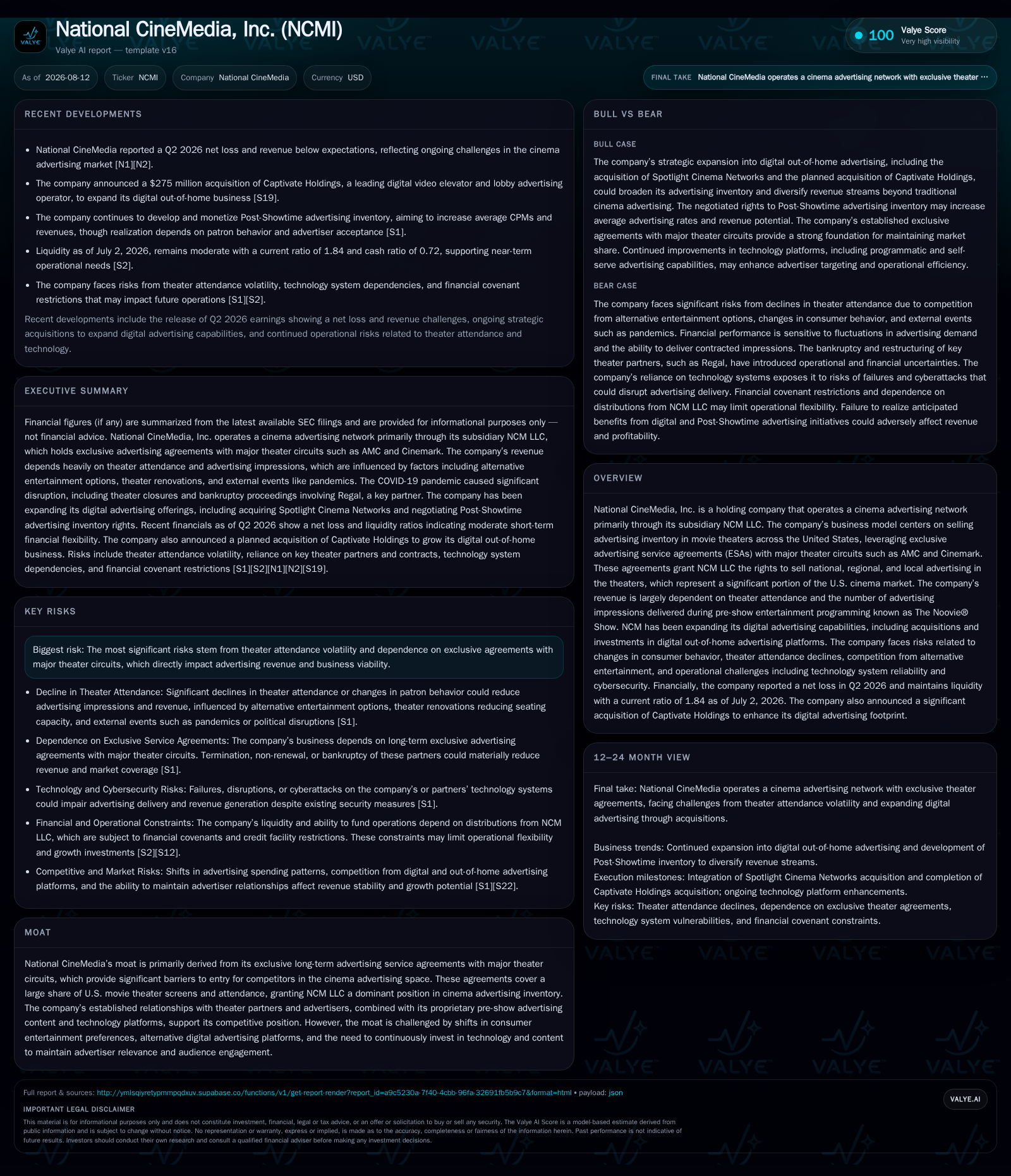
National CineMedia, Inc. operates the largest cinema advertising network in the U.S. through exclusive contracts with major theater circuits, offering pre-show ad inventory primarily via The Noovie® Show. The company's Q2 2026 results highlight ongoing revenue sensitivity to volatile movie theater attendance and intensified competition from alternative digital entertainment platforms. NCMI is actively expanding its digital out-of-home footprint through a significant acquisition, aiming to diversify beyond traditional cinema advertising. However, risks remain around fluctuating attendance, contracting theater capacities due to renovations, and reliance on long-term exclusive agreements with AMC and Cinemark. Financially, NCMI maintains a solid liquidity position with no reported debt as of mid-2026 but will assume structured debt in financing its recent acquisition.
Recent Operating Update: Q2 2026 Results Highlight Attendance Sensitivity
National CineMedia reported Q2 2026 operating results underscoring persistent challenges tied to theater attendance fluctuations. The company disclosed a second-quarter loss that lagged revenue estimates, reflecting softness in advertising impressions due largely to variability in moviegoing audiences during ongoing consumer entertainment shifts [S2][N1][N2]. Although National CineMedia benefits from dominant network access through exclusive contracts with marquee cinema chains like AMC and Cinemark, actual advertising revenue closely tracks whether consumers choose theaters over competing platforms such as streaming services or at-home viewing options.
Business Model: Monetizing Captive Audiences Through Exclusive Theater Agreements
National CineMedia operates primarily via its subsidiary NCM LLC which holds exclusive advertising service agreements (ESAs) with major U.S. theater circuits granting it rights to sell national, regional, and local advertising inventory across a substantial portion of American movie screens [S1]. These ESAs create a competitive moat by limiting rival access to premium cinema ad space. Revenue generation hinges on selling advertising spots during The Noovie® Show — a proprietary pre-show content program shown before feature films which captures captive audience attention.
The company’s pricing depends on volume (advertising impressions), governed by theater attendance levels and show schedules, as well as the average revenue per impression (which reflects advertiser demand and mix). Ad load per program is carefully calibrated to balance client ROI against viewer tolerance; optimizing this metric supports higher yields.
Expanding beyond traditional cinema ads, NCMI targets growth through programmatic digital out-of-home (DOOH) channels such as elevator and lobby displays, aiming for multi-channel advertiser solutions which may provide better measurement and targeting than static cinema ads alone [S25].
Industry Structure: Cinema Advertising’s Unique OOH Niche With Competitive Pressures
Cinema advertising companies anchor their value within the broader out-of-home media ecosystem by serving as intermediaries between advertisers seeking large-scale captive audiences and theater exhibitors providing venue access. Unlike mass broadcast TV or purely digital video platforms where audience fragmentation is high, cinema ads benefit from dwell time in dark environments where distraction is minimal.
However, the sector remains vulnerable to the secular decline or volatility of moviegoing behavior impacted by changing consumer preferences—particularly the rise of streaming—and external shocks like health crises or economic downturns that suppress discretionary spending [S1][S29].
Peers such as Screenvision Media operate similar ESAs covering other theater chains but none match NCMI's scale across AMC and Cinemark screens. Broader OOH competitors include Clear Channel Outdoor or Lamar Advertising whose focus is more on outdoor signage rather than captive indoor experiences.
Digital out-of-home platform providers like Vistar Media represent both competition and potential partnership targets as programmatic capabilities mature.
Growth Drivers
Key growth vectors for National CineMedia remain tied to:
- Theater Attendance Recovery: As economic conditions improve or blockbuster releases draw crowds back, theater footfall will directly boost available advertising impressions driving top-line growth.
- Expansion of Exclusive Agreements: Any extension or addition of contracts can broaden geographic coverage and screen counts enhancing inventory control.
- Digital Out-of-Home Growth: The pending acquisition of Captivate for approximately $275 million signifies strategic intent to diversify into elevator/lobby DOOH networks offering advertisers complementary ambient video channels with potentially richer data-driven targeting capabilities [S25][S6].
- Innovative Pre-show Content: Enhancing The Noovie® Show entertainment value can increase audience engagement duration improving advertiser ROI.
- Advertiser Demand for Multi-channel Solutions: Rising preference among agencies for integrated campaigns spanning theaters plus ancillary DOOH formats may expand wallet share.
- Technology Investments: Upgrading delivery platforms enables dynamic interactive ads which could command higher prices.
Risks and Constraints
Despite its strong positioning via exclusive rights contracts, National CineMedia faces significant risks:
- Attendance Volatility: Attendance shifts driven by streaming adoption or temporary factors like pandemic impacts create direct revenue exposure since fewer patrons mean lower advertising impressions [S1][S29].
- Theater Renovation Effects: Upgrades involving larger seating reduce auditorium capacity thus shrinking potential audience pools even if occupancy remains steady.
- Dependence on First-run Films: Success depends partly on studios' output and marketing which influence draw.
- Competitive Media Alternatives: Digital streaming platforms offer highly targeted ad products competing aggressively for brand budgets.
- Contract Renewal Uncertainty: Loss or non-renewal of ESAs with AMC or Cinemark would substantially impair inventory control.
- Technological Lag: Inability to effectively enhance or integrate DOOH offerings could weaken advertiser appeal.
- Economic Downturns: Reduced discretionary income leads both consumers away from cinemas and advertisers cutting back spending.
What To Watch Next
Upcoming milestones critical for assessing National CineMedia's trajectory include:
- Completion timing and integration progress of the Captivate acquisition including realization of anticipated synergies [S25].
- Same-theater attendance trends during upcoming high-profile releases indicating stability or recovery pace.
- Updates on renewal status or negotiations around key ESAs governing exclusive ad rights.
- KPI disclosures around advertising impressions delivered per quarter alongside average revenues per impression signaling pricing power health.
- Digital out-of-home revenue contribution growth reflecting on diversification success.
- Management commentary addressing strategies against streaming encroachment and consumer behavioral shifts.
Financial Profile Discussion
As of July 2, 2026, National CineMedia reported approximately $43.1 million in cash and cash equivalents supporting liquidity needs with zero total reported debt at that date reflecting a clean balance sheet prior to the announced acquisition financing [F1]
Nonetheless, announced financing arrangements surrounding the $275 million cash acquisition of Captivate involve entering into senior secured term loan and revolving credit facilities totaling up to $300 million subject to customary financial covenants including maximum net leverage ratios starting at 5x stepping down over time [S6][S12]. Thus, while the balance sheet was deleveraged mid-year, leverage will increase post-closing affecting capital structure risk profiles.
Operating income remains under pressure with recent quarterly losses reflecting margin challenges tied mainly to top-line weakness from lower ad volumes rather than fundamental cost base inflation; managing these operational levers will be essential going forward [F1][N2]. Capital expenditure allocation toward technology development for content delivery platforms is also expected as part of sustaining competitive edge in an evolving digital-ad environment [S21].
Disclaimer: This is research-only, informational analysis and not investment advice. It may include AI-generated interpretation and general industry context. Always verify important details using primary sources.

Comments