
Eastern Company’s Engineered Solutions Battle Import Pressures with Operational Discipline
Eastern Company’s latest quarterly results underscore operational resilience amid ongoing import-driven pricing pressures and global trade challenges.
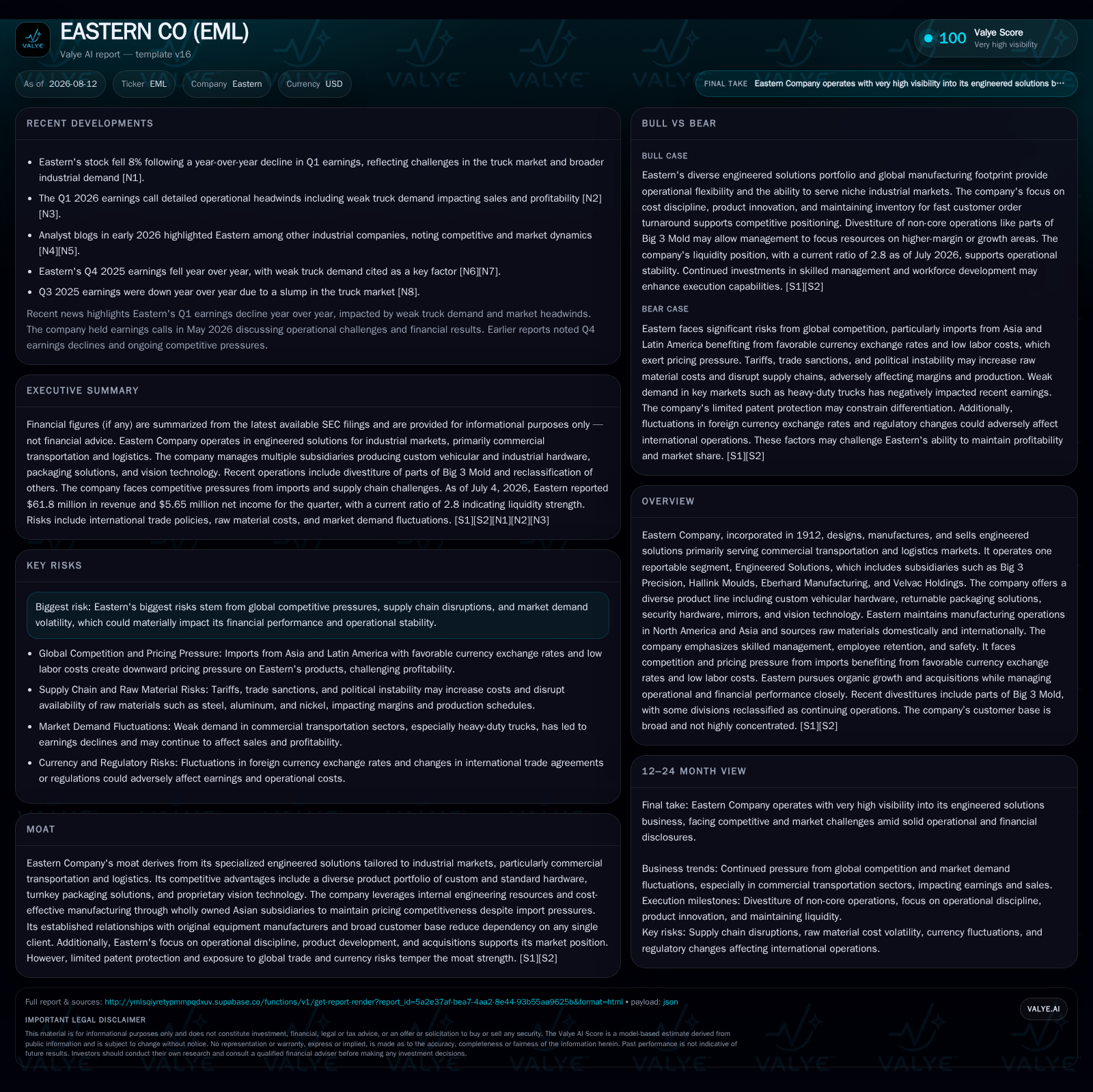
In its August 2026 quarterly filing, Eastern Company reported continued pressure on segment gross profit and operating income due to persistent import competition benefiting from currency advantages and low labor costs. The company’s diversified portfolio of custom engineered hardware and proprietary vision technology, coupled with a manufacturing footprint spanning North America and Asia, supports disciplined cost management and timely customer fulfillment. While import competition and currency volatility constrain margin expansion, Eastern pursues measured organic growth augmented by acquisitions and operational rigor. Key near-term indicators include order backlog trends and product development milestones alongside monitoring of supply chain and regulatory risks.
Second Quarter Performance Under Pricing Pressure: Incremental Resilience or Warning Sign?
The Eastern Company’s Q2 2026 10-Q filing reveals that the Engineered Solutions segment continues to absorb significant pricing pressure caused by imports benefiting from favorable currency exchange rates and lower labor costs abroad [S2]. Despite these headwinds, the company demonstrated operational discipline that partially offset input cost inflation and competitive mark-downs. While exact segment gross profit figures were not detailed in this release, management commentary alongside prior disclosures suggests Gross Profit margins remain compressed versus historical levels but without catastrophic deterioration [S2]. This points towards a resilient demand environment for its specialized products even as customers negotiate on price amid broader market softness in commercial transportation and logistics sectors.
The accompanying August 11 event filing reiterates these dynamics, emphasizing continued vigilance towards cost controls and precision in order fulfillment to retain market share during this sustained period of import competition [S3]. The delicate balance Eastern faces is reflected in modest operating income gains that highlight the benefits of manufacturing efficiency improvements partially offsetting raw material inflation pressures [F1]. For an industrial hardware manufacturer focused on custom components, such as Eastern, maintaining profitability under these global cost variables is a critical barometer of resilience.
Engineering Differentiation: How Product Quality Supports Market Position Despite Limited Patents
Eastern offers a broad portfolio anchored by custom vehicular hardware, returnable packaging solutions, security hardware, as well as proprietary vision technology platforms developed internally or through subsidiaries such as Velvac Holdings and Eberhard Manufacturing [S1][S2]. While patent protection across this suite is generally limited—with patents ranging from 1 to 20 years none central to any business line—the company relies on engineering expertise, product customization capabilities, longstanding OEM relationships, and manufacturing agility as moat elements rather than intellectual property barriers alone [S1].
This approach helps mitigate direct substitution threats from low-cost imports by providing unique value through quality assurance and reliable delivery timing. Continued investment in product development cycle acceleration serves as both a retention lever for existing customers and an entry wedge into adjacent markets requiring advanced vehicular vision solutions or security components. However, the limited patent landscape remains a notable vulnerability, mandating continued emphasis on operational excellence and customer intimacy as differentiation pillars.
Import Competition and Currency Volatility: The Cost Challenges Shaping Margins
The company faces intense competitive pricing pressure stemming from Asian and Latin American competitors whose cost structures benefit from advantageous exchange rates against the U.S. dollar combined with substantially lower labor expenses [S1]. These external factors have intensified since the pandemic-induced supply chain realignments and persistently volatile currency markets. Even modest depreciation of foreign currencies relative to the USD can erode Eastern’s ability to maintain price premiums, forcing reactive price adjustments that press margins.
Additionally, tariffs and evolving trade policies inject uncertainty into raw material sourcing costs. While Eastern sources materials domestically as well as from company-affiliated suppliers overseas to manage cost exposure, unexpected tariff escalations or shipping disruptions could exacerbate input price inflation beyond current forecasts [S1]. This dynamic aligns with peer experiences among industrial hardware manufacturers globally facing similar currency- and trade-related margin erosion challenges.
Manufacturing Strategy: Leveraging Dual-Continental Operations to Manage Costs and Lead Times
Eastern’s manufacturing footprint spans fourteen locations across North America and Asia including wholly owned subsidiaries that support both production efficiency and market responsiveness [S1]. This geographic diversification enables the company to balance lower-cost Asian manufacturing—critical for competitive pricing—with proximity advantages in North America supporting just-in-time delivery commitments crucial for OEMs operating tight supply chains.
While direct capacity utilization metrics are not publicly disclosed this quarter, prior commentary indicates disciplined resource allocation aimed at aligning production output tightly with fluctuating customer demand patterns prevalent in commercial transportation markets [S2]. The dual-continent strategy provides some insulation against localized disruptions; however, cross-border logistics remain vulnerable to port labor disputes or geopolitical tensions which could trigger costly lead time extensions or necessitate rerouting premiums [S1].
Overall, this manufacturing network is a core enabler of Eastern's pricing competitiveness yet necessitates ongoing investment to maintain operational reliability amid growing global supply uncertainties.
Customer Base Resilience: Broad OEM Exposure Reduces Concentration Risk Amid Demand Variability
Eastern highlights that its customer relationships span broad industry geography without significant concentration risk in any single account or region [S1]. This diversity tempers exposure to the cyclical demand swings endemic to commercial trucking and logistics sectors where capital spending fluctuations directly impact aftermarket replacement part orders versus new fleet builds.
A diversified OEM base also affords Eastern vital feedback loops facilitating accelerated product iteration cycles responsive to evolving regulatory standards or technological integration needs such as enhanced vision systems for safety compliance. The stability of these relationships anchors recurring revenue streams while allowing tactical wins in aftermarket sales where margin profiles tend historically stronger. This balanced customer mix represents a strategic advantage compared with single-segment focused industrial suppliers vulnerable to idiosyncratic contract losses.
Growth Trajectory Anchored on Acquisitions and Innovation: What Could Accelerate or Constrain Expansion?
The company pursues growth through a combined model of steady organic innovation plus targeted acquisitions designed to expand its product portfolio or augment manufacturing capabilities [S1][S2]. Recent acquisition integrations appear smooth without ingestion disruption signals reported in the latest filings. Acquisitions especially bolster presence in specialized niches like security hardware or returnable packaging solutions complementing Eastern’s core vehicular product lines.
Innovation cycles focusing on vision technology enhancements aim to reduce time-to-market while meeting evolving client specifications demanding greater customization. This shapes potential margin expansion opportunities if successful. Constraints include integration execution risk elevated by differing geographic footprints and potential cultural mismatches common across cross-border deals.
Moreover, external macroeconomic variables such as supply chain inflation or tariff unpredictability could delay new product introductions or increase R&D costs beyond budget expectations.
Risks Beyond Pricing: Supply Chain Vulnerabilities, Regulatory Shifts, and Workforce Stability Concerns
Management acknowledges multiple operational risks extending beyond direct pricing challenges including raw material supply interruptions driven by geopolitical tensions or trade policy shifts impacting tariffs on steel or plastics vital for production inputs [S1]. Regulatory developments requiring more stringent safety certifications could introduce compliance delays or incremental redesign expenses.
Workforce retention particularly skilled manufacturing employees constitutes another material risk factor highlighted given labor shortages prevalent across industrial sectors in North America. Employee relations remain amicable presently but require continuous engagement efforts given unionized environments within some subsidiaries. Safety incident rates carry financial consequences affecting insurance costs or reputational standing if not tightly controlled.
Geopolitical risks also linger for Asian operations where political instability could disrupt manufacturing continuity or raw material sourcing complicating cost control measures further [S1].
"What Investors Should Monitor Next": Order Backlog, Product Development Milestones, Currency Trends
Key forward-looking indicators include progression in order backlog statistics which serve as an early gauge of demand momentum across commercial transport verticals sensitive to economic cycles [S2]. Monitoring new product development milestones especially tied to vision technology will illuminate success in maintaining engineering-led competitive edges.
Externally observable currency fluctuations remain critical as these materially influence pricing strategies against importers competing aggressively on cost baselines. Supply chain health indicators such as port activity levels or raw material availability provide supplementary signals influencing near-term operating predictability.
Tracking these data points collectively will help assess whether Eastern sustains its margin recovery trajectory or succumbs further to international competitive pressures.
Financial Profile Discussion
As of Q2 ending July 4, 2026, Eastern maintains solid liquidity evidenced by cash & equivalents totaling approximately $15.1 million alongside current assets near $125 million versus current liabilities around $44.6 million yielding a healthy current ratio around 2.8 compliant with prudent working capital thresholds supporting smooth operations [F1]. Total debt remains relatively low at about $1.8 million resulting in a net cash position favorable for funding incremental investment or acquisition activity without excessive leverage constraints [F1]. Operating income stands positive though impacted by prevailing market challenges at just over $10.7 million while net income reflects ongoing profitability albeit pressured relative to prior periods reflecting margin compression dynamics noted above [F1].
This financial profile affords the company flexibility to pursue its strategic growth initiatives while managing cyclical headwinds inherent in industrial engineered hardware sectors characterized by sensitivity to global trade conditions.
Disclaimer: This analysis is intended solely for informational purposes reflecting publicly available data up to August 2026 without providing investment advice or research views.
Disclaimer: This is research-only, informational analysis and not investment advice. It may include AI-generated interpretation and general industry context. Always verify important details using primary sources.

Comments