
Capstone Holding’s Covenant Compliance and Capital Structure Pressure Financial Flexibility
Recent quarterly filings reveal Capstone Holding Corp.’s fragile liquidity amid covenant compliance challenges and operational losses.
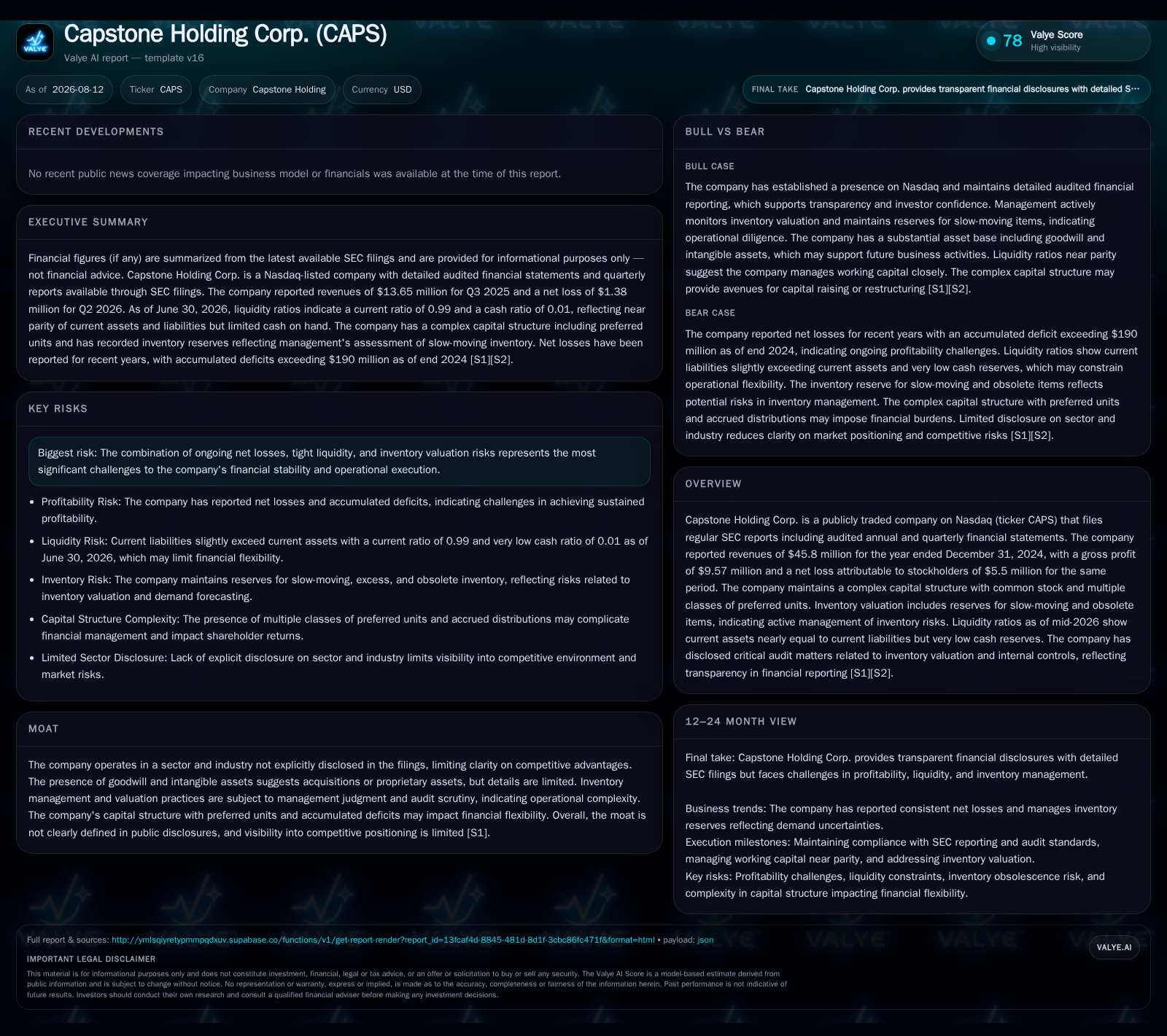
Capstone Holding Corp. reported ongoing net losses alongside tight liquidity and a complex capital structure featuring preferred units and convertible notes. The company achieved compliance with key financial covenants as of June 30, 2026, following waivers and amendments but remains at risk of future defaults that could accelerate debt and impair operations. Its specialty finance business model hinges on managing financial assets and inventory with active valuation reserves, but operational transparency issues and limited moat cloud its outlook. Near-term growth depends on covenant adherence, liquidity management, and potential asset portfolio expansions.
Recent Operating Update: Covenant Compliance Surpassed but Risks Persist
Capstone Holding Corp.'s latest quarterly filing dated August 12, 2026 reveals that the company achieved compliance with the minimum Cash Flow Coverage Ratio and Tangible Net Worth covenants under its Revolving Credit Agreement as of June 30, 2026 [S2]. This follows a prior failure to comply as of March 31, 2026 that required the company to secure a written waiver from its lender. Furthermore, the company negotiated the sixteenth amendment to extend the maturity date from June 19 to December 31, 2026, providing short-term relief [S2]. Despite this progress, the filings underscore concern over maintaining future compliance; there is no assurance the lender will grant additional waivers if needed.
The criticality of these covenants lies in their ability to prevent acceleration events that would force immediate repayment of indebtedness and restrict financial flexibility. If breached without waiver, accelerated debt repayment could lead to material impairment of liquidity or threaten the company's going-concern status [S2]. Such scenarios would also activate cross-default provisions on other debt agreements including the October Note.
Concurrently, the company has managed dilution pressures through multiple reductions in convertible note prices. In April 2026 alone, approximately $1.7 million principal plus accrued interest was converted into about 2.56 million common shares—a single-day dilution spike increasing outstanding shares by ~22% [S21]. This underscores ongoing capital structure complexity that balances investor preferences for preferred units alongside common stock amidst operational losses.
Business Model: Specialty Finance with Embedded Asset Management Complexity
While Capstone Holding does not explicitly state its sector in filings, the nature of disclosures around inventory valuation reserves, multiple classes of equity including preferred units and convertible notes strongly aligns it with specialty finance and asset management firms [S1].
Revenue generation appears anchored in providing financing solutions supported by a managed portfolio of specialized assets or inventory subject to valuation adjustments for slow-moving or obsolete items. This inventory management is integral as it directly impacts reported gross profits and asset quality—key drivers of financial performance in this niche finance sector.
The company's monetization mechanics include contractual arrangements possibly blending fees from asset management or financing services along with gains from asset dispositions or securitizations—though specific contract descriptions are not publicly detailed. Volume or usage metrics are less applicable here; instead revenue sensitivity stems from asset valuation dynamics, default rates on financed assets if applicable, pricing terms embedded in credit agreements, and mix shifts between more/less profitable portfolios.
Operational markers like inventory turnover rates and impairment provisions carry high relevance for margin stability given observed reserves highlighted both by management judgment and independent audits [S1][S2]. The presence of goodwill and intangible assets suggests historical acquisitions contributing proprietary assets needing periodic impairment assessments.
Industry Structure & Competitive Positioning
Capstone operates within an industry segment serving niche markets requiring tailored financing products complemented by active management of underlying asset portfolios. Peer groups include specialty finance companies such as Oaktree Capital Group operating with similarly layered capital structures reliant on lender relationships tightly governed by financial covenants.
Capstone’s business profile lacks clear enduring moat disclosures; accumulated deficits signal operational profitability struggles while tight liquidity narrows maneuvering room relative to competitors with stronger balance sheets. Maintaining lender support amid persistent losses will be critical.
Growth Drivers: Covenant Maintenance & Portfolio Expansion Opportunities
Key growth drivers entail continued compliance with revolving credit facility covenants enabling uninterrupted access to working capital financing—paramount for supporting asset portfolio growth or replenishment necessary for revenue expansion [S2]
Operational improvements such as enhanced inventory turnover reducing slow-moving item reserves would improve gross margins and cash flow coverage ratios—both vital performance signals that influence lender negotiations positively.
New product introductions or geographic expansions have been mentioned but lack specific timelines or details; execution success will rely heavily on efficient capital allocation while sustaining stringent internal controls due to prior audit committee disclosures regarding material weaknesses in earnings per share calculations caused by control inadequacies around share count computations [S27].
Risks & Watchpoints: Liquidity Tension Amid Covenant Pressures & Market Listing Threats
The dominant risk cluster centers around fragile liquidity exacerbated by dependence on lender waivers for covenant breaches which are not guaranteed moving forward—a failure here risks swift debt acceleration crippling operations [S2][S10]. Cross-default cascades through related debt instruments magnify this threat.
Significant dilution from convertible note repricing places downward pressure on share value while raising concerns about long-term capital access and shareholder dilution resistance given ongoing operating deficits [S21].
Inventory valuation risks flagged by auditors represent another vulnerability—misjudgments could materially skew earnings results prompting further reserve build-ups or write-downs negatively impacting tangible net worth measures underpinning revolving credit agreement covenants.
Additionally, Nasdaq listing maintenance poses a challenge as the company remains below minimum bid price requirements entering an extended cure period ending January 2027; failure to regain compliance risks delisting which would undermine equity market access altogether [S25]
Quarterly filings will reveal whether the company can sustain cash flow coverage ratios without further waiver dependence.
Progress against operational KPIs such as inventory turnover improvements or reserve reductions will indicate margin stabilization prospects. Additionally, tracking any further convertible note conversions at reduced prices is crucial due to dilution implications.
Nasdaq bid price movements define near-term listing viability; recovery above $1 per share before January 4, 2027 is necessary to avoid delisting notifications.
Completion of remediation actions addressing internal control deficiencies around share counting supports improved financial reporting reliability moving forward.
Strategic announcements regarding asset acquisitions or new market entries may signal growth pathway clarity if sustained alongside stronger balance sheet metrics.
Financial Profile Discussion
As of June 30, 2026 (latest quarter), Capstone Holding’s cash position is critically low at $225,000 compared to total debt near $14 million resulting in net debt approximating $13.8 million—indicative of significant leverage burden [F1]. Current assets marginally trail current liabilities ($26.9M vs $27.1M), yielding a current ratio just below one at approximately 0.99 that signals constrained liquidity buffer under standard working capital analysis norms [F1].
Net losses remain elevated which have contributed to accumulated deficits eroding tangible net worth metrics integral for covenant testing under revolving credit agreements [F1][S2]. While revenue stood at $44.9 million for year ended December 31, 2024 with gross profit about $9.57 million indicative of thin margins typical in specialty finance sectors facing inventory valuation challenges [F1][S1], operating losses persisted into subsequent periods underscoring profitability hurdles.
Recent amendments extending revolving credit maturities afford temporary relief but reiterate heightened refinancing risk pending operational turnaround evidencing via improved cash flows and earnings gains.
The balance sheet complexity with multiple equity classes—common stock combined with preferred units plus convertible notes—requires vigilant capital structure management given dilution events expounded in recent SEC filings where conversion price resets led to substantial share count inflation affecting per-share metrics materially [S21][S23].
Auditor-flagged critical audit matters concerning inventory valuation underscore exposure points potentially influencing future impairment charges affecting book value calculations vital for lenders’ quantitative covenant tests.[S1][S2]
In sum, Capstone Holding’s financial positioning reflects a specialty finance firm grappling with balancing growth ambitions against severe liquidity constraints compounded by financial covenant pressures typical for niche lending or structured finance operators navigating tight credit markets.
This analysis synthesizes publicly available SEC disclosures through August 12, 2026 without forecasting forward outcomes or making investment research views.
Disclaimer: This is research-only, informational analysis and not investment advice. It may include AI-generated interpretation and general industry context. Always verify important details using primary sources.

Comments