
CalciMedica Advances Clinical Programs Amid Safety Setback and Capital Constraints
Clinical trial developments and capital structure shape CalciMedica's near-term outlook for its inflammatory and kidney disease therapies.
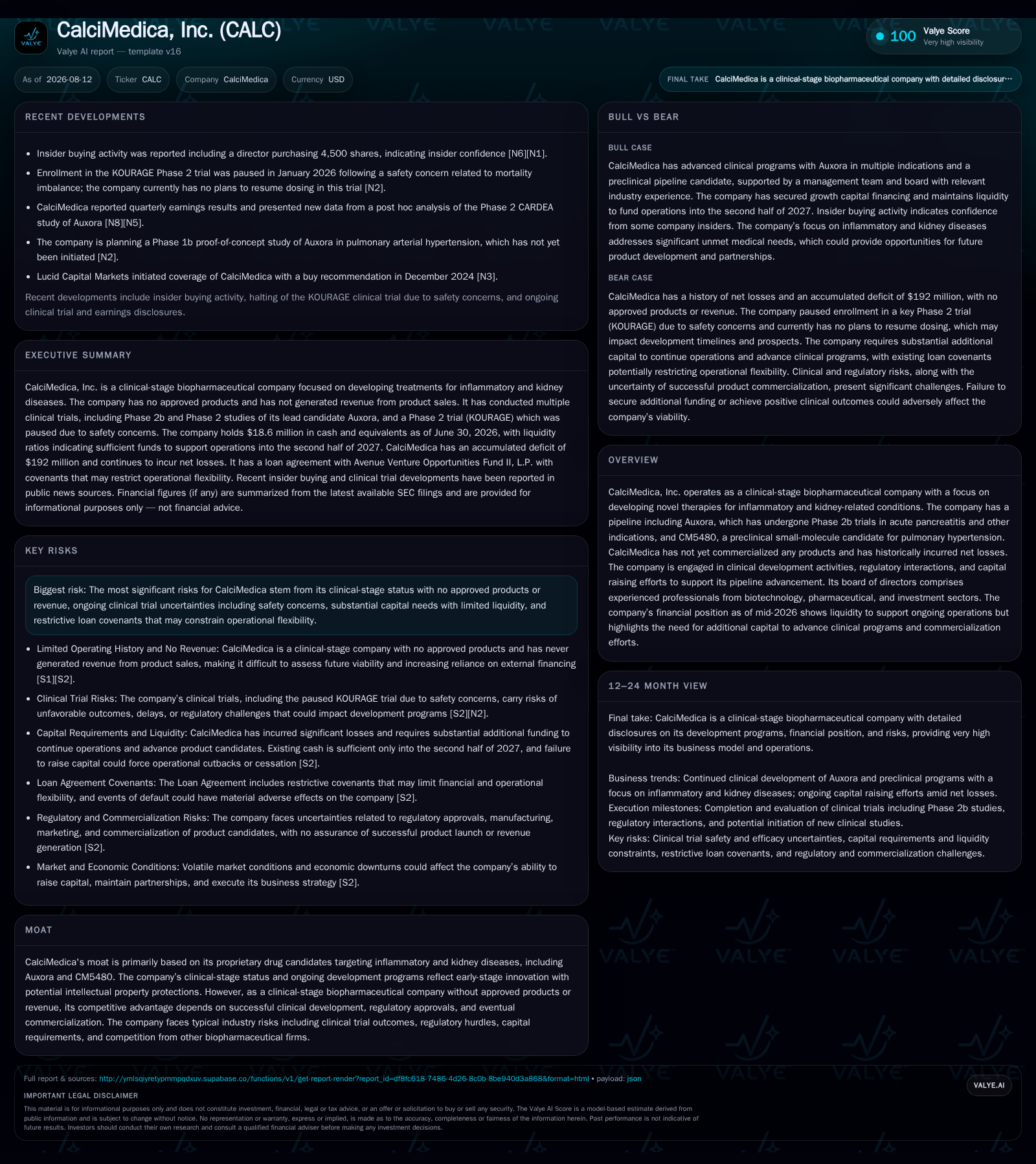
CalciMedica, a clinical-stage biopharmaceutical company, reported in its latest quarterly filing that it continues advancing its pipeline centered on Auxora and CM5480 despite recent trial discontinuation due to safety concerns. The company faces typical early-stage biotech challenges including the absence of product revenues, reliance on external financing, and operational restrictions from loan covenants. Its cash position as of mid-2026 supports operations into late 2026 or beyond contingent on successful additional financing. Future clinical milestones and regulatory engagements remain key drivers and risk factors influencing CalciMedica’s development trajectory.
Recent Operating Update
CalciMedica’s latest quarterly report filed August 11, 2026 [S2] confirms a noteworthy change in its clinical development plans with the discontinuation of the Phase 2 KOURAGE trial evaluating Auxora in patients suffering from acute kidney injury (AKI) associated with acute hypoxemic respiratory failure. This decision followed an independent Data Monitoring Committee’s (DMC) research view citing a mortality imbalance necessitating study re-evaluation [S2], [S5]. Although a setback, management remains committed to progressing Auxora through more targeted indications. A planned Phase 2b trial in acute pancreatitis has been agreed upon in consultation with the FDA [S2], designed to generate pivotal data informing a potential Phase 3 program.
Simultaneously, CalciMedica continues preclinical development of CM5480, a small molecule candidate targeting pulmonary hypertension. While clinical progress for CM5480 remains at an early stage without disclosed trial enrollment or readouts yet, its presence broadens the company’s portfolio beyond inflammation-focused assets [S1]
On the financial front, CalciMedica reported cash and equivalents of $18.6 million as of June 30, 2026 [F1], supported by earlier equity raises and a $10 million growth capital loan closed March 2025 [S6]. The balance sheet shows current assets of approximately $19.5 million against current liabilities near $3.5 million, yielding a strong current ratio over 5.5x [F1]. Despite this liquidity cushion enabling continued operations into late 2026 as indicated by company guidance [S5], persistent reliance on external financing persists given no revenue generation to date.
Business Model Analysis
CalciMedica operates as a clinical-stage biopharmaceutical entity developing therapeutic candidates principally in inflammatory and renal disease domains. The core business model is R&D-centric: discovery and refinement of drug candidates such as Auxora—a biologic agent previously evaluated in Phase 2 trials for acute pancreatitis and COVID-19 pneumonia with ARDS—and CM5480 as a small molecule aimed at pulmonary vascular pathology [S1].
Revenue generation remains aspirational pending regulatory approvals; funding to date has primarily come from equity issuance and prior debt arrangements, with no current detailed disclosures on financing agreements or grants [F1]. The monetization pathway involves securing FDA approval through progressive clinical phases demonstrating safety and efficacy endpoints followed by commercialization either directly or through partnerships. Until then, expenditure focuses heavily on costly clinical trials, investigational new drug (IND) filings, manufacturing scale-up preparations outsourced to third parties, and administrative overheads.
Industry Structure and Competitive Position
Within the broader biotechnology sector focusing on immune modulation and nephrology conditions, CalciMedica occupies an early-to-mid value chain slot emphasizing drug development rather than commercialization or manufacturing. Competition arises from numerous specialized biotech firms pursuing novel anti-inflammatory agents or renal therapeutics backed by robust pipelines often diversified across multiple indications.
Peers include other clinical-stage companies targeting ARDS-related syndromes or kidney diseases with varying success rates through elongated phase transitions. The uniqueness of CalciMedica's Auxora lies partly in its molecular mechanism addressing calcium release-activated calcium channels implicated in systemic inflammation—a niche biochemical target offering differentiation but also bearing inherent risk if translational efficacy proves limited.
The recent safety concern leading to the KOURAGE trial halt exemplifies common sector hurdles where mortality imbalances can abruptly impact development timelines and stakeholder confidence. Industry-wide success hinges on navigating regulatory scrutiny (notably FDA interactions), achieving milestone triggers that unlock further financing tranches or partnership interest, protecting intellectual property portfolios amidst patent uncertainties [S20], and managing sizeable R&D investments concentrated on lengthy clinical programs.
Growth Drivers
Incremental value for CalciMedica will derive primarily from advancing clinical trials generating robust safety and efficacy data sufficient to warrant late-stage development commitments or licensing transactions. Achieving FDA alignment on clear endpoints—such as with the planned acute pancreatitis Phase 2b study—supports smoother transition toward potential Phase 3 registration efforts.
Expanded indication targeting offers avenues to increase pipeline breadth; leveraging orphan drug designations or expedited review pathways may help accelerate timelines given the unmet need in inflammatory kidney diseases where existing therapies are limited.
Strategic collaborations could enhance resource access or commercialization capability once proof-of-concept is established. Ongoing intellectual property maintenance ensures barriers against biosimilar competition which is crucial given the typical high costs associated with bringing biologics or novel small molecules to market.
Finally, calibrated capital raising aligned with defined clinical milestones will underpin sustained operational capacity essential for navigating the protracted drug development cycle intrinsic to biotechnology ventures.
Risks and Watchpoints
Key risks stem from CalciMedica’s purely developmental status devoid of commercial revenues leaving it vulnerable to dilution via equity issuance or restrictive lending terms impinging operational freedom. The KOURAGE trial discontinuation spotlights inherent uncertainties common in biotech regarding patient safety events that can halt or derail otherwise promising programs [S2]. Regulatory delays or unfavorable FDA feedback on study designs might further compound timeline extensions.
The Loan Agreement’s covenants limit flexibility regarding incurring further indebtedness or asset transactions which could hamper strategic options especially if cash positions dwindle prematurely [S10]. Intellectual property enforcement risks remain material; failure to secure strong patent claims could expose candidates to competitive encroachment adversely impacting future market potential [S20].
Operationally, dependencies on third-party CROs for trial conduction introduce execution risks including enrollment delays or compliance lapses potentially triggering costly setbacks [S1]. Market volatility reflected in share price swings adds uncertainty for investor confidence tied closely to binary outcomes from experiments still underway.
Monitoring evolving legislation impacting drug approval processes such as changes triggered by judicial reviews also warrants attention given their possible influence over regulatory complexities faced by medical innovation companies broadly [S21]
What To Watch Next
Critical upcoming inflection points include initial enrollment progress reports from the next Phase 2b Auxora trial along with interim safety data releases which will be pivotal for gauging forward-looking feasibility toward pivotal studies. Additional preclinical milestones related to CM5480’s IND-enabling activities may surface investor interest though remain earlier stage.
Monitoring liquidity levels vis-à-vis burn rate forecasts during quarterly updates will provide insight into urgency surrounding additional fundraises; any announcements about strategic partnerships or licensing agreements could materially affect both financial flexibility and pipeline validation perceptions.
Regulatory feedback following proposed trial protocols represents another key milestone validating CalciMedica’s engagement quality with health authorities influencing timing expectations considerably. Finally, tracking changes or waivers related to Loan Agreement covenants may signal shifts in financial strategy or pressures impacting governance decisions.
Financial Profile Discussion
CalciMedica’s financial footing as of June 30, 2026 presents a moderate liquidity buffer highlighted by approximately $18.6 million in cash equivalents supported by current assets totaling about $19.5 million versus current liabilities near $3.5 million yielding a current ratio above 5.5x—a traditionally healthy short-term solvency measure uncommon for similarly situated biotech startups reliant on successive funding rounds [F1]
Given this backdrop combined with industry-standard high cash burn rates linked to phase-based R&D investment increments tied directly to enrollment pace and study scope scaling, periodic equity issuance or alternative financing will remain necessary barring breakthrough partnering transactions ahead of commercialization readiness.
This analysis is based solely on publicly filed documents and industry context without offering investment research views or views about stock valuation. It reflects operating realities common within early-stage biotechnology business models emphasizing capital-intensive development cycles shaped significantly by clinical progress milestones and regulatory interactions.
Disclaimer: This is research-only, informational analysis and not investment advice. It may include AI-generated interpretation and general industry context. Always verify important details using primary sources.

Comments