
Autolus Therapeutics Accelerates AUCATZYL Sales with Expanding Commercial Footprint and Technical Innovation
Q2 2026 results reveal a sharp revenue increase driven by broader patient access and UK market entry supported by Autolus’s proprietary CAR T modular platform.
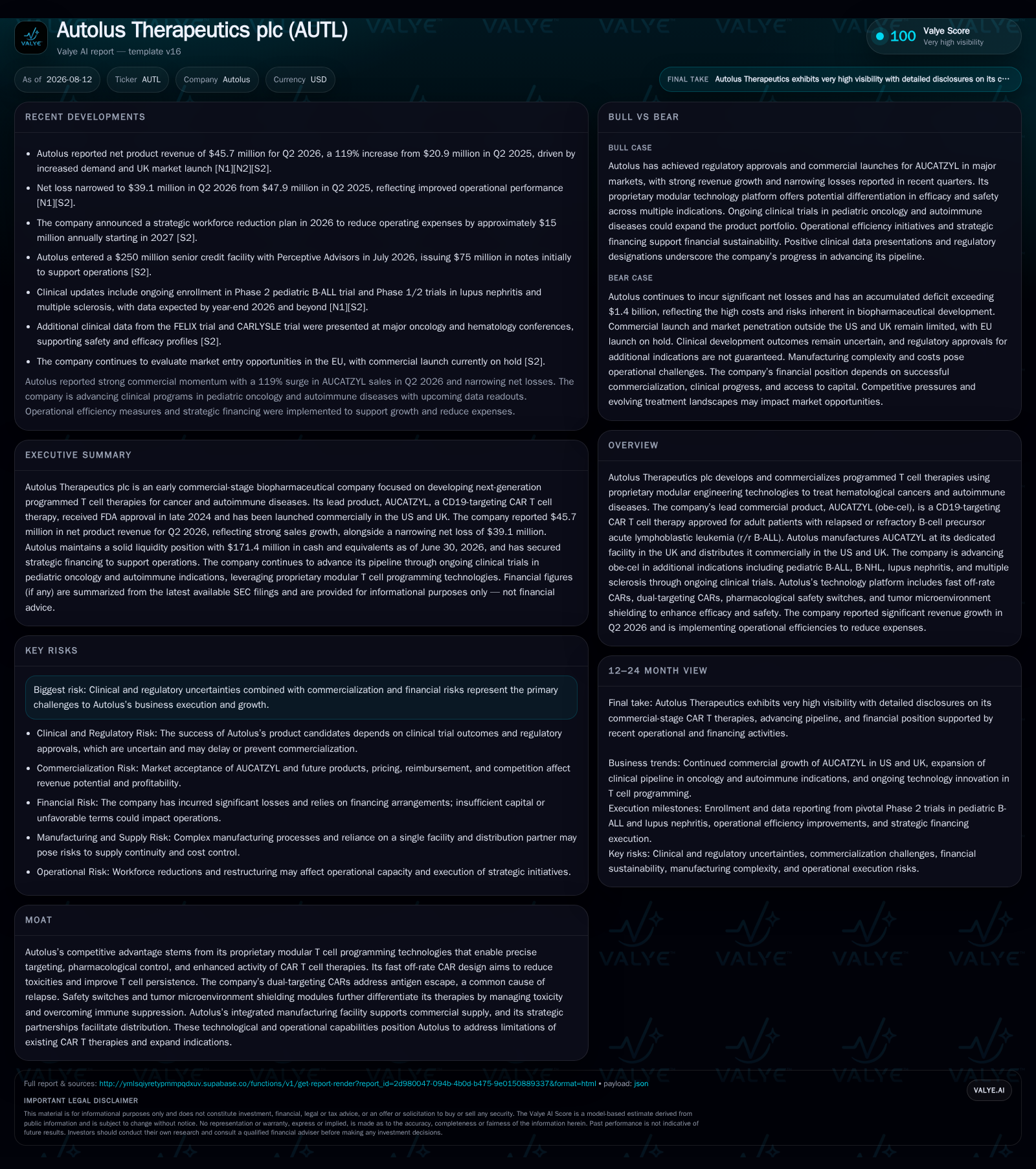
Autolus Therapeutics’s Q2 2026 results show a 119% year-over-year surge in net product revenue for AUCATZYL, driven by expanded patient treatment volumes in the US and the initial commercial launch in the UK. The company’s modular engineering platform underpins its CAR T therapy differentiation through safety and efficacy features, positioning it well amid intensifying competition. Operationally, Autolus is managing manufacturing scale-up and rising SG&A expenses linked to workforce restructuring and commercial expansion while continuing clinical development investment. Key near-term focus areas include sustaining sales momentum, advancing pediatric trial data by end-2027, navigating EU market entry, and securing capital for ongoing growth.
Q2 Surge Reflects Expanding Patient Base and Market Footprint for AUCATZYL
This volume-driven revenue model aligns with typical commercialized cell therapies where income is primarily derived from one-time personalized product sales administered at specialized centers. Growth is thus contingent upon physician adoption rates, payor coverage expansion, and activation of additional treatment sites.
Proprietary Modular Engineering as Autolus’s Competitive Differentiator
Autolus’s CAR T therapy leverages proprietary modular T cell programming technologies that enable advanced features such as fast off-rate binding domains designed to modulate T cell activation intensity. This approach aims to reduce adverse events like cytokine release syndrome (CRS), which commonly limit first-generation CAR-T therapies [S1]. Pharmacological safety switches embedded within the engineered cells provide reversible control mechanisms that enhance patient safety profiles.
Additionally, dual-targeting CAR constructs are being developed to address antigen escape—a key mechanism by which tumors evade single antigen therapies—potentially improving long-term remission durability.
These innovations seek to differentiate AUCATZYL clinically relative to legacy CAR Ts such as Novartis’s Kymriah or Gilead's Yescarta. Supporting evidence includes data from pivotal adult r/r B-ALL trials leading to FDA approval in late 2024 as well as real-world registry data (ROCCA Consortium) confirming improved safety and efficacy profiles compared to initial clinical trials [S1]
Integrated Manufacturing Supports Quality Control Amid Scale-Up Challenges
Autolus maintains an integrated manufacturing model centered at its Nucleus facility in Stevenage, UK, which produces AUCATZYL for all commercial markets [S1]. This vertical integration grants greater control over production quality — a vital factor given regulatory demands and the complexity of autologous cell therapy logistics.
This contrasts with many peers who rely heavily on contract manufacturing organizations (CMOs) that have experienced scale-up difficulties affecting supply reliability during launches. While specific capacity utilization figures have not been disclosed, successful ramping of patient treatments will be a crucial operational KPI confirming manufacturing scalability.
Industry Context: Emerging Among Established CAR T Innovators
Within the competitive cell therapy landscape dominated by players like Kite Pharma (Gilead) and Novartis, Autolus operates as a smaller but rapidly growing entity. Its quarterly revenues have roughly doubled within eighteen months of US market introduction [N1], [S2].
Autolus’s modular engineering platform could confer competitive advantages if it translates into meaningful clinical benefits driving payor reimbursement decisions and physician preference — key factors influencing uptake amidst expanding therapeutic options.
Regulatory complexities remain a common challenge across this sector due to therapy novelty and evolving standards impacting commercialization timelines.
Growth Drivers: Pipeline Diversification Beyond Adult Hematologic Cancers
The company is actively advancing obe-cel into pediatric relapsed/refractory B-ALL (r/r B-ALL) and B-cell non-Hodgkin lymphoma (B-NHL) through ongoing Phase 1b/2 CATULUS trials supported by FDA Regenerative Medicine Advanced Therapy designation [S1], [S2]. Beyond oncology indications, Autolus is developing modular CAR T therapies targeting autoimmune diseases such as lupus nephritis and multiple sclerosis — leveraging its platform’s versatility towards immune modulation rather than cytotoxicity.
Pipeline expansion enhances addressable markets substantially but depends on successful clinical outcomes — a critical sector KPI influencing valuation and investor confidence.
Risks: Clinical Uncertainties and Capital Intensity Amid Commercial Scale-Up
Despite commercial progress, Autolus continues to operate at a loss driven by high R&D expenditures alongside investments in building its sales infrastructure [S2]. Selling, general & administrative expenses rose by $21.3 million year-over-year during H1 2026 largely due to severance costs related to an April workforce reduction coupled with hiring aligned to commercialization needs
Net loss narrowed from $47.9 million in Q2 2025 to $39.1 million in Q2 2026 but remains significant amidst negative operating cash flows requiring ongoing capital raises or partnerships — common challenges for early commercial-stage biotech companies.
Additional risks stem from trial timing variability (notably pediatric data expected end-2027), regulatory hurdles especially regarding EU market entry deferred pending pricing assessments [S1], intensifying competition with next-gen CAR Ts incorporating similar innovations, and execution risks around manufacturing scale-up.
What to Watch: Revenue Momentum, Trial Data Milestones, Regulatory Progression, Funding Strategy
Near term indicators include sustaining double-digit quarterly revenue growth supported by increasing patient volumes and expanding UK adoption post NHS commissioning. Favorable real-world evidence updates reinforcing obe-cel's safety profile would support payer reimbursement confidence.
Longer term catalysts center on completion of pediatric CATULUS trial phases with pivotal data anticipated toward late 2027 potentially enabling label expansion into new patient populations.
EU market entry remains contingent on pricing negotiations subject to health technology assessments typical for innovative therapies.
Capital management will be critical given continued operating losses despite strong liquidity; balancing equity raises or strategic collaborations without excessive dilution remains a key execution focus.
Financial Profile Discussion: Strong Liquidity Cushions Operating Investments Amid Losses
As of June 30, 2026, Autolus held cash and cash equivalents of approximately $171.4 million against current liabilities around $68.8 million — yielding a healthy current ratio near 4.9x indicative of solid short-term financial stability [F1], [S2].
Nevertheless, management anticipates continued significant operating losses tied to simultaneous commercialization expenditures including SG&A increases from workforce restructuring alongside sustained R&D investments advancing its pipeline candidates [S2].
With no debt outstanding [F1], funding strategies will likely emphasize equity financing or partnership deals typical within early-stage biotech commercialization frameworks where profitability remains distant.
This analysis synthesizes publicly filed financial reports and disclosures without offering investment research views.
Disclaimer: This is research-only, informational analysis and not investment advice. It may include AI-generated interpretation and general industry context. Always verify important details using primary sources.

Comments