
CAVA Group’s Multi-Channel Expansion Challenges Operational Consistency Amid Strong Growth
Latest quarterly results confirm rapid restaurant footprint growth and digital engagement growth but underscore execution and cost control hurdles amid competitive fast casual market dynamics.
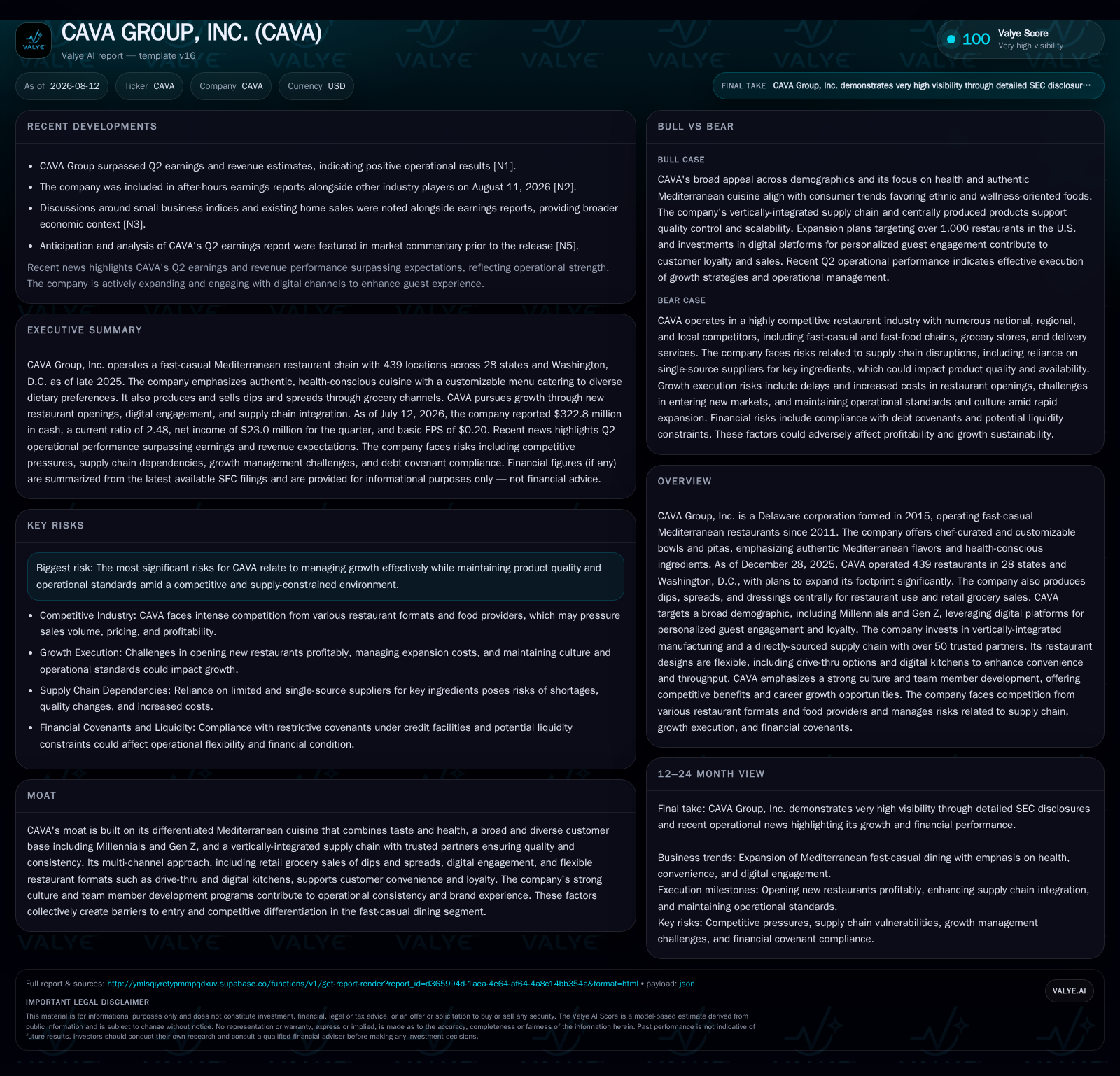
CAVA Group accelerated restaurant openings to 439 units across 28 states and Washington, D.C. by year-end 2025, leveraging its Mediterranean fast-casual niche with customizable, health-conscious bowls and pitas. The company’s integration of retail packaged goods alongside digitally enhanced loyalty programs supports multi-channel revenue growth but raises operational complexity risks. Food and labor cost pressures persisted in Q2 2026, consistent with sector-wide challenges, while management emphasized technology-enabled automation to improve consistency across new and existing locations. Maintaining product quality and culture during rapid expansion remains a critical watchpoint for durable competitive positioning.
Recent Operating Update: Q2 2026 Drives Momentum during Cost Pressure
CAVA Group’s second quarter results ended July 12, 2026, underscore the company’s ongoing aggressive footprint expansion alongside rising demand for Mediterranean-inspired fast casual dining [S2][S3]. As of the end of 2025, CAVA operated 439 restaurants spanning 28 states plus Washington, D.C., reflecting an increasingly national presence beyond its founding Mid-Atlantic base [S1]. This scale positions CAVA as a distinctive player in the health-conscious fast casual segment by combining authentic flavors with menu customization—offering over 17 billion bowl or pita combinations from chef-curated ingredients [S1].
The quarter highlighted sustained digital engagement growth, with mobile app use and online ordering contributing a growing proportion of transactions. Enhanced loyalty program features are reportedly driving repeat guest visits and increased average check size [S3], aligning with broader industry shifts that reward integrated digital ecosystems tied to personalized marketing.
However, these positives were balanced by continued inflationary headwinds impacting food and labor costs—core drivers of margin pressure across the fast casual industry broadly. Management emphasized initiatives to deploy automation technologies at kitchen and front-of-house levels to streamline operations, aiming for improved throughput without compromising the Mediterranean hospitality brand experience [S2]. These efforts are critical because reproducibility of food quality and service consistency becomes more challenging as unit count grows rapidly.
Business Model: Multi-Channel Fast Casual with Vertical Integration
CAVA generates revenue primarily through in-restaurant sales of freshly prepared Mediterranean bowls and pitas. Its menu's focus on health-conscious, diet-inclusive options (vegan, paleo, keto-friendly) caters well to Millennials and Gen Z consumers who prioritize wellness alongside convenience [S1]. Monetization extends beyond restaurants into retail packaged goods—centrally produced dips, spreads, and dressings sold through grocery channels—broadening brand exposure while requiring complex supply chain coordination to maintain consistent product quality [S1].
Restaurants operate under flexible formats including traditional dine-in/takeout, drive-thru lanes, and digital kitchens designed exclusively for off-premises orders. These formats respond to rising consumer demand for convenience without undermining menu integrity or production control [S1]. Pricing is influenced by ingredient costs (notably fresh produce), wage rates reflecting labor market tightness, and competitive benchmarks set by established peers like Chipotle or Panera Bread.
Vertical integration plays a strategic role: owning manufacturing capabilities for sauces and dressings plus sourcing directly via over 50 trusted partners helps CAVA control input quality, reduce supply disruptions, and protect brand standards during large-scale rollouts [S1]. This differentiates it somewhat from fragmented fast casual competitors who rely more heavily on third-party suppliers.
Industry Structure & Competitive Positioning
The fast casual restaurant industry sits between traditional quick-service models (QSR) and full-service dining by emphasizing quality ingredients, customization options, moderate price-points, limited table service, and speed. CAVA competes against both broad-menu chains like Chipotle—which also emphasize customization—and newer ethnic-focused entrants targeting millennial palates with health-forward offerings.
CAVA's advantage is anchored in its authentic Mediterranean positioning coupled with multi-channel distribution—restaurants plus branded packaged goods—which creates diversified earning streams while reinforcing brand awareness in grocery aisles. However, peers with larger footprints benefit from greater economies of scale in procurement and marketing spend. Furthermore, competition from delivery platforms offering wide cuisines complicates customer acquisition strategies in digital channels.
Operating challenges typical for this commodity-like space include sustaining food quality as throughput rises; managing labor availability given wage inflation; adapting store formats quickly; navigating fluctuating commodity prices particularly fresh vegetables; and maintaining guest experience consistency across geographies [S1].
Growth Drivers
Emerging consumer trends favoring ethnic cuisine diversity, meal personalization, combined with wellness-centric diet adherence underpin CAVA's growth opportunity [S1]. The company’s stated ambition to reach over 1,000 units in the U.S. by 2032 rests on replicating its chef-curated formula nationally while leveraging technology to enhance operational efficiency [S1].
Digital ordering penetration is a key growth engine—where higher margin off-premise sales offset some dine-in volatility—and loyalty program engagement fuels repeat business. The retail product line extension contributes stable revenue independent of restaurant foot traffic fluctuations.
Operational improvements aimed at automating food prep steps sync with efforts to accelerate throughput per location without inflating labor costs excessively. Geographic expansion into underpenetrated states alongside diversified restaurant formats (including drive-thru) taps into convenience-driven consumption behaviors post-pandemic [S2].
Innovation pipeline includes new menu items catering to dietary trends (e.g., keto-friendly choices) that expand addressable markets while reinforcing brand relevance. Monitoring same-store sales growth remains critical to validate customer retention amid increasing unit economics pressure.
Risks & Watchpoints
While scaling rapidly provides strategic momentum, it carries inherent execution risks that could impair product quality or guest satisfaction if not managed diligently [S1]. Maintaining consistent culinary standards during growth requires continuous training investment amidst elevated labor turnover risks common in this sector.
Supply chain complexity increases as retail packaged goods volumes grow alongside restaurant needs. Any disruption or compromise in ingredient freshness impacts brand trust disproportionately compared to peers offering less perishable products.
Competition intensifies from both entrenched players leveraging superior scale economics and nimble startups capitalizing on ethnic or regional niches similar to CAVA's target demographic. Price sensitivity among consumers amid inflationary pressures might constrain ability to fully pass through cost increases.
Financial covenant constraints embedded in debt facilities could limit flexibility if cash flow generation falters due to macroeconomic shocks or operational missteps [S4][F1]. Rapid innovation cycles must balance risk of alienating loyal customers against potential incremental traffic gains.
What To Watch Next
Key demand markers include quarterly same-store sales trends evidencing customer retention versus reliance on new unit openings. Margins benefit metrics will center on food cost control improvements complemented by labor productivity gains tied to automation rollout effectiveness.
Retail channel sales volume trajectory is another critical milestone; achieving meaningful shelf presence while avoiding channel conflict remains delicate. Digital sales penetration rates within total revenue will reveal strength of personalized engagement strategies.
Capital expenditure pacing aligned with growth targets will indicate management’s confidence level amid economic uncertainty. Monitoring supply chain partner expansions or bottlenecks provides early warning about scalability constraints.
Financial Profile Discussion
The absence of significant outstanding debt reflects conservative leverage positioning, but future facility draws could increase financial risk if earnings volatility arises from competitive or macroeconomic factors [S4][F1]. Capital investments focus mainly on asset-light restaurant build-outs incorporating digital kitchen infrastructure to enable faster throughput.
Management continues investing heavily into team member development programs rooted in company culture—a non-financial asset important for operational consistency but associated with upfront cost recognition impacting near-term profitability metrics [S1].
This analysis integrates recent SEC filings through August 12, 2026 ([S2],[S3],[S1]) supported by company-specific financial snapshot data ([F1]) within the context of fast casual industry dynamics derived from sector knowledge frameworks. It emphasizes a fact-based understanding of operations combined with cautious interpretation regarding scalability risks amid an intensifying competitive environment. No investment research views are provided herein.
Disclaimer: This is research-only, informational analysis and not investment advice. It may include AI-generated interpretation and general industry context. Always verify important details using primary sources.

Comments