
Cardinal Infrastructure Group's Backlog Growth and Capital Expansion Strengthen Regional Footprint
Robust backlog increase supported by acquisitions and organic gains underpins near-term revenue visibility amid cancellable contracts risk.
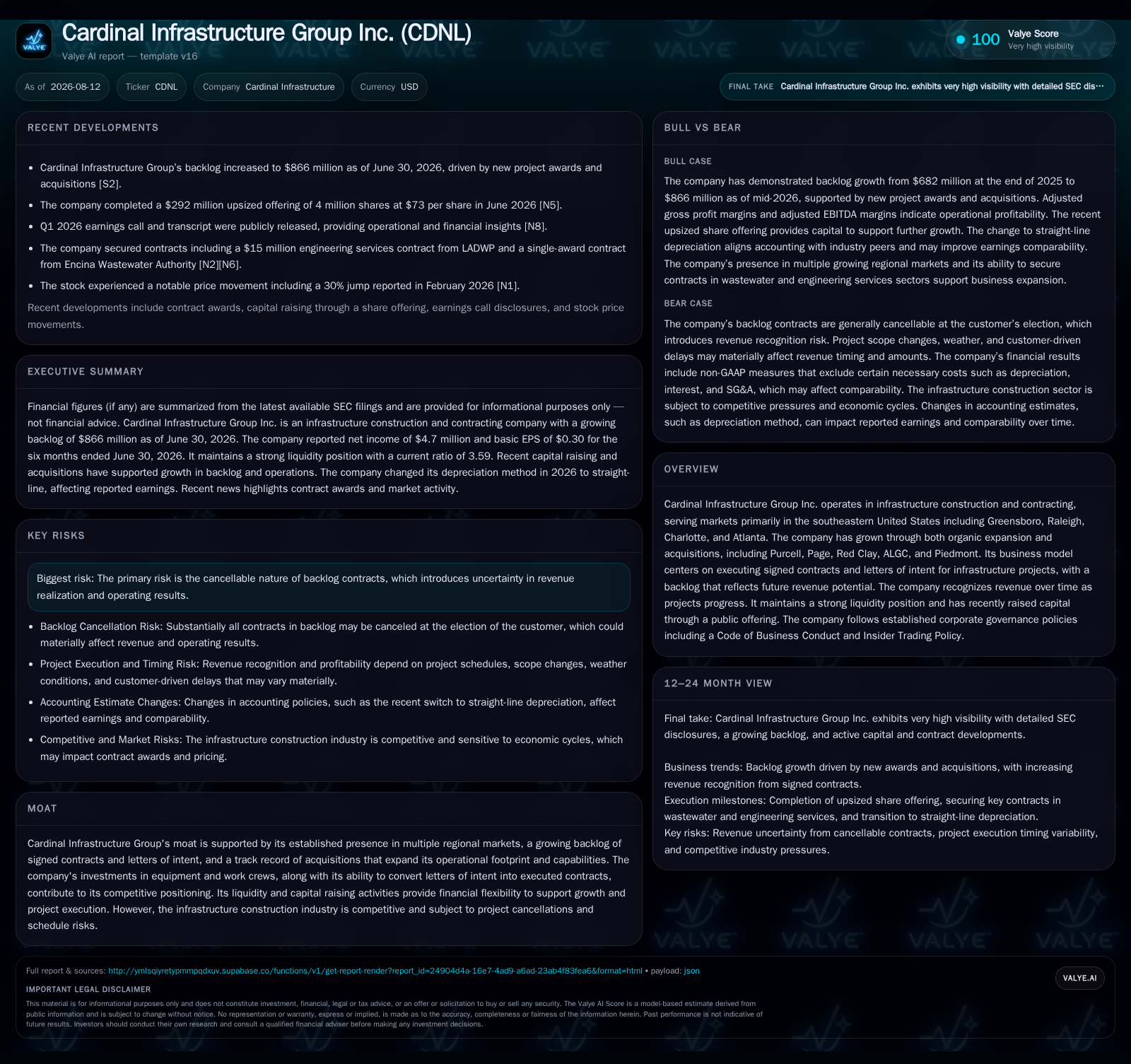
Cardinal Infrastructure Group Inc. demonstrated a significant expansion in its project backlog to $866 million as of mid-2026, driven by new contract awards across key southeastern U.S. markets and strategic acquisitions including ALGC and Piedmont. The company operates primarily in infrastructure construction with a business model centered on executing signed contracts and converting letters of intent into revenue over time, supported by investments in equipment and workforce. While the backlog growth signals strong near-term revenue potential, the cancellable nature of most contracts introduces execution risk typical in the infrastructure construction industry. Cardinal maintains a strong liquidity position with a current ratio exceeding 3.5 and manageable net debt levels, buttressed by recent capital raises to finance fleet expansion and acquisitions. Key upcoming indicators include contract conversion rates from letters of intent and timely project execution amid competitive pressures in regional infrastructure contracting.
Recent Operating Update and Why It Matters
Cardinal Infrastructure Group’s latest quarterly filing as of August 12, 2026, reveals robust momentum in its core infrastructure construction business with backlog growing from $682 million at the end of 2025 to $866 million by mid-2026 — a year-over-year gain exceeding 27% [S2]. This sizeable expansion arises from a combination of organic new project awards across established southeastern U.S. markets (including Greensboro, Raleigh, Charlotte, and Atlanta) alongside strategic tuck-in acquisitions made in late 2025 and early 2026 (notably Purcell, Page, Red Clay in 2025 followed by ALGC and Piedmont in 2026) [S2, S3].
This growth matters because backlog serves as the primary leading indicator for future revenue streams given Cardinal’s contractual model: it recognizes revenues over time based on work completed on signed contracts or converted letters of intent [S2]. The company expects to convert between roughly $734 million and $812 million of this backlog into revenue over the coming twelve months [S2], underscoring considerable near-term visibility compared to many peers where backlog may have shorter duration or lower visibility.
Cardinal’s latest update also highlights that while most contracts are cancellable at customer discretion — an industry norm — past experience shows minimal material adverse effect from cancellations or modifications so far [S2]. Nonetheless, this remains a watchpoint given how cancellations could impact realized revenues or project scheduling if economic or regulatory conditions shift unexpectedly.
Business Model: Contract Execution Anchored by Regional Focus and Acquisition Strategy
Cardinal operates primarily as a regional infrastructure contractor focused on civil works including roads, bridges, utilities support, and related public infrastructure projects within the southeastern United States — mostly North Carolina and Georgia metro areas [S1]. The company monetizes by bidding for contracts issued mostly by government agencies or private developers. Once projects are awarded via signed contracts or confirmed letters of intent (which imply principal agreement but pending full execution), revenue is recognized proportionally over time as work progresses.
Critical operating variables include:
- Backlog composition: Cardinal’s signed contracts ($701 million) form the bulk of its backlog with more committed revenue streams; letters of intent ($165 million) represent contingent projects expected to convert but subject to final approvals or negotiations [S2].
- Contract conversion: Conversion rates from LOI to signed contract are key early signals for sustaining backlog growth.
- Capital investment: The company actively invests capital expenditures into equipment fleets (trucks, trailers, asphalt plants) tailored to specific project demands; these investments both enable scaling operations capacity and serve as tangible assets supporting contracted work execution [S1].
- Labor force: Work crews sized appropriately ensure project timelines meet contract requirements.
Cardinal has demonstrated disciplined organic growth complemented by strategic acquisitions that broaden geographic reach and technical capability—typical for infrastructure contractors seeking economies of scale regionally without extending into national heavy civil sectors. This dual approach supports steady backlog replenishment while enhancing operational flexibility.
Industry Structure and Competitive Position
The infrastructure construction industry is capital intensive with companies competing primarily on execution capability, local market presence, equipment availability, pricing bids, and regulatory compliance. Firms typically face significant schedule risks from weather disruptions or client-driven scope changes alongside cyclical demand linked to public infrastructure spending patterns.
Within this landscape:
- Cardinal positions itself among regional contractors leveraging deep roots in southeastern markets, differentiating by maintaining sizable fleets and experienced work crews enabling timely project completion.
- Peers like Granite Construction or MasTec operate nationally with broader geographic diversification but often face different scale dynamics; large firms such as Fluor or Jacobs focus more on heavy civil/megastructures.
- Public sector clients (local governments) compose a large share of demand given historically stable funding flows through state-level transportation budgets alongside federal stimulus programs.
- The company’s growing backlog coupled with acquisition integration success enhances competitive positioning against peers reliant more heavily on organic bids alone.
Growth Drivers
Key drivers supporting Cardinal's growth trajectory include:
- Backlog Expansion: New project awards surged markedly—from $319 million new awards during H1 2025 to $578 million in H1 2026—reflecting both market demand increases and stronger win rates aided by acquisition synergies raising presence in target metros [S2].
- Conversion Efficiency: Investment in sales capabilities improves the rate at which preliminary commitments (letters of intent) transition into signed binding contracts, expanding reliable revenue streams.
- Capital Expenditures: Growing CapEx budget (~$43.8M net in 2025 rising relative to previous years) funds new asphalt manufacturing facilities and fleet upgrades essential for bidding larger or multiple simultaneous projects without capacity constraints [S1].
- Urbanization & Stimulus Spending: Southeastern urban centers have elevated infrastructure needs underpinned by federal stimulus programs targeting roads/bridges renewal—a structural source bolstering project pipelines.
- Acquisitions: Recent deals like ALGC/Piedmont infuse both manpower and equipment access rapidly scaling operational footprint at lower cost than greenfield expansions [S2,S3].
Risks / Watchpoints / Growth Constraints
Despite visible growth avenues, notable risks include:
- Backlog Cancellability: Nearly all contracts allow customer cancellation potentially affecting expected revenues; although past cancellations have been immaterial [S2], this characteristic injects variability common throughout infrastructure contracting.
- Schedule Delays: Weather disruptions or permitting/regulatory hurdles can slow projects reducing cash flow timing or escalating costs.
- Cost Overruns: Rising labor/materials/equipment costs pressure margins if not adequately priced into bids.
- Competitive Pressure: Multiple regional players bid aggressively potentially compressing pricing power.
- Acquisition Integration Risk: Challenges incorporating acquired entities’ operations without disrupting workflows could delay anticipated synergies.
- Liquidity Dependency: Maintaining sufficient liquidity is crucial given upfront capital outlays before contract billing milestones; any tightening could constrain project financing.
Monitoring KPIs like utilization rates for labor/equipment alongside contract renewal rates will be important mitigants against these risks.
What to Watch Next
Market participants should track:
- Quarterly updates on backlog size/composition covering both signed deals versus letters of intent to gauge pipeline health beyond reported figures [S10,S18].
- Progress converting LOIs into executed contracts indicating sales momentum sustainability.
- CapEx deployment pace reflecting readiness for anticipated project ramp-ups including completion timelines for asphalt plants.
- Operating margin trends verifying ability to hold pricing amid inflationary cost inputs.
- Any announcements regarding project cancellations or significant schedule shifts demonstrating risk crystallization.
- Integration progress reports concerning recent acquisitions ALGC & Piedmont revealing operational impact on staffing/equipment/fleet efficiency.
Financial Profile Discussion
Cardinal Infrastructure maintains a strong liquidity position essential for its working capital-intensive operating model. As of June 30, 2026:
- Current assets stood at approximately $555 million against current liabilities near $154 million yielding a current ratio around 3.59—an ample buffer supporting ongoing contract execution activities [F1].
- Total debt outstanding was about $11 million net as per latest balance sheet metrics—manageable relative to cash balances underpinning short-term obligations [F1].
- The company has raised capital recently via public offerings allowing both fleet expansion investments and funding acquisitions critical for continued geographic footprint growth [S1,S2].
While infrastructure construction companies often carry leverage linked to equipment financing or credit facilities supporting large project cycles, Cardinal’s prudent balance sheet choices aid financial flexibility mitigating liquidity risk amid cyclical sectoral demand variations.
© Valye News retains editorial independence despite use of publicly available data sources; this analysis excludes investment advice.
Disclaimer: This is research-only, informational analysis and not investment advice. It may include AI-generated interpretation and general industry context. Always verify important details using primary sources.

Comments