
TScan Advances TCR-T Therapy Amid Clinical Focus Shift and Financial Constraints
TScan Therapeutics prioritizes its heme malignancies Phase 3 trial while managing cash runway challenges and manufacturing dependencies.
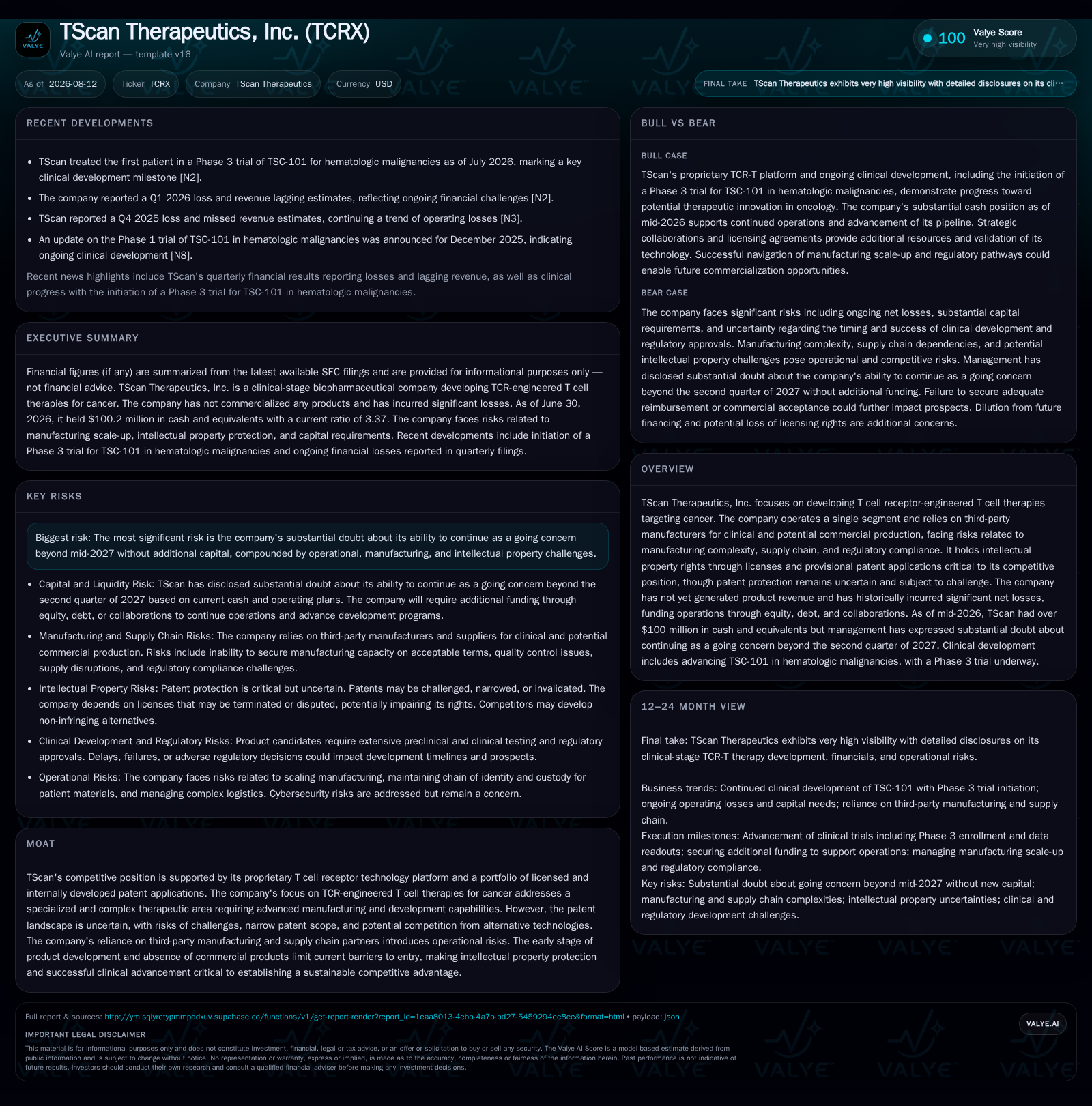
TScan Therapeutics, a clinical-stage biotech developing T cell receptor-engineered T cell therapies for cancer, reported Q2 2026 results with continued net losses and a shrinking cash runway now extended only through mid-2027. The company recently shifted strategic focus toward its heme malignancies program, initiating a Phase 3 trial for TSC-101 while pausing solid tumor enrollment. Reliance on third-party manufacturing and intellectual property uncertainties remain notable risks. Successful Phase 3 progression and capital raises will be crucial milestones for validating TScan’s business model and bridging to potential commercialization.
Recent Operating Update
Notably, TScan has reprioritized its clinical development pipeline by commencing patient enrollment in the Phase 3 trial of TSC-101 targeting hematologic malignancies in mid-2026 ([N4]). Concurrently, the company paused solid tumor Phase 1 enrollment to concentrate preclinical efforts on in vivo T cell engineering and autoimmune disease target discovery ([S21]). This shift aligns resources toward near-term pivotal readouts for its lead heme oncology candidate, with topline Phase 3 data anticipated in 2028 ([N3]).
Business Model Analysis
TScan operates as a clinical-stage biotechnology company focusing exclusively on developing engineered T cell receptor (TCR) therapies for oncology indications. Its core revenue mechanics currently hinge on research collaborations and licensing agreements rather than product sales since no candidates have obtained regulatory approval or commercialization status yet ([S1]).
The company’s value proposition rests heavily on its proprietary TCR platform designed to redirect patient T cells against cancer antigens. However, the drug development pathway involves costly preclinical studies and protracted clinical trials due to the biological complexity underlying adoptive cell therapies. Revenue generation is ultimately contingent upon regulatory approval—an inherently binary milestone influencing licensing deal terms and commercial market access.
Manufacturing is outsourced entirely to third-party contract manufacturing organizations (CMOs), a common industry practice given the specialized processes required for biologics like engineered T cells. This arrangement injects dependencies related to production scale-up reliability, quality control adherence, and regulatory compliance at multiple steps ([S1]). Manufacturing batch success rates and capacity utilization are thus critical operational KPIs impacting timelines and margin prospects once commercialized.
Intellectual property (IP) protection forms another pillar underpinning TScan’s strategic positioning. It holds a portfolio combining licensed patents and internally filed provisional applications that safeguard its platform technologies ([S1]). Yet patent challenges loom as material risks due to potentially narrow patent claims or oppositions by competitors. Maintaining enforceable IP rights will be vital for deterring rivals including other developers specializing in TCR or CAR-T modalities such as Adaptimmune or Kite Pharma.
Industry Structure And Competitive Positioning
Within the broader biotechnology sector focusing on cell therapy and immuno-oncology, TScan sits upstream in discovery and clinical development rather than commercialization or marketing phases. Peers such as Adaptimmune Therapeutics or Immunocore similarly navigate comparable clinical advancement hurdles but may differ in targeting strategies or partnership models.
Competition bases itself not only on clinical efficacy but also on platform versatility (antigen targets), manufacturing scalability, safety profiles, and regulatory progress pace. Unlike large pharma entities with immuno-oncology franchises capable of rapid late-stage trials and commercialization ramp-up, companies like TScan depend heavily on capital markets access coupled with strategic collaborations.
The licensing landscape often sees early-stage firms encourage partnerships with pharma companies who assume later-stage development risks in exchange for royalties or milestone payments. Thus, prospective collaborations represent both funding sources and validation signals for emerging cell therapy companies.
Growth Drivers
TScan’s near-term growth vector hinges on successfully enrolling patients into its Phase 3 study of TSC-101 for hematologic cancers ([N4]). Achieving predefined efficacy endpoints could unlock regulatory submission pathways leading potentially to market authorization—a gateway event transforming the company from R&D stage into a product-generating biotech.
Continual expansion of their pipeline through target discovery programs, particularly focusing on solid tumors via novel in vivo engineering approaches, also underpins longer-term growth aspirations ([S21]). Advancements in gene editing or synthetic biology platforms could enhance therapeutic efficacy or reduce manufacturing complexity over time.
Strategic partnerships remain a plausible source of non-dilutive funding and shared technical expertise; however, no major deals beyond existing collaborations were disclosed recently. Favorable future collaboration structures coupled with successful IP prosecution would bolster financial sustainability.
Finally, improvements in manufacturing process efficiency—specifically batch success rate enhancement—would ease cost pressures associated with commercial-scale production.
Risks And Watchpoints
The most acute risk confronting TScan is financial sustainability. Management explicitly underscores substantial doubt regarding continuation past Q2 2027 without additional funding secured promptly ([S2]). Failure to raise sufficient capital could compel delays or cancellations in clinical trials or force unfavorable asset sales compromising future prospects.[S2]
Clinical trial risk pervades throughout: delays or unsuccessful outcomes can stall valuation inflection points significantly given the all-or-nothing nature of late-stage oncology trials ([S1]). Beyond clinical aspects, reliance on third-party manufacturers presents supply chain vulnerability; any disruption may impede timely trial execution or cGMP compliance jeopardizing regulatory submissions.[S1]
Intellectual property coverage remains uncertain due to ongoing patent prosecution complexities documented by the company ([S20]). Legal disputes could arise involving enforcement costs or invalidation proceedings that diminish competitive exclusivity crucial for financiers’ confidence.
Reimbursement uncertainties also merit consideration though primarily relevant at commercialization stage: securing adequate payor coverage will influence pricing power impacting long-term revenue quality ([S1]).
What To Watch Next
Key upcoming milestones include continued patient recruitment updates from the Phase 3 TSC-101 trial and interim safety/efficacy data releases potentially anticipated within the next year.[N4] Market observers should monitor management commentary around patient enrollment cadence as an indicator of operational execution capability.
Additionally, any announcements concerning new collaborations or licensing deals would reflect ongoing external validation of pipeline potential amid capital constraints.[S2]
Financially, quarterly burn rates relative to cash position updates will signal runway extension prospects; any material capital raises or restructurings should be scrutinized carefully given current going concern caveats.[F1], [S2]
Finally, developments around intellectual property grants or disputes could materially impact strategic barriers protecting innovation assets.
Financial Profile Discussion
TScan’s financial profile typifies an advanced-stage biotechnology firm still engaged fully in R&D investment without product sales revenue. As of June 30, 2026, cash reserves were approximately $100 million against total debt near $32.5 million resulting in a healthy current ratio of about 3.37 reflective of short-term liquidity adequacy ([F1]).
Operating expenses are poised to rise further due to intensified clinical activity including costly Phase 3 trials plus incremental public company-related costs such as compliance infrastructure ([S2]). Management forecasts this elevated expenditure profile will exhaust current resources by second quarter 2027 absent additional fundraising activities ([S2]).
Historically financed via equity offerings (including a $30 million pre-funded warrant issuance in late 2024) alongside convertible debt instruments ([S8]), future financing events may dilute shareholders but are essential given the negative free cash flow backdrop typical in this space until product approval commercialization stages are entered.[S12]
Overall, while liquidity remains sufficient near term under planned budgets, bridging the gap through pivotal data milestones with adequate capital is more critical than ever as failure might force program cuts detrimental to enterprise value preservation.
Disclaimer: This analysis is intended solely for informational purposes reflecting facts supported by public disclosures as of August 2026 and does not constitute investment advice.
Disclaimer: This is research-only, informational analysis and not investment advice. It may include AI-generated interpretation and general industry context. Always verify important details using primary sources.

Comments