
flyExclusive Faces Liquidity and Legal Risks Amid Seasonal Charter Demand Growth
Latest quarterly filing reveals liquidity constraints, ongoing legal disputes, and seasonal operational strength at flyExclusive.
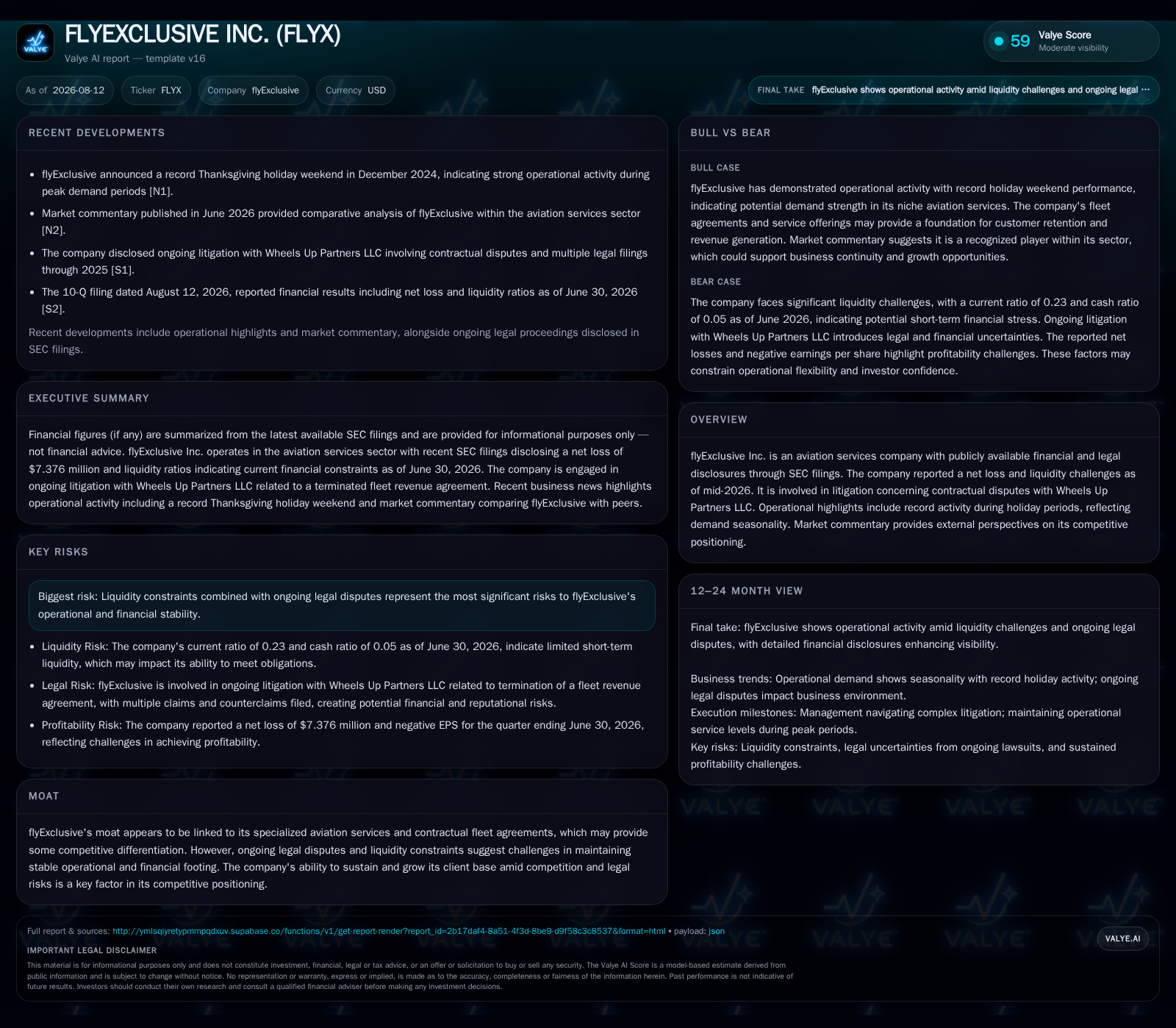
flyExclusive Inc., an aviation services company specializing in charter flight operations tied to contractual fleet agreements, reported a challenging financial and legal environment as of mid-2026. Its latest quarterly filing highlights continued net losses, a low current ratio indicating liquidity strain, and unresolved litigation with Wheels Up Partners LLC affecting its fleet utilization and revenue stability. Despite these headwinds, operational activity peaked during holiday seasons, reflecting the industry's demand seasonality. The company's strategic position depends on managing contractual fleet relationships and navigating financial constraints amid competitive pressures.
Recent Operating Update: Q2 2026 Financials and Event Highlights
flyExclusive's latest quarterly filing dated August 12, 2026 ([S2], [S3]) reveals continued financial pressure characterized by an unrelenting net loss trajectory and strained liquidity. The company recorded cash and equivalents of approximately $14.2 million at quarter-end June 30, 2026, against a substantial total debt load near $104 million ([F1]). This results in an alarming current ratio of just 0.23 ([F1]), signaling immediate short-term liquidity challenges that are critical given the highly fixed-cost nature of aviation services. Operationally, flyExclusive noted record activity during peak holiday season periods within the quarter ([S2]), consistent with established seasonality trends in private charter demand.
These developments come during ongoing legal disputes that are materially relevant to flyExclusive's business model. A protracted contractual conflict with Wheels Up Partners LLC centers around the termination of a Fleet Guaranteed Revenue Program Agreement initially signed in November 2021 ([S1], [S19]). Wheels Up alleges wrongful termination by flyExclusive and has initiated lawsuits both in federal and state courts ([S1]). These disputes threaten fleet availability and revenue continuity because such contractual fleet agreements underpin flyExclusive’s guaranteed revenue streams. Resolution outcomes will significantly influence the company's ability to sustain utilization levels critical for mitigating high fixed operating costs.
Business Model Analysis
flyExclusive operates primarily as an aviation services provider focused on aircraft charter operations augmented by contractual fleet management agreements. Customers typically include private clients and corporate entities seeking on-demand or membership-based access to private flights. Revenue derives mainly from hourly charges on flight operations under both direct charters and guaranteed revenue contracts with parties like Wheels Up ([S1]). These agreements grant predictable utilization patterns but expose flyExclusive to counterparty risks as seen in current litigation.
The business requires balancing fleet utilization—quantified through flight hours operated—and customer contract renewal rates to achieve stable recurring revenues. High fixed costs such as maintenance, crew management, insurance, and regulatory compliance mean that achieving strong operating leverage hinges on efficient capacity management. Seasonal peaks during holidays drive higher utilization but also compression risks during off-peak periods. FlyExclusive’s ability to maintain or grow its client base amid competitive pressure relies heavily on operational reliability (on-time performance) and service differentiation via contractual guarantees.
Industry Structure and Competitive Position
The broader aviation services market comprises private jet charter operators, fractional ownership firms, aircraft leasing specialists, and corporate flight departments. flyExclusive sits between pure charter providers like XOJET or VistaJet and fractional ownership leaders such as NetJets or Flexjet, with its niche centered on contractual partnerships guaranteeing minimum revenues from managed fleets ([S1]).
Wheels Up is both a litigant adversary and a peer within this membership-driven charter landscape—highlighting intense competition where customer retention through contracts sustains fleet economics. Peers benefit from scale effects in negotiations for maintenance, fuel procurement, crew training, and regulatory compliance that can lower operating costs per flight hour relative to smaller operators like flyExclusive.
The firm’s moat is partial: while contractual guarantees provide some revenue stability uncommon among spot-market-only charters, exposure to legal disputes with major partners erodes this advantage. In addition, liquidity constraints may impair flyExclusive’s ability to invest in fleet modernization or new service expansions compared to more financially robust peers.
Growth Drivers
Growth prospects are linked mainly to expanding demand for private air travel driven by increasing corporate travel needs post-pandemic recovery cycles and rising affluent consumer segments valuing time-efficiency over commercial flights ([S2]). Membership or subscription-based models continue gaining preference due to enhanced flexibility versus fractional ownership paradigms.
FlyExclusive’s recent merger transactions culminating in July 2026 with Jet.AI illustrate strategic efforts to consolidate technology capabilities or scale operations ([S7], [S8]). Such corporate maneuvers aim to enhance booking efficiencies, customer engagement platforms, or asset utilization analytics—factors poised to boost revenue per available flight hour if successfully deployed.
Seasonality effects remain strong; holiday quarters demonstrate step-ups in flight hours operated evidencing robust demand spikes essential for recovering margin compression during trough periods ([S2]). Contractual expansions or renewals also form a pillar of sustained growth tied tightly to customer retention metrics within managed fleet programs.
Risks and Watchpoints
Primary risks remain liquidity constraints exacerbated by a very low current ratio restricting operating cash flow flexibility ([F1]). High leverage limits capacity for capital expenditure needed for necessary maintenance upgrades impacting safety compliance and regulatory adherence.
Legal disputes with Wheels Up represent significant tail risk capable of disrupting contracted flight hours pivotal to revenue forecasts ([S1], [S19]). Prolonged litigation can lead either to contract loss or costly settlements reducing profitability margins.
Customer concentration risk compounds threats as reliance on a few large contractual partners amplifies volatility in renewal likelihoods.
Market competition from larger peers endowed with deeper capital pools puts additional pressure on pricing power—especially critical when spot charters proliferate as alternatives during off-peak demand.[
Watchpoints include upcoming court rulings or settlement progress concerning Wheels Up claims; quarterly updates on cash burn rates; contract renewal announcements; reported flight hours by quarter showcasing seasonality execution; plus integration milestones related to Jet.AI merger synergies.
What to Watch Next
Investors should monitor:
- Progress in legal dispute resolution timelines particularly any material settlements or dismissals affecting guaranteed revenue contracts.
- Improvement (or further deterioration) in liquidity ratios signaling operational sustainability.
- Seasonal Q4 2026 activity spikes reflecting ability to capitalize on peak demand windows.
- Updates on merger integration between flyExclusive and Jet.AI enabling scalability or technology-driven efficiency gains.
- Changes in debt structure refinancing attempts or covenant amendments relieving near-term balance-sheet pressures.
Financial Profile Discussion
At quarter-end June 30, 2026,[F1] flyExclusive displayed cash reserves near $14 million juxtaposed with sizable total debt exceeding $104 million leading to net debt approximation of $89.8 million. The company’s current assets of roughly $63.5 million are dwarfed by massive current liabilities totaling over $278 million resulting in a critically low current ratio of about 0.23—a clear stress signal regarding short-term debt servicing abilities.[F1]
This financial posture places intense pressure on cash conversion cycles requiring either operational cash flow improvements or external funding sources for continuity [F1]. Operating loss trends underscore ongoing negative free cash flow which may necessitate asset sales or equity issuance if organic growth fails to offset obligations.
In conclusion, flyExclusive faces substantial near-term challenges from an operational liquidity perspective compounded by ongoing material litigation risks that affect the very contractual backbone supporting its revenue streams. While seasonal rebounds offer upside potential reflective of broader aviation service market dynamics, sustainable profitability depends critically on dispute resolution success coupled with balanced capital structure management amidst competitive member-driven charter landscapes.
Disclaimer: This is research-only, informational analysis and not investment advice. It may include AI-generated interpretation and general industry context. Always verify important details using primary sources.

Comments