
Invech Holdings Faces Scale and Capital Constraints in Microcap Compliance Consulting
IVHI operates a niche compliance consulting business for microcap public companies but has yet to generate revenue amid ongoing losses and limited resources.
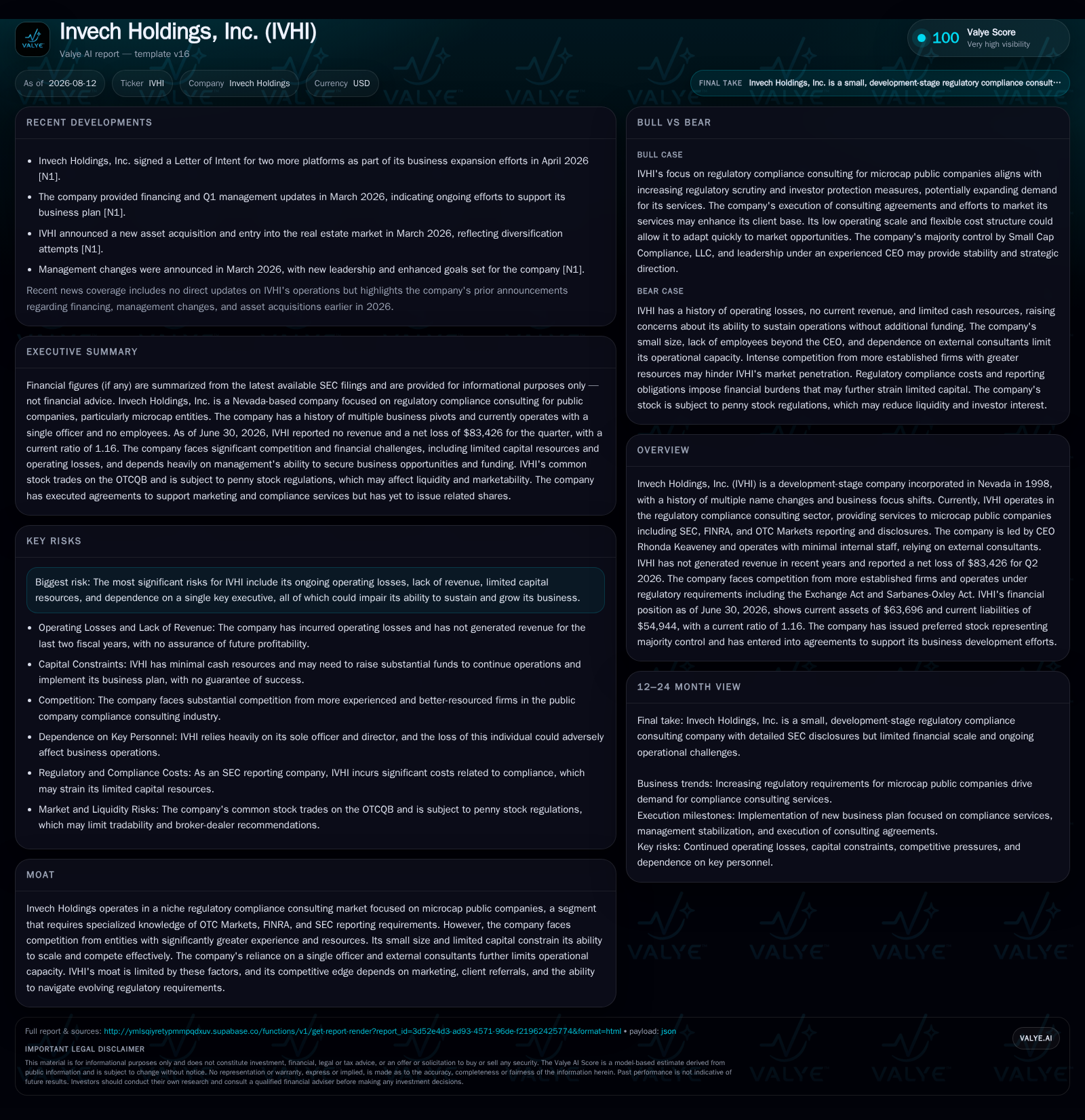
Invech Holdings, Inc. remains a development-stage company focused on regulatory compliance consulting for microcap public companies, primarily supporting SEC, FINRA, and OTC Markets reporting requirements. Despite the growing complexity in public company compliance driving demand industry-wide, IVHI has not generated revenue in recent years and continues to incur operating losses while relying on minimal internal staff and external consultants. The company's small scale, limited capital resources, and dependence on a single key executive hinder its ability to compete with more established firms in the sector. IVHI’s future growth depends on expanding its client base through marketing and referrals, but financial sustainability remains an open question given current cash levels and historical results.
Recent Operating Update
The latest quarterly filing dated August 12, 2026, reveals that Invech Holdings continues operating without revenue generation while incurring net losses; specifically, a loss of $83,426 was reported for Q2 2026 [S2]. This marks an extended period without top-line inflows as the company transitions to focusing exclusively on regulatory compliance consulting services for microcap public companies. The firm's current asset base stood at $63,696 with liabilities of $54,944 as of June 30, 2026, yielding a current ratio of approximately 1.16 [F1]. Notably, IVHI carries no long-term debt as of this date [F1], which limits leverage risk but also reflects constrained capital availability for scaling operations.
A recent event filing on August 3 disclosed an ownership transaction involving the majority shareholder selling a significant block of common and preferred shares to a new buyer under a stock purchase agreement [S3]. Meanwhile, the company divested its Paragon Assets real estate software platform during the same period to an affiliated entity [S3], signaling strategic focus sharpening away from diversified holdings toward core consulting services.
Business Model Analysis
Invech's business model centers on providing advisory and fulfillment services needed by microcap public companies to comply with complex SEC filings (such as Form 10-Qs), FINRA regulations, and OTC Markets disclosure requirements. These clients typically lack the internal infrastructure or expertise to navigate demanding regulatory frameworks like the Exchange Act and Sarbanes-Oxley Act. Consequently, they outsource necessary tasks such as preparing financial reports, ensuring timely submissions aligned with strict reporting deadlines, managing corporate governance documentation, and mitigating compliance risks.
Monetization arises primarily through consulting fees charged per engagement or ongoing retainer arrangements. Because microcaps usually operate under cost pressures with smaller budgets than mid- or large-cap firms, average contract sizes tend to be low. Operationally, IVHI appears to sustain its services with minimal full-time personnel led by CEO Rhonda Keaveney supplemented by external consultants [S1]. This delivery model reduces fixed overhead but also caps potential billable hours and limits responsiveness—critical factors impacting client retention rates and revenue per consultant.
Effective client acquisition strategies hinge on building reputation via referrals and targeted marketing campaigns tailored to this niche segment [S1]. Success depends heavily on proving credibility in delivering flawless regulatory filings with zero deficiencies—a metric crucial to sustaining long-term client relationships given the reputational risks faced by public companies in case of non-compliance.
Industry Structure and Competitive Position
The regulatory compliance consulting industry serving public companies encompasses a spectrum ranging from large integrated accounting/legal firms offering bundled services to boutique specialists focusing narrowly on segments like microcap or OTC-listed entities. Invech sits at the low end of the scale specializing in microcaps where regulatory complexity is high relative to client internal resources but engagement sizes remain modest.
Competitors often include well-established professional service networks benefiting from broader brand recognition, deeper capital reserves for service expansion, higher consultant headcount enabling broader geographic coverage and faster turnaround times, plus investments in proprietary software enhancing filing accuracy and timeliness.
IVHI’s competitive moat is shallow due to these scale disadvantages combined with reliance on external contractors rather than building an internal bench. However, niche positioning enables targeting clients overlooked by larger players due to their size or limited wallet share.[S1]
Pricing power is subdued in this space as competing firms frequently engage in aggressive fee discounting given fragmented demand among numerous small clients. Moreover, substitute offerings from emerging compliance automation platforms could pressure consulting margins further by shifting routine filing tasks away from human advisers.
Growth Drivers
Several secular trends support medium-term growth prospects for compliance consultancies specializing in microcap markets:
- Increasing Regulatory Complexity: Heightened enforcement from SEC and FINRA coupled with evolving disclosure requirements under Sarbanes-Oxley enhance demand for expert guidance.
- Growth in Microcap Listings: New IPOs or uplistings raise the number of entities needing outsourced assistance.
- Outsourcing Trends: Cost-conscious companies continue favoring external consultants over costly internal compliance departments.
- Referrals and Reputation Effects: Positive client outcomes drive word-of-mouth growth opportunities critical for smaller firms lacking broad marketing reach.
To translate these into sustained revenue growth, IVHI must expand its client engagements count while maintaining impeccable timeliness of filings and minimizing error rates—KPIs directly correlating with client retention rate and average fee per engagement.
Risks and Constraints
IVHI faces multiple inherent risks that constrain its scalability:
- Operating Losses & Revenue Absence: The inability to generate revenue raises questions about financial sustainability absent successful business development efforts [S2].
- Capital Limitations: With only modest current assets relative to liabilities (current ratio ~1.16) [F1], there is limited runway to invest in marketing or incremental staffing essential for scaling.
- Key Personnel Dependence: Heavy reliance on CEO Rhonda Keaveney coupled with sparse internal staffing creates operational vulnerability if key individuals depart [S1].
- Competitive Pressures: Larger firms' deeper resource pools enable broader service offerings at competitive prices.
- Regulatory Environment Sensitivity: Changes reducing disclosure burdens could undermine demand; conversely rules tightening could increase service complexity but require investment outlays.
- Technology Disruption: The rise of compliance software platforms poses substitution risk especially where clients prioritize cost efficiency over bespoke consulting insight.
- Client Concentration & Market Fragmentation: Small number of clients or engagements can lead to volatile revenues.
What To Watch Next
Key milestones signaling progress include:
- Evidence of new client acquisitions manifested through disclosed engagements or elevated contract volumes.
- Improvement in quarterly financial metrics such as narrowing net losses or achieving positive operating income.
- Expansion or formalization of staffing beyond CEO-led external consultant arrangements indicating scaling capacity.
- Updates related to ownership structure following majority shareholder's pending stock sale could influence governance dynamics impacting strategic direction [S3].
- Marketing initiatives or partnership announcements that broaden referral pipelines within microcap networks.
- Adaptation or integration of technology tools that enhance productivity or differentiate service delivery in a crowded market.
Financial Profile Discussion
Invech’s financial position remains fragile due to extended absence of revenue coupled with continual operating losses reported most recently at $83K negative net income for Q2 2026 [S2]. Current assets near $64K versus liabilities about $55K place the firm just above breakeven liquidity thresholds (current ratio ~1.16) [F1]. Absent any outstanding debt positions [F1], leverage concerns are minimal; however limited capital restricts financial flexibility.
Cash burn driven by consultant fees and administrative expenses will likely persist without notable increases in collections from clients. The auditors have previously expressed doubt about continuation as a going concern due to recurring losses and minimal cash reserves [S1]. Future equity raises or other financing would be required to fund growth initiatives including marketing investments essential for client acquisition expansion. Without improvements in top-line traction or capital injections the sustainability outlook remains uncertain.
Disclaimer: This analysis is based solely on publicly available information including SEC filings dated through August 12, 2026. It does not constitute investment advice nor endorse any securities mentioned herein.
Disclaimer: This is research-only, informational analysis and not investment advice. It may include AI-generated interpretation and general industry context. Always verify important details using primary sources.

Comments