
AmBase Corp’s Litigation-Driven Asset Management Faces Capital and Going Concern Pressures
AmBase continues navigating litigation with its key real estate investment amid ongoing losses and constrained liquidity.
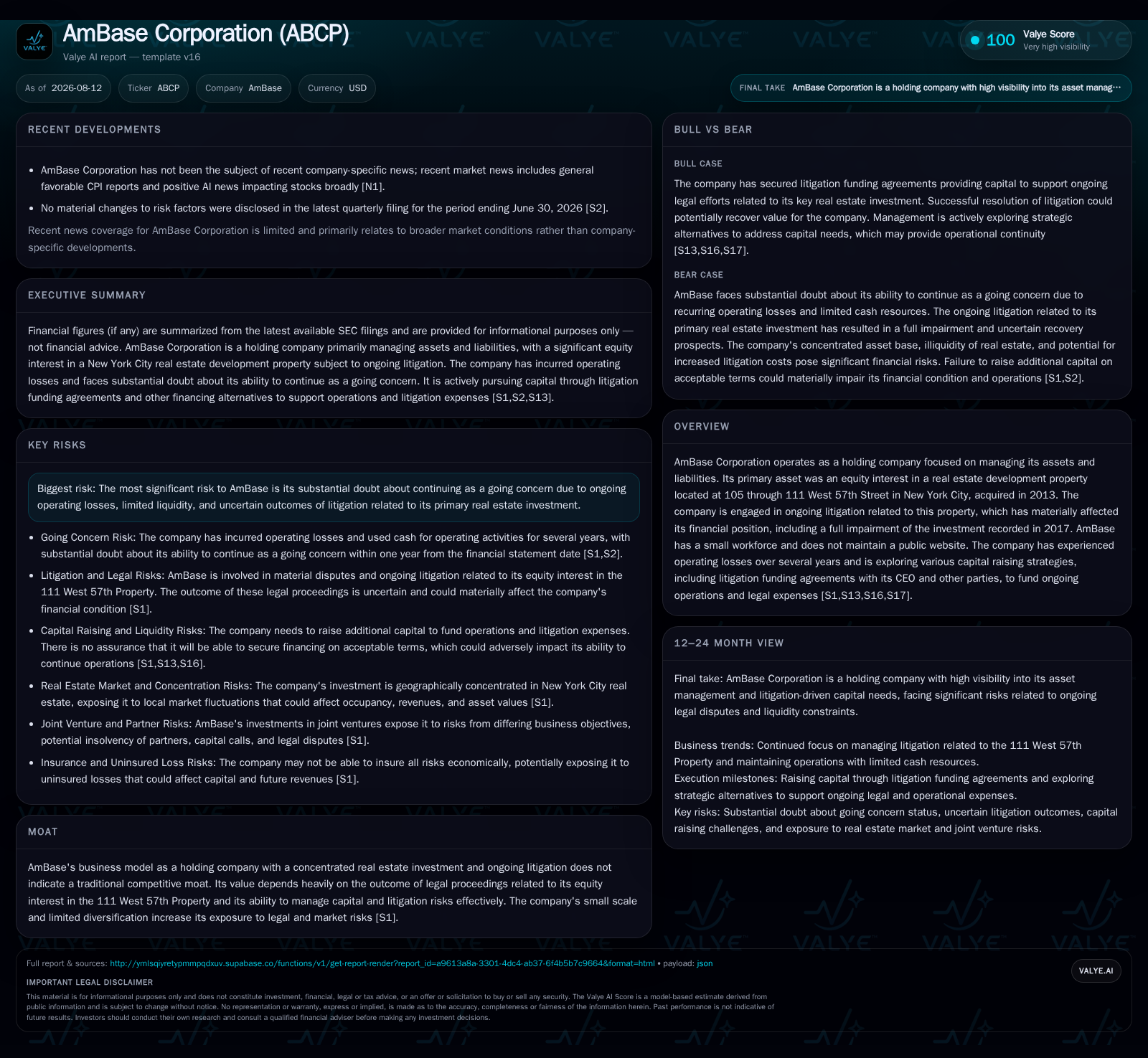
AmBase Corporation operates primarily as a holding company managing a concentrated equity interest in the 111 West 57th Street real estate venture. The company’s operational and financial profile remains dominated by protracted, material litigation surrounding this asset, which led to a full impairment of its investment in 2017. Recent quarterly disclosures reiterate ongoing operating losses, minimal liquidity, and a dependence on litigation funding agreements—particularly with its CEO—to meet continuing capital needs. Without resolution or successful capital raises, the company faces substantial doubt about its ability to continue as a going concern. This risk profile, combined with limited business diversification and a small workforce, highlights AmBase’s vulnerability in a highly competitive real estate investment landscape.
Recent Operating Update
AmBase Corp’s latest quarterly filing from August 12, 2026, confirms continuation of several critical dynamics from prior periods [S2]. The company remains mired in legal disputes regarding its equity interest in the jointly-owned real estate property at 111 West 57th Street, New York City—a single asset that dominates AmBase's portfolio. No material change in risk factors was disclosed compared to their March 2026 annual report [S1,S2], underscoring persistent uncertainty in both legal outcomes and financial viability.
A significant recent development involves capital support through litigation funding agreements. In March 2026, AmBase formalized an agreement with CEO Richard Bianco whereby he will provide up to $6 million to cover ongoing litigation expenses and working capital needs. This arrangement was supplemented by an additional $1 million infusion as of late July 2026 under similar terms [S3,S25,S16]. Such related-party financing reflects constraints in accessing traditional capital markets due to the company's protracted legal struggles and weakened financial standing.
Despite these injections, liquidity remains severely limited with net cash of only $98,000 on hand as of June 30, 2026 [F1]. The absence of recurring revenue streams beyond potential recoveries from legal proceedings amplifies dependency on external funding. The sustained operating losses further fuel concerns about AmBase's status as a going concern; management acknowledges substantial doubt regarding continued operations without successful capital raises or favorable litigation resolution [S1,S8,S12].
Business Model: Litigation-Focused Holding Company
AmBase functions predominantly as a holding entity managing its remaining asset: an equity interest acquired in June 2013 in a high-profile residential real estate joint venture spanning addresses from 105 to 111 West 57th Street in Manhattan [S1,S10]. The company does not generate operational revenues through active property management or leasing but relies on the appreciation or monetization of this investment—currently hampered by contested ownership rights due to "Strict Foreclosure" events leading to ongoing lawsuits.
The full impairment of this investment recognized in 2017 dramatically reshaped AmBase’s balance sheet and operating profile. Since then, the company’s reported financial results have reflected continual operating losses driven by legal costs rather than traditional business expenses [F1]. To sustain operations amid negligible revenues, AmBase depends heavily on litigation funding agreements that provide upfront capital but at significant repayment multiples and fees contingent on future recovery amounts [S8,S15].
This monetization strategy places considerable emphasis on managing legal expenses meticulously while pursuing potential recoveries through courts or negotiated settlements. Without successful claims or asset recovery strategies materializing, AmBase lacks alternative business lines or asset diversification to offset losses or generate cash flow.
Industry Structure and Competitive Position
AmBase resides within a narrow industry niche: holding companies with concentrated real estate investments undergoing complex litigation processes. Compared with broader real estate investment trusts (REITs) such as Hudson Pacific Properties (HPP), which derive value through property operations and income-producing leases [N10], AmBase's model lacks scale, recurring revenue streams, tenant diversification, and geographic breadth.
Other comparable entities might include companies such as MFA Financial (MFA), which manage real estate finance portfolios entailing credit risk and market exposures but generally maintain diversified asset bases and active portfolio management teams [N1]. In contrast, AmBase's concentrated exposure to a single disputed asset magnifies concentration risk.
Additionally, aspects of AmBase's capital raising via litigation funding arrangements align it tangentially with litigation finance firms that specialize in providing non-recourse funding for legal disputes; however, these specialized funders typically operate at scale with diverse portfolios of cases rather than being themselves litigant holders of impaired assets.
The company's small workforce—four full-time and two part-time employees as of December 31, 2025—limits operational capacity for proactive asset management or expansion into new investments [S1]. Its strategic focus remains anchored in navigating complex legal proceedings for the current equity interest.
Growth Drivers
Potential upside for AmBase hinges predominantly on successful resolution of ongoing litigation concerning the ownership rights and value recovery from the 111 West 57th Property. Should courts or settlements favorably recognize AmBase's interests or remuneration claims related to "Strict Foreclosure" disputes, underlying asset valuation could materially improve from its fully impaired carrying basis.
Secondary drivers include:
- Favorable shifts in Manhattan luxury real estate market conditions potentially increasing the ultimate realizable value of the development property,
- Strategic capital raises enabling sustained funding of expensive legal processes,
- Exploration of alternative monetization avenues including sale of interests or rights related to the disputed asset should settlement opportunities arise,
- Operational cost containment reducing cash burn rates during protracted legal engagement periods.
These drivers are underpinned by KPIs such as changes in estimated asset valuations post-litigation milestones, pace of capital raised under funding agreements, operating expense trends relative to available liquidity, and progress reports on material court rulings or settlement discussions.
Risks and Constraints
The most salient risks relate directly to AmBase's core strategic challenge:
- Litigation Outcome Uncertainty: There is no assurance the company will prevail in ongoing disputes affecting its landmark investment.
Closer attention may also focus on amendments or new financing agreements terms that could impact dilution risks or creditor priority positions.
Financial Profile Discussion
At quarter end June 30, 2026, AmBase reported extremely limited cash and equivalents totaling just $98,000 reflecting operational constraints tied mostly to litigation spending requirements [F1]. While total debt levels are reported from March 2024 at approximately $3.55 million with net debt around $3.45 million after subtracting cash balances [F1], more current debt figures remain undisclosed publicly.
Operating incomes have been consistently negative; for calendar year end December 31, 2025 net income was -$4.56 million driven largely by ongoing legal expenses without corresponding revenue generation capability [F1]. This loss trajectory exacerbates concerns about sustainability absent fresh external funding.
Management has explicitly stated that existing cash resources are unlikely sufficient for covering operating needs over the following twelve-month period without additional financing secured through sales of securities, debt instruments, long-term borrowings—including affiliation-backed loans—or enhanced litigation funding contracts [S1,S12,S16]. These strategic alternatives carry execution risk given prevailing market perceptions rooted in current impairment status.
Overall financial health is fragile with low working capital adequacy ratios anticipated given disparity between liabilities associated with indebtedness plus accrued legal costs against constrained liquid assets plus uncertain receivable recoveries emerging from pending cases [S1]. Going concern qualifications signal heightened credit risk while restricting access even further through traditional banking channels.
AmBase exemplifies a narrowly focused holding company confronting material operational constraints due to persistent reliance on contentious real estate joint venture litigation. Stakeholders should prioritize monitoring developments around capital adequacy measures coupled tightly with legal progression that ultimately will dictate whether long-dormant equity values can be resurrected from years-long impairments amid adversarial property ownership challenges.
This analysis synthesizes publicly filed SEC disclosures up to August 12, 2026 ([S1],[S2],[S3],[F1]) alongside peer-contextual industry understanding without constituting financial advice.
Disclaimer: This is research-only, informational analysis and not investment advice. It may include AI-generated interpretation and general industry context. Always verify important details using primary sources.

Comments