
Procaccianti Hotel REIT Extends Advisory Agreement Amid Stable Portfolio and Capital Strategy
Renewal of advisory agreement signals management confidence as Procaccianti maintains steady operations across a five-property select-service hotel portfolio.
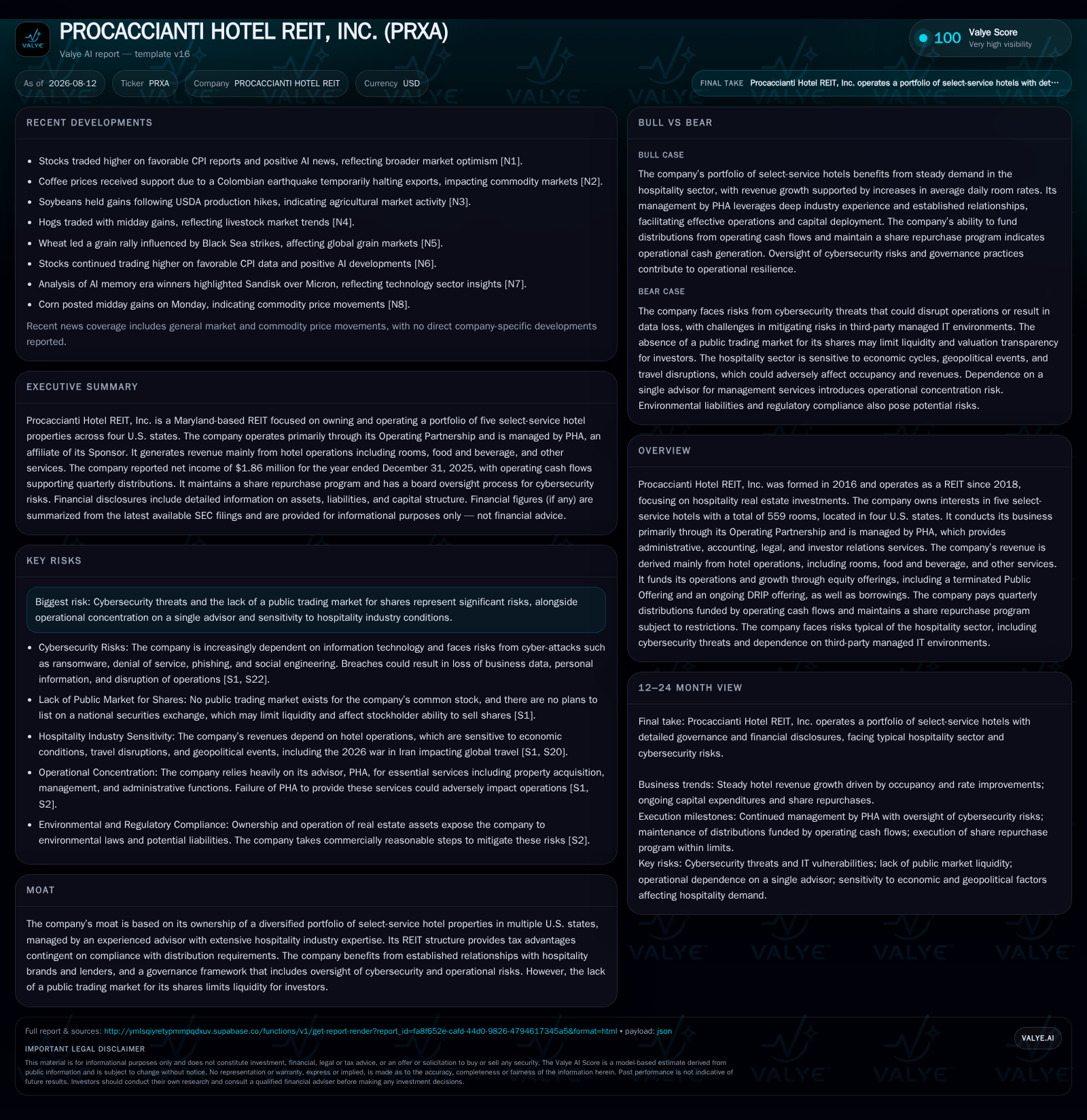
Procaccianti Hotel REIT, Inc. continued its focus on select-service hospitality properties with a stable operational footprint comprising five hotels across four states as of year-end 2025. The company’s board renewed the advisory agreement with Procaccianti Hotel Advisors, reflecting satisfaction with management performance, while maintaining capital discipline through controlled borrowing and share repurchase programs. Despite limited public trading liquidity for its shares, the REIT sustained quarterly distributions funded by operating cash flows and managed refinancing activities to optimize debt maturity profiles. Risks include cybersecurity vulnerabilities typical in hospitality and real estate sectors, with governance oversight implemented. Key growth drivers remain tied to travel demand recovery and operational metrics improvement.
Recent Operating Update
Procaccianti Hotel REIT disclosed in its August 2026 quarterly filing that it continues stable operations across its portfolio of five select-service hotels encompassing 559 rooms located in four U.S. states [S2], building on their status as reported in the March 2026 annual report [S1]. Notably, in July 2026, the board unanimously approved a one-year renewal of the advisory agreement with Procaccianti Hotel Advisors (PHA), underscoring satisfaction with the external management's performance across acquisition, operation, and investor relations functions [S3]. This renewal eliminates prior sunset clauses from the asset management fee arrangements extending beyond August 2026, providing continuity in corporate governance and operational oversight.
The company's operational results for the year ended December 31, 2025 show revenues totaling approximately $32.8 million with operating income near $6.28 million driven primarily by consistent room rental revenue complemented by food and beverage offerings—a classic revenue mix for select-service hotels focusing on lodging and ancillary services rather than full-service luxury experiences [S23]. Net income attributable to common stockholders was about $1.54 million; cash distributions have been consistently funded out of operating cash flows in line with typical REIT practice to preserve status under IRS tax provisions requiring high payout ratios [S16], [S23].
Business Model
Procaccianti operates as a real estate investment trust specializing in owning interests in select-service hotels—properties offering moderate amenities focused on business and leisure travelers seeking cost-effective lodging solutions. Revenue streams comprise primarily room rentals that fluctuate based on occupancy rate and average daily rate (ADR), supplemented by food & beverage sales along with other hotel services [S1]. The company structures ownership interests through an Operating Partnership under management by PHA, which handles day-to-day property management, acquisitions, and investor relations functions via an Advisory Agreement. This setup enables Procaccianti to outsource operational expertise while retaining asset-level control and focusing corporate resources on capital allocation and strategic initiatives.
Monetization relies fundamentally on capturing net operating income through effective hotel performance (key KPIs: occupancy rate, ADR, RevPAR) which translates into distributable cash flow supporting shareholder distributions. To finance growth or improvements, Procaccianti employs equity raises mostly via its Dividend Reinvestment Plan (DRIP) offering alongside borrowings secured against real estate assets—maintaining leverage targets generally capped at around 50% of asset value unless otherwise approved by independent directors to balance risk and return. Shareholder liquidity is constrained since shares are not listed publicly; however, the company offers a regulated share repurchase program aimed at limited interim liquidity for investors subject to restrictions linked to ongoing equity offerings under DRIP terms.
Industry Structure and Competitive Position
Procaccianti fits squarely within the niche Hospitality REIT sector focusing on select-service properties which contrasts larger peers like Host Hotels & Resorts (HST) that lean toward full-service luxury portfolios or Apple Hospitality REIT's broader scale in select-service lodging. Select-service hotels typically benefit from higher operational efficiencies due to more standardized service levels but compete intensely on price and location quality given more homogeneous product offerings.
The company's modest scale—five properties totaling just over 550 rooms—positions it at a smaller scale relative to larger peers but allows potentially closer asset-level oversight and nimble capital deployment. Geographic diversification across four states partly mitigates regional demand shocks while maintaining manageable complexity within U.S. travel markets.
PHA’s role as advisor brings seasoned hospitality industry expertise enabling effective property management agreements with brands franchising these hotels—driving brand recognition critical to sustaining occupancy rates amid varied competition—including branded midscale chains versus growing alternatives such as AirBnB or boutique independent hotels.
Growth Drivers
Key drivers stem from recovering travel demand that generally fuels occupancy gains across business and leisure segments. Enhancements in ADR supported by favorable market dynamics or capital improvements boosting property appeal add further upside potential. Strategic use of DRIP equity offerings provides incremental capital to fund acquisitions or renovations without disproportionate dilution risks.
Efficient refinancing activity observed—including recent refinances of Hilton Garden Inn Providence note extending maturities with fixed interest at around 6.1%—demonstrates proactive capital structure management optimizing debt costs amid prevailing interest rate environments [S14], [S29]. These moves are critical given the cyclical nature of hospitality revenues sensitive to economic conditions affecting travel volumes.
Moreover, brand affiliation through franchise agreements enhances marketing reach benefiting RevPAR metrics while limiting operational execution risks tied to third-party operators under agreed service standards.
Risks and Watchpoints
Notable risks include cybersecurity exposures highlighted explicitly due to increased dependence on IT systems both internally and across third-party environments managing reservations or guest data—malicious attacks could disrupt operations or result in reputational damage despite governance efforts involving frequent board oversight and incident reviews [S1].
Liquidity constraints persist given no public market exists for shares; investor exit opportunities depend largely on DRIP-driven share purchases/sales or share repurchases capped by regulatory limits tied closely to net asset value estimates under volatile valuation scenarios.
Operational concentration risk also arises from reliance on a single external Advisor (PHA) controlling significant property management functions; any transfer or failure here could pose transition challenges.
Economic cyclicality remains endemic; downturns curtail travel spending impacting occupancy rates directly influencing FFO available for distributions unlike more stable commercial property sectors.
Finally, maintaining REIT tax status demands high dividend payout ratios limiting retained earnings availability for reinvestment which can constrain growth unless supplemented effectively by capital markets access.
What to Watch Next
Milestones center around monitoring quarterly changes in operating KPIs such as occupancy trend shifts or ADR movements providing early signals of market strength or softness affecting revenue yield dynamics. Progress in deploying DRIP proceeds into accretive acquisitions or improvements will be indicative of growth momentum.
Corporate governance updates regarding cybersecurity incident frequency/severity disclosures would shed light on risk mitigation effectiveness over time.
Additionally, any shifts toward listing shares publicly or executing liquidity events would mark transformative changes impacting shareholder value realization options.
Financial Profile Discussion
Operating cash flows remain sufficient to cover distributions paid quarterly reflecting prudent payout policies aligned with funds from operations—a crucial measure supplementing GAAP net income that excludes non-cash items like depreciation critical for assessing underlying asset-generated earnings capacity in real estate sectors such as hospitality REITs [S19], [S26].
In sum, Procaccianti’s financial profile exhibits typical REIT traits: controlled leverage focused on flexibility amid cyclical industry pressures; disciplined dividend policy maximizing tax-advantaged returns; moderate scale favoring operational focus over diversification; financial flexibility maintained through ongoing capital raises balanced against prudent refinancing efforts.
This analysis synthesizes information from recent SEC filings focusing on key operational metrics, governance developments, capital structure details, risks peculiar to hospitality REITs including cybersecurity concerns, and strategic financial actions taken by Procaccianti Hotel REIT while avoiding unsupported claims or forecast projections. It contextualizes Procaccianti within its industry niche emphasizing relevant KPIs shaping investor outcomes without offering investment research views.
Disclaimer: This is research-only, informational analysis and not investment advice. It may include AI-generated interpretation and general industry context. Always verify important details using primary sources.

Comments