
Utah Medical Products Strengthens Niche With Safety-Focused Innovation and Robust Manufacturing
UTMD’s Q2 update reveals sales softness from customer losses alongside sustained innovation and strong liquidity underpinning its niche medical device franchise.
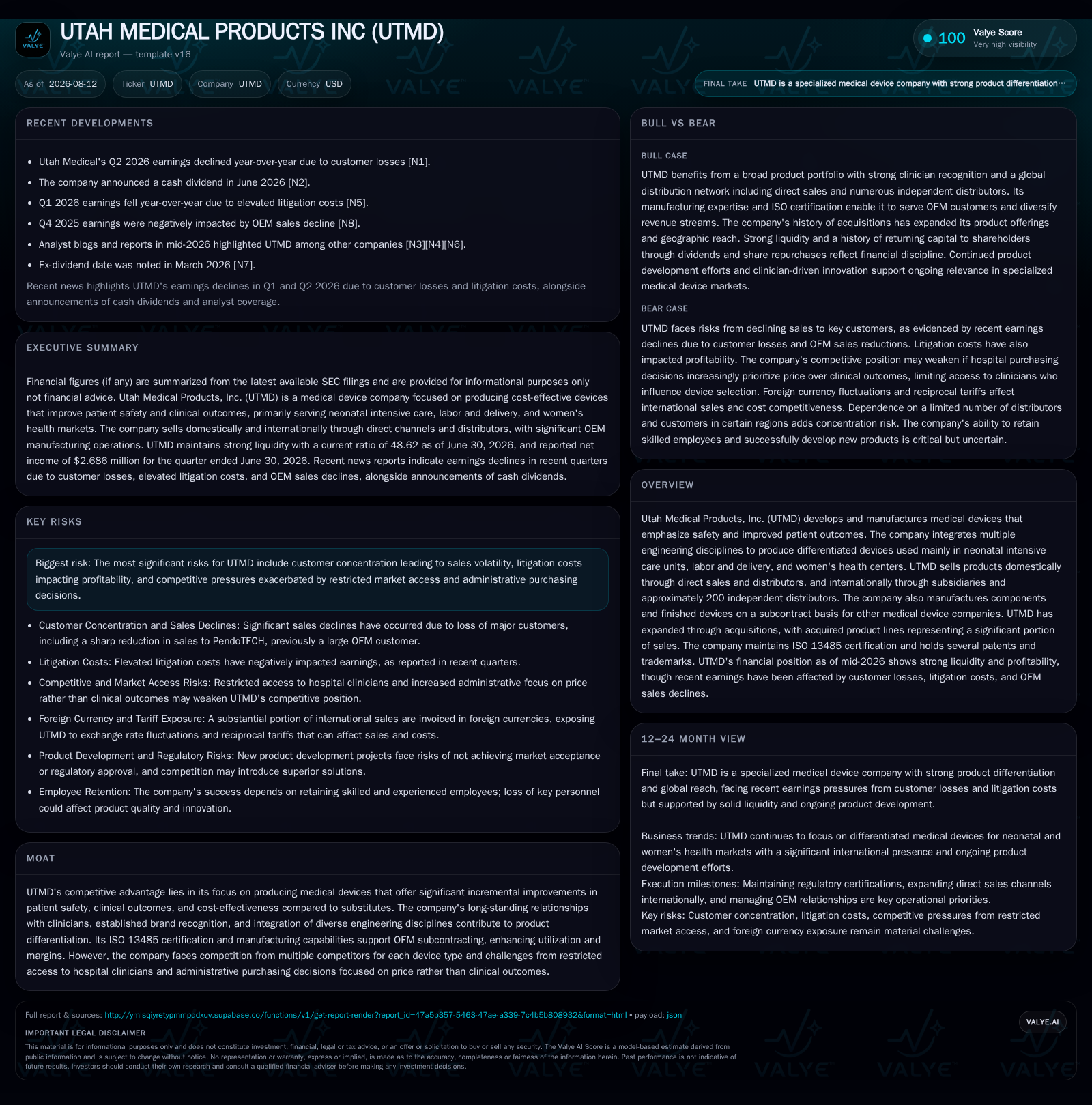
Utah Medical Products Inc. (UTMD) reported a Q2 performance marked by revenue volatility due to customer attrition, underscoring its ongoing sales concentration risk. Despite this, the company continues to advance product development efforts in neonatal, labor & delivery, and women’s health device segments, supported by rigorous regulatory compliance and ISO 13485 certification. UTMD's dual distribution channels—direct sales domestically and an extensive international distributor network—facilitate broad clinical adoption and geographic reach. The business benefits from a healthy balance sheet with $87.5 million cash and nominal debt, enabling investment in innovation and manufacturing capacity. Key risks remain around navigating hospital purchasing decisions increasingly dominated by price sensitivity over clinical outcomes.
Q2 Sales Volatility From Customer Losses Highlights Risk Amid Operational Strength
Innovative Product Development Underpins UTMD’s Clinical Value Proposition
UTMD continues investing approximately 2% of sales into research and development aimed at delivering devices that materially improve patient safety and clinical outcomes [S1][S4]. Its product strategy encompasses internal design enhancements responding to clinician needs, acquisition of complementary technologies, and licensing partnerships. The company’s engineering teams integrate multiple disciplines—electronic instrumentation, software, plastics processing—to produce products distinguished by reliability, ease of use, and outcome improvements relative to substitutes [S4][S8]. Regulatory clearances act not only as market entry gates but also reinforce UTMD’s credibility with clinicians prioritizing safety features over commodity pricing. These innovations underpin the company’s reputation in specialized clinical segments where small but meaningful device improvements can reduce complications or total cost of care.
Leveraging Manufacturing Certifications and OEM Subcontracting to Expand Margins
A key element supporting UTMD’s operational resilience is its certified manufacturing platform. The company holds ISO 13485 quality certification alongside Medical Device Single Audit Program (MDSAP) status since 2019 for its Utah and Ireland plants, allowing streamlined compliance with FDA requirements plus major global regulatory bodies including Australia and Japan [S7]. These certifications not only assure product quality but enable UTMD to attract contract manufacturing work (OEM subcontracting) from other device companies—a significant contributor to capacity utilization and gross margin expansion given high fixed-cost absorption in medical-grade manufacturing environments [S11].
A Dual-Channel Distribution Model Navigating Complex Domestic vs International Dynamics
UTMD employs a two-pronged distribution approach aligned with geographic nuances: domestically, products are sold primarily through direct sales channels targeting clinicians or stocking distributors; internationally it relies on subsidiaries in key countries (UK/Ireland, Canada, Australia/New Zealand) plus roughly 200 independent distributors covering other overseas markets [S6][S8]. Nearly half of total sales derive from outside the U.S., generating exposure to foreign currency fluctuations but providing growth diversity [S11]. While direct sales leverage deep clinical trust domestically—which is critical given diminishing clinician involvement in hospital purchasing decisions—international distributor networks enable scale across fragmented markets where local relationships compound market penetration challenges.
Industry Positioning: A Focused Player Amidst Specialized Device Peers
Within neonatal care and women's health device niches, UTMD competes against established peers such as CooperSurgical—a specialist in women's health devices—and OEM leaders like Becton Dickinson who provide safety-focused products across broader platforms. Unlike diversified giants Boston Scientific or Medtronic with complex global footprints and wide-ranging product offerings, UTMD’s smaller scale allows nimble responsiveness but limits bargaining power against hospital Group Purchasing Organizations (GPOs) that emphasize price competitiveness over qualitative clinical differentiation [S11]. UTMD's moat derives from trusted clinician relationships cultivated over decades, a focused IP portfolio combining patents and trademarks for brand protection, and proven product incremental improvements that justify premium pricing based on clinical outcomes rather than commodity status.
Growth Opportunities Lie In Geographic Expansion, Licensing, And New Device Launches
The company views expansion into emerging OUS markets as a vital growth vector complemented by acquisitions adding incremental product lines currently constituting about 57% of consolidated sales [S6]. Regulatory approvals remain milestone events enabling broadened market access; effective post-clearance marketing is essential for translating technical innovation into commercial success. Licensing arrangements augment the internal pipeline by integrating synergistic third-party technologies while avoiding direct competition where possible. Sector tailwinds include aging populations requiring advanced neonatal care innovations coupled with rising global healthcare expenditure favoring higher-value medical devices with demonstrated safety benefits.
Emerging Risks Center on Customer Concentration And Market Access Barriers
The company's ongoing reliance on a relatively concentrated base of healthcare providers means that any customer loss can disproportionately affect revenues—a vulnerability exposed by recent quarterly results [S2][N1]. Further risk derives from an increasingly complex hospital procurement ecosystem where clinicians wield less influence over purchasing compared to administrative entities focused predominantly on unit price or bundled contracts negotiated via GPOs. Such dynamics challenge UTMD's ability to emphasize patient safety innovations as primary purchase drivers against aggressive competitor discounting or long-term supply agreements potentially excluding newer entrants. Litigation costs represent another profitability pressure point given inherent product liability exposures associated with medical devices [S22].
Key Milestones Ahead: Regulatory Clearances And Adoption Rates To Watch
Future catalysts include successful navigation of regulatory approval timelines for innovative device launches across core neonatal/L&D categories—pacing here serves as an early indicator of pipeline vitality. Additionally, adoption rates within targeted hospital systems will reveal whether UTMD's differentiation strategy resonates sufficiently within pricing-constrained purchasing environments to sustain top-line growth. Backlog trends especially concerning OEM orders and distributor commitments could provide forward-looking markers of demand stability or volatility [S1]. Monitoring these operational KPIs will be vital in assessing whether recent customer losses are isolated events or signal structural challenges.
Financial Profile Discussion: Strong Liquidity Supports Operational Flexibility
As of June 30, 2026, UTMD held roughly $87.5 million in cash and equivalents against nominal total debt near $0.2 million—yielding a remarkable current ratio exceeding 48x—highlighting exceptional liquidity available for reinvestment or opportunistic acquisitions [F1]. This capital strength cushions short-term revenue fluctuations caused by lost customers while enabling continued funding for R&D efforts integral to sustaining competitive differentiation. The balance sheet profile supports the company's ability to maintain manufacturing certifications essential for OEM subcontracting margins without undue capital constraints [S2].
Disclaimer: This is research-only, informational analysis and not investment advice. It may include AI-generated interpretation and general industry context. Always verify important details using primary sources.

Comments