
United Bancorp's Local Loan and Deposit Growth Drive Q2 Profit Momentum
UBCP's latest quarterly results underscore robust loan and deposit expansions alongside margin improvement, reinforcing its community banking model amidst market pressures.
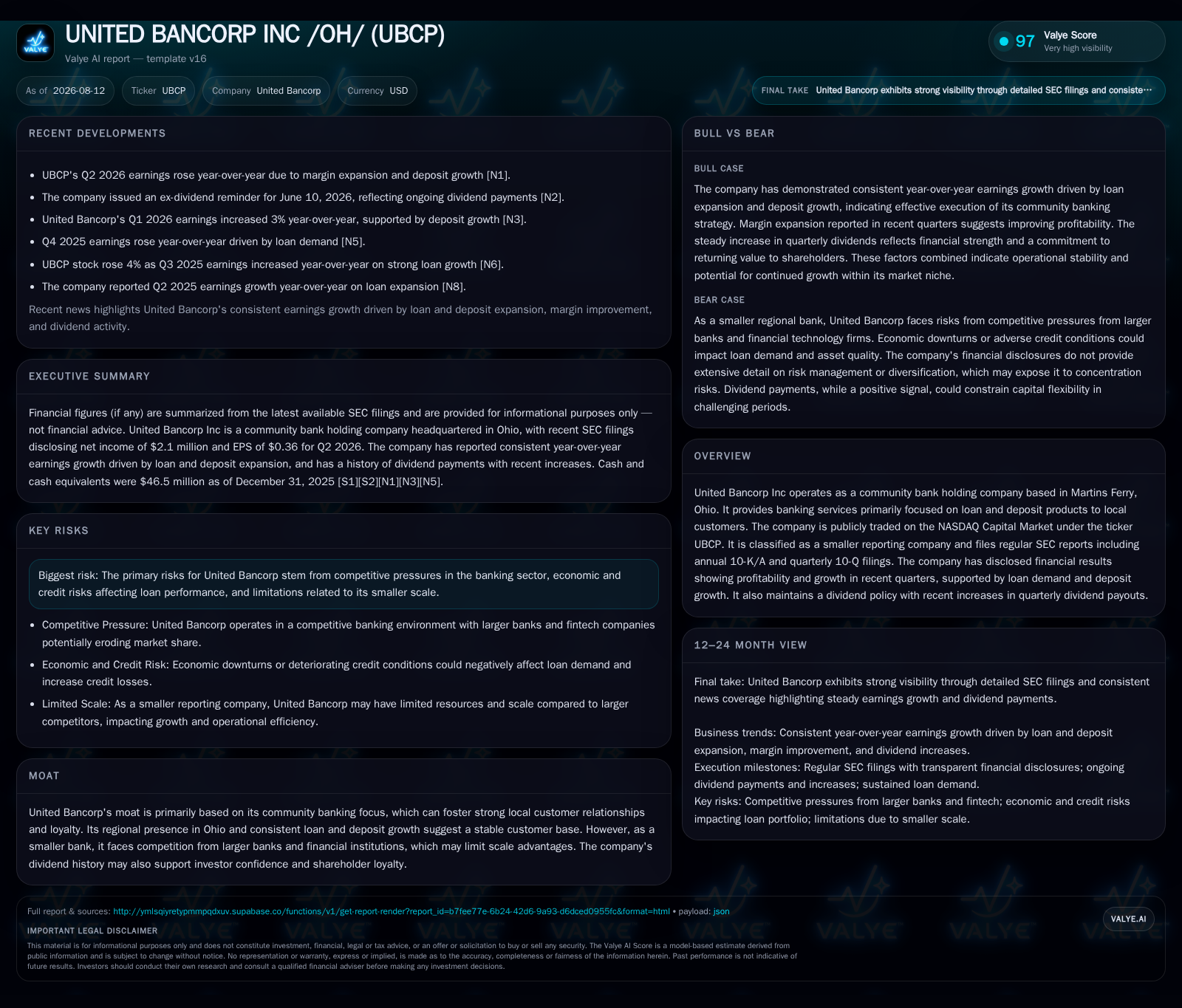
United Bancorp Inc reported strong second-quarter 2026 performance marked by sustained growth in its loan portfolio and deposit base, driving net interest income higher. The company achieved net interest margin expansion reflecting effective asset-liability management despite competitive pressures typical for smaller regional banks. Its dividend policy continues to signal financial discipline and shareholder alignment, while local economic conditions underpin demand. Key watchpoints include maintaining credit quality and efficiency as growth accelerates.
Sustained Loan and Deposit Expansion Accelerate Revenue Growth in Q2
In its latest quarterly filing for Q2 2026, United Bancorp Inc reported notable growth across key operating metrics that anchor its revenue engine. The loan portfolio expanded steadily, reinforcing the company’s ability to generate higher net interest income — the core profit driver for community banks like UBCP [S2]. Simultaneously, the company's deposit base grew further, providing a stable low-cost funding source that mitigated pressure from rising market-wide funding costs. This dual expansion of loans and deposits facilitated an increase in UBCP’s net interest margin (NIM), highlighting effective management of asset-liability sensitivity despite the intense competition seen outside its local Ohio footprint [N1]. Such performance underlines a resilient revenue model directly linked to broadening customer engagement within its defined regional market.
Community-Focused Banking Model Underpinning Local Customer Loyalty and Product Quality
United Bancorp’s business model centers squarely on community banking principles — generating net interest income from lending primarily to local individuals and small businesses while attracting deposits through trusted regional relationships. This localized approach fosters a degree of customer loyalty resistant to larger players’ scale advantages [S1]. The company primarily offers traditional loan products complemented by deposit accounts suited for the demographics of their Ohio customer base. Supplementary fee income streams contribute marginally but are not the principal focus. Importantly, United Bancorp has maintained a progressive dividend policy with periodic increases—an indicator of stable earnings generation capacity that supports shareholder confidence and retention [S3][S25]. This dividend pattern reflects careful capital stewardship balancing reinvestment needs with stable payouts, which is a notable feature among similar-sized community banks.
Competitive Environment Challenges Scale but Reinforces Strategic Positioning
Growth Catalysts: Local Economy, Interest Rates, and Customer Engagement Dynamics
UBCP’s recent operating momentum is buoyed by positive underlying catalysts. The local Ohio economy's expansion supports rising loan demand from small businesses and consumers—a key driver for volume growth in its loan portfolio [S2][N1]. Concurrently, the current moderate-to-high interest rate environment favors net interest margin expansion for well-positioned banks managing funding costs effectively; UBCP’s deposit beta appears manageable amid these conditions. Additionally, consistent efforts in deepening customer relationships through tailored service improve deposit retention rates and encourage incremental product cross-sales. Although fee income opportunities exist, the filings do not emphasize any transformative digital or ancillary service growth initiatives at this stage.
Risk Spectrum: Credit Quality, Competitive Pressures, and Regional Economic Factors
Risks facing United Bancorp align closely with typical challenges endemic to smaller community banks. Competition from larger banks offering broader product suites or technologically advanced platforms may pressure UBCP’s market share or force pricing concessions affecting margins. Regional economic downturns represent another vulnerability due to geographic concentration limiting portfolio diversification. Liquidity risks center around deposit outflows but are partially mitigated by the bank's conservative funding profile. Regulatory compliance costs also pose operational cost pressures which can disproportionately impact smaller operators.
"Signs to Monitor": Leading Indicators from Upcoming Earnings and Market Behavior
Looking forward, several indicators warrant close observation to validate United Bancorp’s trajectory. Monitoring loan growth trends in subsequent quarters will reveal if demand momentum sustains or softens amid macroeconomic shifts [S2]. Stability or further expansion of net interest margin will confirm ongoing success in managing asset-liability dynamics. Any material changes in provision for loan losses will signal credit quality trends requiring timely action. Efficiency ratio improvements reflect operational leverage gains critical under competitive pressures. Dividend announcements continue serving as barometers of capital adequacy and management confidence; unexpected cuts would suggest financial stress [N2]. Regulatory developments affecting capital thresholds or reporting requirements could influence strategic priorities.
This analysis integrates verified company disclosures with sector-native framing applicable to community banking institutions like United Bancorp Inc (UBCP). It highlights how localized lending-deposit dynamics drive sustainable earnings while acknowledging inherent competitive challenges and economic sensitivities typical for regional players. Future operational updates will clarify trajectory on profit margins, credit risk containment, and capital deployment strategies essential for ongoing viability.
This report does not constitute investment advice or research views.
Disclaimer: This is research-only, informational analysis and not investment advice. It may include AI-generated interpretation and general industry context. Always verify important details using primary sources.

Comments