
Mitchell Facility Ramp-Up and Biofuel Policy Outlook Define SDSYA’s Near-Term Trajectory
Q2 2026 reveals operational challenges in scaling new Mitchell capacity amid volatile soybean oil demand linked to federal biofuel regulations.
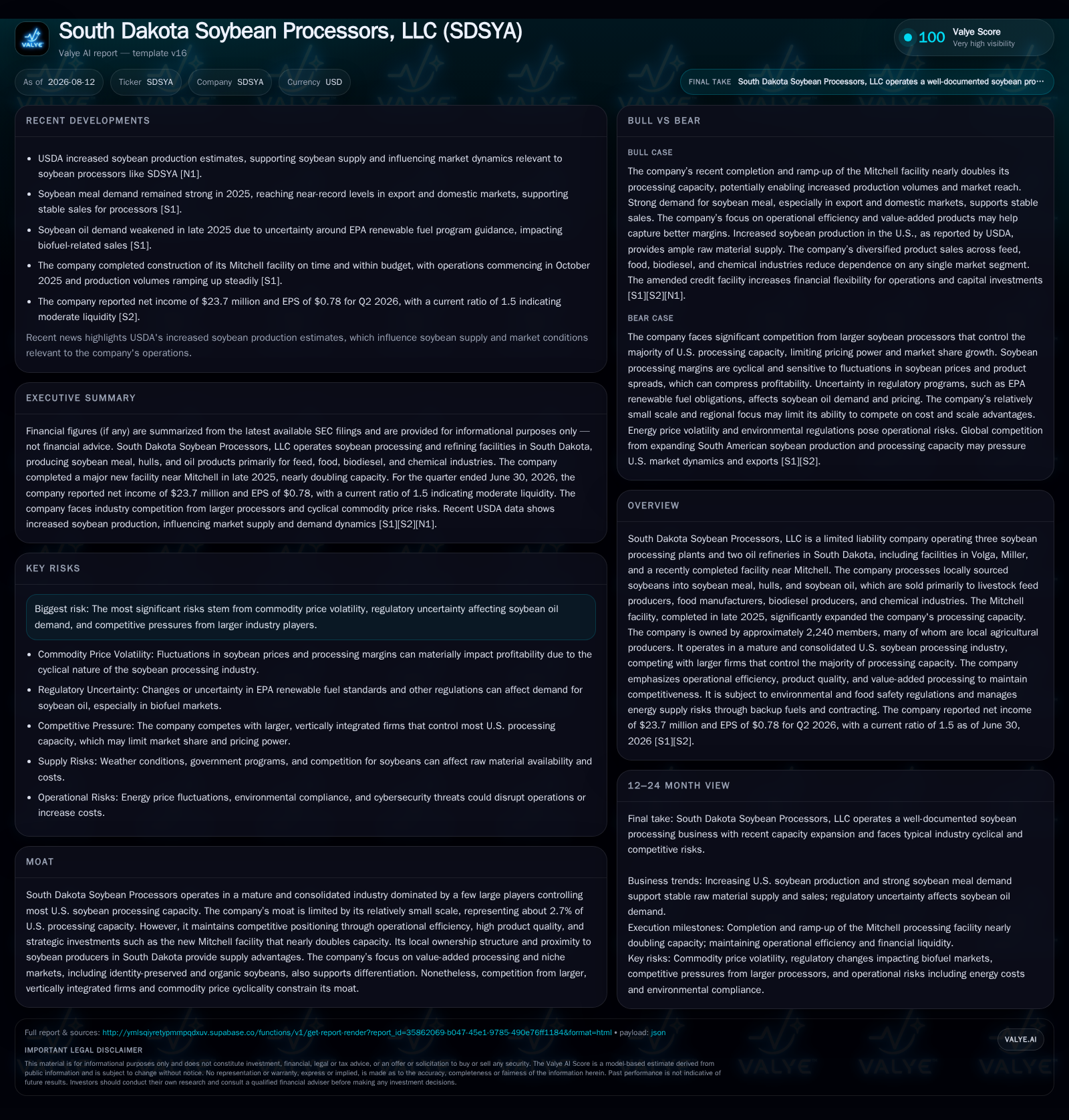
South Dakota Soybean Processors LLC (SDSYA) has recently commissioned its new Mitchell facility, effectively doubling its soybean processing capacity. The Q2 2026 filing shows that while processing volumes have increased, initial ramp-up inefficiencies and subdued utilization have pressured margins. Meanwhile, ongoing uncertainty around EPA renewable volume obligations creates near-term volatility in soybean oil demand and impacts processing spread dynamics. SDSYA's reliance on local soybean supply and focus on value-added products positions it uniquely among predominantly larger integrated peers, but scale disadvantages and commodity cyclicality remain key constraints.
Q2 Operating Update Highlights Capacity Increases and Margin Pressures
South Dakota Soybean Processors LLC (SDSYA) reported its Q2 2026 operating update highlighting the first full quarter following the October 2025 commissioning of its Mitchell facility, a strategic investment that nearly doubled its aggregate soybean processing capacity across South Dakota by adding a large-scale plant and refinery near Mitchell [S1][S2]. While the expanded capacity facilitated a marked increase in soybean crushing volumes—exceeding prior years’ levels—the company discloses that operational efficiency remains below optimal levels due to the standard commissioning phase challenges such as lower utilization rates, process optimization issues, and workforce ramp-up hurdles. These bottlenecks weighed on processing margins despite the growing throughput volume [S2].
Concurrent with these startup inefficiencies, the company faces margin headwinds driven primarily by softening demand for soybean oil in the biodiesel sector. This decline is linked to ongoing uncertainty surrounding U.S. Environmental Protection Agency (EPA) renewable volume obligations (RVOs), which guide required biomass-based diesel blending targets for renewable fuel producers—a key demand driver for soybean oil [S1]. The resulting oversupply pressure depressed soybean oil prices relative to raw soybean input costs, tightening the overall crushing spread during this quarter [S2]. This interplay between improved scale from capacity expansion and compressed margins encapsulates the near-term operating narrative for SDSYA.
Soybean Processing Business Model: Local Sourcing & Product Differentiation
SDSYA operates as a midstream agricultural processor converting raw soybeans into intermediate products: primarily soybean meal for animal feed markets, soybean hulls also targeting livestock feed segments, and both crude and refined soybean oils serving food manufacturing, biodiesel production, and chemical industry customers [S1]. Its revenue model hinges on crushing volumes sourced largely from approximately 2,240 cooperative members who are mostly local farmers or agricultural producers based in South Dakota and neighboring states. This local procurement strategy supports supply chain reliability and reduces feedstock logistics costs relative to more geographically dispersed competitors.
The product mix contributes materially to revenue dynamics: meal typically commands higher volumetric sales driven by strong domestic and export feed demand; oil sales face greater pricing volatility tethered to renewable fuel mandates; hulls represent lower-margin byproducts with steady feed market acceptance [S1]. Importantly, SDSYA pursues value-added differentiation through product quality improvements—such as identity-preserved soybean sourcing catering to specialty food or feed applications—and refined oil offerings that capture premium customer segments. These strategic efforts aim to offset scale disadvantages in a mature market dominated by large integrated processors [S1].
Competitive Positioning within a Consolidated Soybean Processing Industry
The U.S. soybean processing landscape is heavily consolidated with the top few players—Archer Daniels Midland (ADM), Bunge Limited, Cargill—controlling well over 90% of national crushing capacity. SDSYA occupies a niche cooperative status with roughly 2.7% of total U.S. capacity following its recent expansion [S1]. This limited scale restricts bargaining power on raw soybean pricing and downstream contracts compared to diversified agribusiness multinationals.
Nevertheless, SDSYA leverages competitive advantages from proximity to local producers ensuring consistent high-quality feedstock access along with operational efficiency initiatives at its facilities. The new Mitchell plant embodies these efforts with state-of-the-art equipment designed for throughput optimization and energy efficiency gains relative to legacy plants operated by regional cooperatives.
'Near-Doubling' Processing Capacity: Operational Leverage & Efficiency Challenges
Capital expenditures culminating in the Mitchell facility represented a major financial outlay completed on schedule and within budget by late 2025 [S1]. While this investment positions SDSYA for substantial long-term growth potential by increasing nominal crushable bushels annually by almost 100%, ramp-up execution typicalities have surfaced as expected risks. Initial commissioning phases have witnessed suboptimal capacity utilization reflecting calibration needs across refining processes, quality control stabilization, workforce training cycles, and supply chain fine-tuning [S2].
These factors compressed gross margins since fixed costs are incurred regardless of throughput volume during early operations while product yields take time to reach design efficiencies [S1][S2]. Nonetheless, management guidance anticipates progressive improvement in these metrics as utilization rates climb toward target ranges through subsequent quarters supported by continued operational learning curves
'Policy Winds': Biofuel Mandates Shaping Soybean Oil Demand Dynamics
A core external determinant influencing SDSYA’s commodity price spreads is U.S. federal biofuel policy executed through annual EPA renewable volume obligations under the Renewable Fuel Standard (RFS) program [S1]. These mandates dictate volumetric blending targets for biomass-based diesel fuels derived substantially from soybean oil feedstock. Delays or reductions in announced RVOs suppress market expectations for demand growth in biodiesel production thereby weighing negatively on crude soybean oil prices.
In contrast, favorable RVO determinations supporting higher biodiesel mixing would logically underpin stronger pricing power for processors like SDSYA by tightening soy oil availability relative to feedstock procurement costs [S1]. Given that biofuel programs are subject to political negotiation cycles and regulatory updates pending EPA forthcoming announcements anticipated imminently after Q2 filing dates, this uncertainty constitutes a key top-down influence on near-term financial performance prospects for SDSYA
'Growth Bottlenecks': Ramp-Up Risks and Commodity Price Cyclicality Constraints
Beyond the immediate operational challenges at Mitchell facility startup lies broader sector cyclicality risk driven by fluctuating global commodity prices including raw soybeans and processed products like meal and hulls. This cyclicality is amplified for relatively smaller processors like SDSYA who lack broad vertical integration or geographic diversification options available to industrial peers such as ADM or Bunge.
Moreover, heightened global competition stems from expanding crushing capacities internationally — particularly across Brazil and Argentina — imposing downward pressure on U.S.-based crushing spreads through export displacement effects [S1]. Combined with persistent operational execution risks inherent in complex facility startups manifested as lower throughput speeds or delayed stabilization of quality yields observed in current quarters these factors require careful monitoring as potential growth constraints alongside macroeconomic variables.
'What’s Next': Policy Signals, Ramp-Up Metrics, and Market Pricing Developments to Watch
Investors tracking SDSYA should prioritize incoming regulatory signals from forthcoming EPA announcements clarifying renewable volume obligations that serve as critical barometers shaping future soy oil demand trajectories across biofuel markets. Additionally quarterly disclosures reflecting progress toward full capacity utilization at Mitchell—such as increases in bushels processed per day or improved product yield consistency—will provide tangible evidence of operational scalability overcoming early-stage inefficiencies.
Finally monitoring price trends across product segments—especially meal exports responding to global livestock feed trends—and shifts in input cost inflation will help gauge evolving gross margin profiles beyond temporary commissioning effects seen thus far.
Financial Profile Discussion: Capital Structure Amidst Expansion Investment
As of June 30, 2026 balance sheet data shows SDSYA carrying approximately $323 million in total debt related largely to financing its Mitchell facility expansion balanced against cash reserves near $6 million yielding a net debt position just shy of $317 million while maintaining current assets at $237 million against current liabilities of $158 million resulting in a healthy current ratio around 1.5 indicating short-term liquidity adequacy despite leverage elevation post expansion [F1]
This capital structure reflects typical characteristics of capital-intensive midstream agricultural processors undergoing growth phase upgrades where substantial borrowing funds asset additions ahead of full incremental cash flow realization via ramped throughput volumes reducing unit fixed costs over time. Continuous oversight of interest expenses relative to earnings generation alongside working capital efficiency will remain important metrics as operating leverage effects materialize post-ramp-up.
This analysis synthesizes recent filings up through Q2 2026 providing contextually grounded insights into South Dakota Soybean Processors LLC's evolving operational landscape shaped chiefly by its pivotal Mitchell facility start-up phase compounded by externally driven biofuel policy uncertainties critical to shaping near-term profitability patterns within a mature yet cyclical agricultural commodity processing sector.
Disclaimer: This report is purely informational without any investment advice or research views.
Disclaimer: This is research-only, informational analysis and not investment advice. It may include AI-generated interpretation and general industry context. Always verify important details using primary sources.

Comments