
Local Bounti’s Stack & Flow Expansion Signals Growth Amid Retail Demand
Local Bounti’s latest quarterly highlights capacity expansion plans leveraging proprietary hybrid technology to meet robust demand from major retail partners.
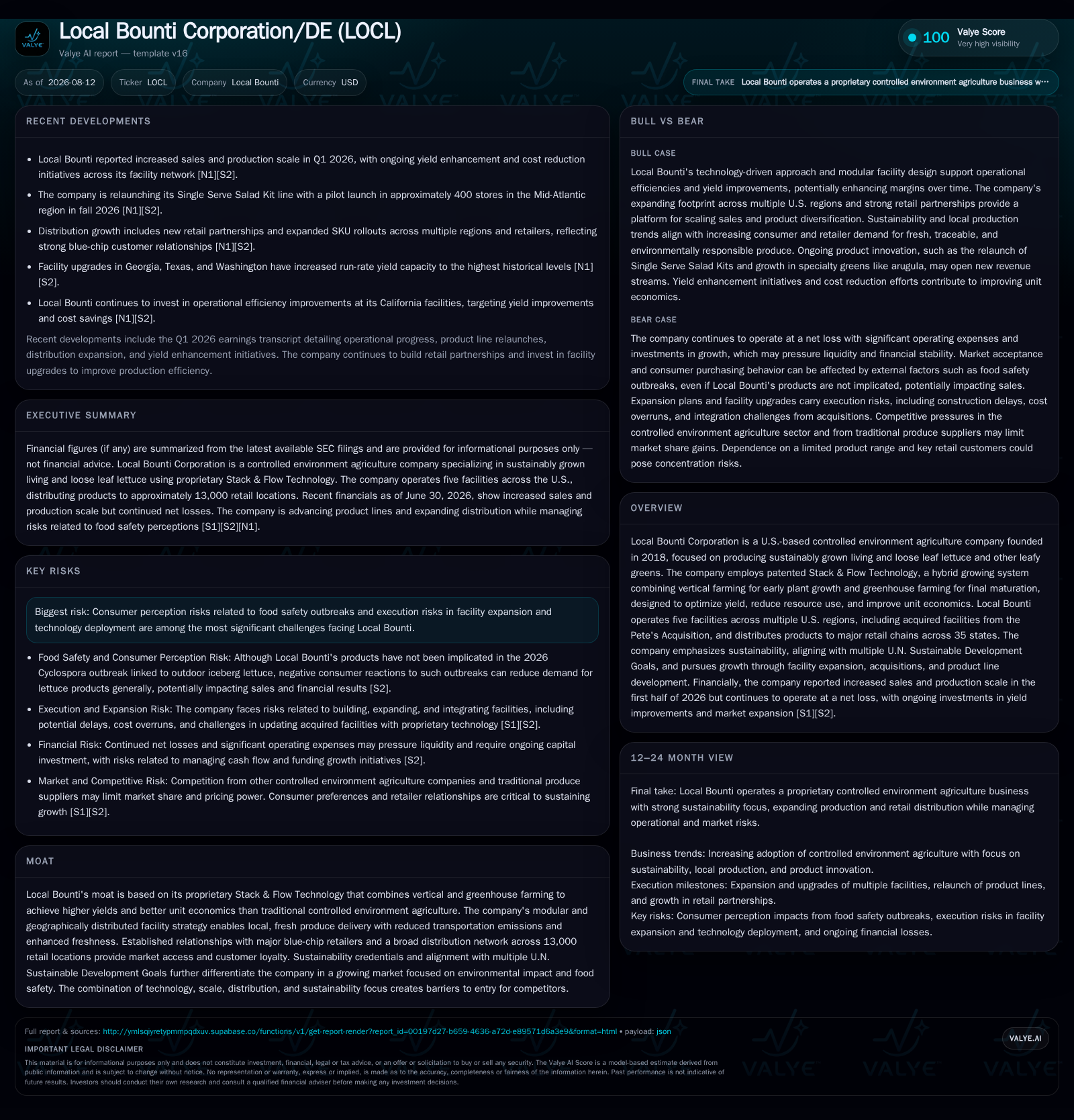
Local Bounti Corporation’s August 2026 quarterly filing reveals ongoing strategic capacity expansions using its patented Stack & Flow Technology. These initiatives aim to enhance production scale and product assortment aligned with retailer commitments, including potential market entry into the Midwest. The company’s hybrid vertical and greenhouse farming approach supports improved harvest efficiency and sustainability credentials, underpinning volume growth across approximately 13,000 retail locations. While cost of goods sold pressures remain, management anticipates improvements as operations scale. Execution risks persist amid the capital-intensive controlled environment agriculture sector and broader produce-market challenges related to consumer perception.
Quarterly Capacity Expansion Initiatives Align With Retailer Demand Trends
Local Bounti’s Q2 2026 filing confirms active plans to build additional production capacity across its network of controlled environment agriculture facilities equipped with the company’s patented Stack & Flow Technology ® [S2]. These expansions are explicitly designed not just to increase volume but also to support a growing product assortment tailored to direct blue-chip retailer demands. Notably, management disclosed ongoing evaluations regarding geographic extension into the Midwest, a strategic region beyond their stronghold in Western and Southern U.S. markets. However, precise timing and scope remain fluid as site readiness is tied closely to retailer discussions aimed at optimizing product mixes for local consumer preferences and distribution commitments [S2]. This implies a measured approach balancing aggressive capacity scaling with customer-centric customization.
The emphasis on retail collaboration reflects the critical role that large grocery chains play as direct customers in the revenue model. By aligning facility functionality—whether in plant varieties or packaging formats—with specific retailer supply strategies, Local Bounti seeks to secure stable volume contracts while enhancing product velocity through familiar market channels.
Hybrid Growing Model Enhances Product Quality and Unit Economics
Local Bounti’s core technological differentiation stems from its Stack & Flow Technology ® which combines vertical farming methodologies during early plant growth stages (“Stack”) with traditional greenhouse cultivation (“Flow”) for final crop maturation [S1], [S2]. This hybrid design aims to capitalize on vertical farming’s spatial efficiency where seedlings occupy stacked layers under controlled environmental conditions before transplanting into greenhouse beds that facilitate fuller development cycles.
This dual-phase approach purportedly generates higher harvest efficiency by ensuring each plant receives optimized conditions appropriate at each growth stage, simultaneously improving yield per square foot while curbing resource consumption such as water (claimed reductions exceeding 90% vs outdoor farming), land use, and pesticide application [S1]. These sustainability advantages resonate strongly during rising consumer demand for environmentally responsible food production methods that align with broader ESG trends.
Moreover, the controlled environment ensures consistent quality of non-GMO living lettuce products crucial for maintaining taste freshness associated with premium retail categories such as butter lettuce—the company’s flagship crop dominating approximately 80% of CEA Western U.S. market share—and assorted loose leaf greens utilized in value-added salad kits launched regionally with positive velocity trends reported [S1]. Such product consistency is key for mass retail acceptance and repeat purchase behavior.
Retail Distribution Footprint Drives Volume Growth Strategy
A notable competitive strength lies in Local Bounti’s extensive retail channel footprint servicing around 13,000 stores across 35 states via direct relationships with prominent grocery chains including Walmart, Kroger, Albertsons, Sam's Club, Target, Whole Foods, Brookshire's, and H-E-B among others [S1]. This broad distribution allows scalable volume throughput that is essential for absorbing production growth from new or expanded facilities.
Operating sales mechanics depend on steady product velocity—the number of units sold per store per week—which has demonstrated positive momentum particularly for new product introductions like their Romano Caesar Salad Kit showing a 75% velocity increase in fourth quarter prior year performance metrics [S1]. This underscores an evolving consumer receptiveness not only to traditional leafy greens but also value-added packaged offerings fostering category expansion opportunities.
The direct-to-retail sales model bypasses intermediary wholesale markets which can bolster margin retention provided distribution costs are managed effectively—a consideration critical in balancing local production benefits against logistics expenses to reduce “food miles” and carbon footprint.
Comparing Local Bounti’s Technology and Scale Within the CEA Landscape
In the broader controlled environment agriculture sector featuring peers such as BrightFarms (whole-plant greenhouse grower) and Bowery Farming (vertical farmer), Local Bounti differentiates through its hybrid Stack & Flow system blending vertical seedling stacks with greenhouse finish lines rather than purely vertical or glasshouse-based models alone. This technological architecture aims to reduce some of the capital intensity associated with fully automated vertical farms while achieving better scale efficiencies than stand-alone greenhouse providers reliant solely on horizontal layout expansion.
Capital intensity remains a substantial barrier intrinsic to this segment due to significant upfront facility construction costs coupled with ongoing operational investments in climate control systems, energy consumption optimization, labor specialization, and technology integration. Achieving sustainable margin improvement depends heavily on accelerating production cycles (harvest frequency), increasing yield per square foot per plant cycle, lowering cost of goods sold through economies of scale and process standardization while expanding high-velocity retail penetration.
Local Bounti’s portfolio expansion both organically via greenfield builds and through acquisitions such as Hollandia Produce Group (“Pete’s Acquisition”) reflects an industry norm where build-versus-buy decisions calibrate scaling speed against cost synergies achievable by upgrading acquired assets with proprietary growing technology.
Growth Drivers: Facility Deployment, Product Line Expansion, and Geographic Reach
Growth is fundamentally driven by capacity deployment targeting untapped geographies like the Midwest alongside expanding existing sites in Washington, Texas, Georgia, and California per prior completions reported by year-end 2024 or earlier [S1], [S2]. New variety launches such as arugula—leveraging baby leaf expertise despite conventional arugula shortages—and further family-sized salad kits provide product mix diversification aligned with evolving retailer category strategies.
Measurable KPIs supporting growth narratives include scaled-up production capacity measured in acres or square feet under cultivation enabling higher sales volume; increases in sales velocity within existing retail doors corroborating strong product-market fit; enhanced harvest efficiency yielding better profitability levers; all contributing toward a planned decrease in cost of goods sold percentage over time as fixed costs spread over larger output volumes [S2]
Continued expansion depends on securing financing aligned with capital expenditure schedules necessary for new construction phases plus operational ramp-ups bolstered by workforce training focused on skilled labor retention vital for consistent quality outputs.
Risks in Scaling Capital-Intensive Facilities Amid Consumer Perception Challenges
Execution risks remain material given the complexity inherent in constructing technologically advanced agricultural facilities which hinge on timely government approvals, supply chain continuity for critical inputs like seeds/nutrients/packaging materials, fluctuating material prices affecting budgets, as well as skilled labor availability constraining full-scale operations ramping [S1], [S2].
Additionally, while Local Bounti’s products have not been implicated directly in recent Cyclospora outbreaks linked to outdoor iceberg lettuce causing recalls elsewhere starting May 2026, adverse shifts in consumer sentiment towards lettuce purchases generally have posed indirect demand headwinds affecting sales momentum industry-wide including CEA producers [S2], amplifying exposure to reputation externalities beyond the firm’s control.
Retail customer concentration requires continued attention since failure to renew or expand contracts with major grocers could disproportionately impact revenue streams. Moreover, inflationary pressures elevating labor wages and input costs pose ongoing cost containment challenges threatening near-term margin recovery trajectories.
"What to Watch": Retail Adoption Signals, Capacity Utilization, Cost Trajectories
Key upcoming indicators include formalization of Midwest facility roll-out timelines aligned with retailer onboarding milestones—a bellwether reflecting underlying demand validation beyond exploratory discussions documented currently [S2]. Operational metrics such as yield improvements per harvest cycle measuring effectiveness of agronomic enhancements within Stack & Flow phases; tighter cost of goods sold percentages indicating beneficial operating leverage; product velocity data updates revealing consumer acceptance trends serve as practical gauges affirming execution credibility or conversely highlighting emerging bottlenecks.
Regular disclosures updating acreage utilization rates will also provide insight into balancing supply-demand dynamics critical for optimizing inventory freshness without excessive perishability risks inherent in fresh produce channels.
Financial Profile Discussion: Capital Structure Amid Rapid Expansion
As of June 30, 2026 balance sheets show Local Bounti holding approximately $3.63 million in cash against current liabilities near $21.7 million resulting in a modest current ratio around 1.07 implying tight near-term liquidity buffers that require careful working capital management [F1]. Meanwhile total debt exceeds $431 million primarily related to financing construction projects including sale-leaseback obligations extending well into future years beyond 2030 [F1], [S2].
In summary financials portray a business heavily investing ahead of revenue stabilization requiring continual access to capital markets or partner funding sources while managing leverage within tolerable covenants essential for sustaining operational runway through expected breakeven horizons.
This analysis synthesizes Local Bounti Corporation's recent SEC disclosures contextualized within controlled environment agriculture industry dynamics without making investment research views. Indicators highlighted should be monitored over forthcoming quarters for signs of execution efficacy amid an evolving produce market landscape.
Disclaimer: This is research-only, informational analysis and not investment advice. It may include AI-generated interpretation and general industry context. Always verify important details using primary sources.

Comments