
How Bitcoin Price Movements Shape WisdomTree Bitcoin Fund's NAV and Liquidity Dynamics
Latest quarterly data reveals how BTCW’s direct bitcoin holdings, NAV calculation, and authorized participant mechanisms maintain operational resilience amid market fluctuations.
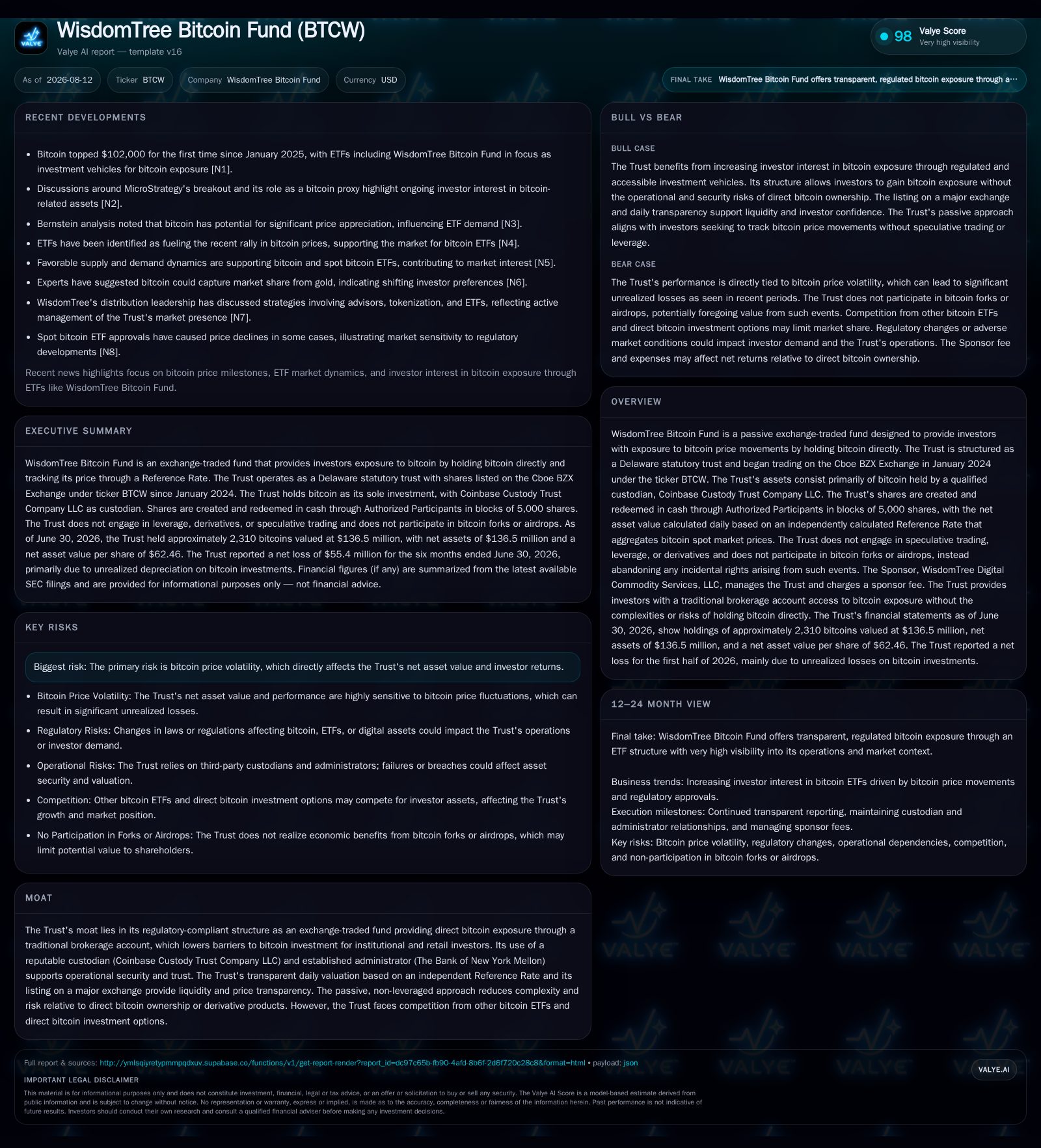
WisdomTree Bitcoin Fund (BTCW) provides regulated, liquid exposure to bitcoin via an ETF structure that holds bitcoin directly with Coinbase Custody. The fund's net asset value per share is calculated daily using the CME CF Bitcoin Reference Rate, ensuring price transparency aligned with spot bitcoin prices. As of June 30, 2026, BTCW managed $136.5 million in assets with 2.185 million shares outstanding, reflecting fluctuations driven by bitcoin price volatility and active creation/redemption flows through authorized participants. Custody security and benchmark integrity underpin investor trust in a competitive market alongside other bitcoin ETFs and trusts. Sponsor fees scale with assets under management, while trade financing agreements support liquidity during creation events. Key risks include bitcoin’s price volatility, reliance on benchmark pricing availability, custody risk despite safeguards, and liquidity dependence on authorized participant functioning.
Quarterly Asset and NAV Developments: Implications for Investor Liquidity
As of June 30, 2026, WisdomTree Bitcoin Fund (BTCW) reported net assets of approximately $136.5 million with about 2.185 million shares outstanding, resulting in a net asset value (NAV) per share of $62.46 [S2]. This represents a decline from December 31, 2025 levels—$139.7 million in net assets and NAV per share at $92.51—primarily due to decreases in the underlying bitcoin spot price alongside ongoing creation and redemption activity by authorized participants.
The creation/redemption mechanism is central to BTCW's liquidity profile. Shares are issued or redeemed only in fixed increments (“baskets”) of 5,000 shares tied directly to proportional bitcoin holdings valued through the Trust’s NAV calculation [S1]. This structure mitigates premium/discount divergences common among less liquid crypto trusts by aligning share supply dynamically to investor demand.
Since the Trust holds primarily physical bitcoin via custody arrangements rather than derivatives exposure, shifts in assets under management closely track two factors: net inflows/outflows from creations/redemptions and fluctuations in USD bitcoin prices [S2]. Maintaining sufficient liquidity to meet redemption requests depends on this interplay between trusted custody infrastructure and active market participation by authorized participants managing share inventories
ETF Structure Providing Direct Bitcoin Exposure
BTCW operates as a pure-play exchange-traded fund providing direct exposure to bitcoin price movements without engaging in futures contracts or derivative instruments [S1]. Unlike futures-based ETFs such as ProShares BITO or digital asset trusts like Grayscale GBTC—which can experience tracking errors or trade at premiums/discounts—BTCW holds actual bitcoins via Coinbase Custody Trust Company LLC.
Revenue is generated primarily through sponsor fees charged as a percentage of assets under management. These fees create a modest expense ratio near 0.25% annually [S2], covering administrative costs but causing slight dilution since bitcoins are sold periodically to pay these fees [S10].
A critical feature supporting investor confidence is the daily NAV calculation based on the CME CF Bitcoin Reference Rate—a composite benchmark overseen by an independent committee comprising representatives from CME, the Benchmark Administrator, and industry experts [S1]. This external pricing reduces valuation opacity seen in other crypto products that rely on internal mark-to-market estimates.
Authorized participants serve as intermediaries submitting cash for creation baskets or receiving cash upon redemption baskets—bridging traditional fiat capital markets with underlying digital asset exposure [S1]. The absence of leverage or synthetic strategies simplifies risk profiles compared to leveraged or futures-based products.
Custody and Benchmark Integrity: Foundations for Investor Trust
Secure custody is paramount given historical vulnerabilities in cryptocurrency holdings nationally [S1]. BTCW entrusts Coinbase Custody Trust Company LLC with all bitcoins held on its behalf; Coinbase is widely recognized for robust security protocols including cold storage vaults and insurance coverage frameworks.
Benchmark integrity is maintained through reliance on the CME CF Bitcoin Reference Rate New York Variant [S1], governed by an Oversight Committee that publicly discloses governance charters and meeting minutes—enhancing transparency that reassures investors regarding pricing accuracy.
Together these custody solutions and benchmark governance reduce operational risks that might otherwise deter institutional capital allocation into regulated bitcoin funds.
Competitive Positioning within Bitcoin Investment Products
Among competitors, BTCW aligns most closely with direct-hold bitcoin ETFs such as VanEck Bitcoin Trust but contrasts markedly with digital asset trusts like Grayscale GBTC which lack redemption liquidity leading to volatile premiums/discounts. Compared to futures-based ETFs like ProShares BITO—which track futures indices rather than holding physical bitcoins—BTCW avoids basis risk from futures roll costs but remains exposed directly to spot price volatility.
Investor choice between direct-hold ETFs like BTCW versus derivatives-based products reflects preferences for simplicity versus leverage or synthetic exposures; fee structures typically differ with futures-based funds incurring higher ongoing expenses due to brokerage costs.
BTCW’s listing on Cboe BZX Exchange supports broad retail broker distribution enhancing tradability relative to less widely supported trusts.
Growth Drivers: Adoption Trends and Regulatory Clarity
Institutional adoption remains a primary growth driver expanding AUM across regulated digital asset funds including BTCW [S1]. Incremental regulatory clarity over recent years has removed barriers limiting fund launches or investor participation.
Technological improvements in custody reduce counterparty risk concerns while integration into traditional brokerage platforms streamlines investor access without requiring direct private key management.
While macroeconomic conditions influence overall demand sensitivity impacting risk appetite or bitcoin valuations directly, growing structural demand arises from retail investors seeking allocated exposure within tax-advantaged accounts alongside institutional portfolios incorporating digital commodities into diversified strategies.
This characteristic necessitates investors accept rapid NAV swings intrinsic to cryptocurrency markets.
Liquidity depends on sustained functioning of authorized participant networks executing trades in prescribed block sizes; disruptions or concentration among these counterparties could impair timely creation/redemption execution resulting in wider bid-ask spreads or temporary premium/discount dislocations.
Operational reliance on externally administered benchmark indices exposes BTCW valuation precision to third-party system reliability—while mitigated risks of failure or manipulation persist. Despite robust custody protocols residual custodial risk related to theft or technology failures remains albeit minimized compared to unregulated wallets.
Tax treatment uncertainties persist though evolving IRS guidance may clarify long-term implications affecting appeal across investor segments [S21]
Monitoring Key Indicators: Adoption Patterns and Regulatory Developments
Important indicators include trends in assets under management correlated with creation/redemption volumes signaling shifts in investor interest toward regulated vehicles like BTCW amidst changing market sentiment.
Regulatory developments impacting product eligibility across brokerage platforms remain critical since expanded approvals can materially broaden accessibility fueling inflows.
Financial Profile Discussion: Sponsor Fees Aligned With Assets Under Management
Trade financing agreements with Coinbase provide short-term credit facilities smoothing timing mismatches during large basket creations but entail explicit repayment obligations secured against fund assets representing prudent risk containment rather than open-ended leverage exposure [S3][S4][S28]
Overall financial positioning aligns logically with a business model focused on transparent pass-through valuation reflecting fluctuating market prices offset by sponsor fee income yielding modest operational margins customary for passive crypto ETF products.
Disclaimer: This is research-only, informational analysis and not investment advice. It may include AI-generated interpretation and general industry context. Always verify important details using primary sources.

Comments