
K-TECH SOLUTIONS Accelerates Infrastructure JV While Pivoting to Outdoor Sporting Goods
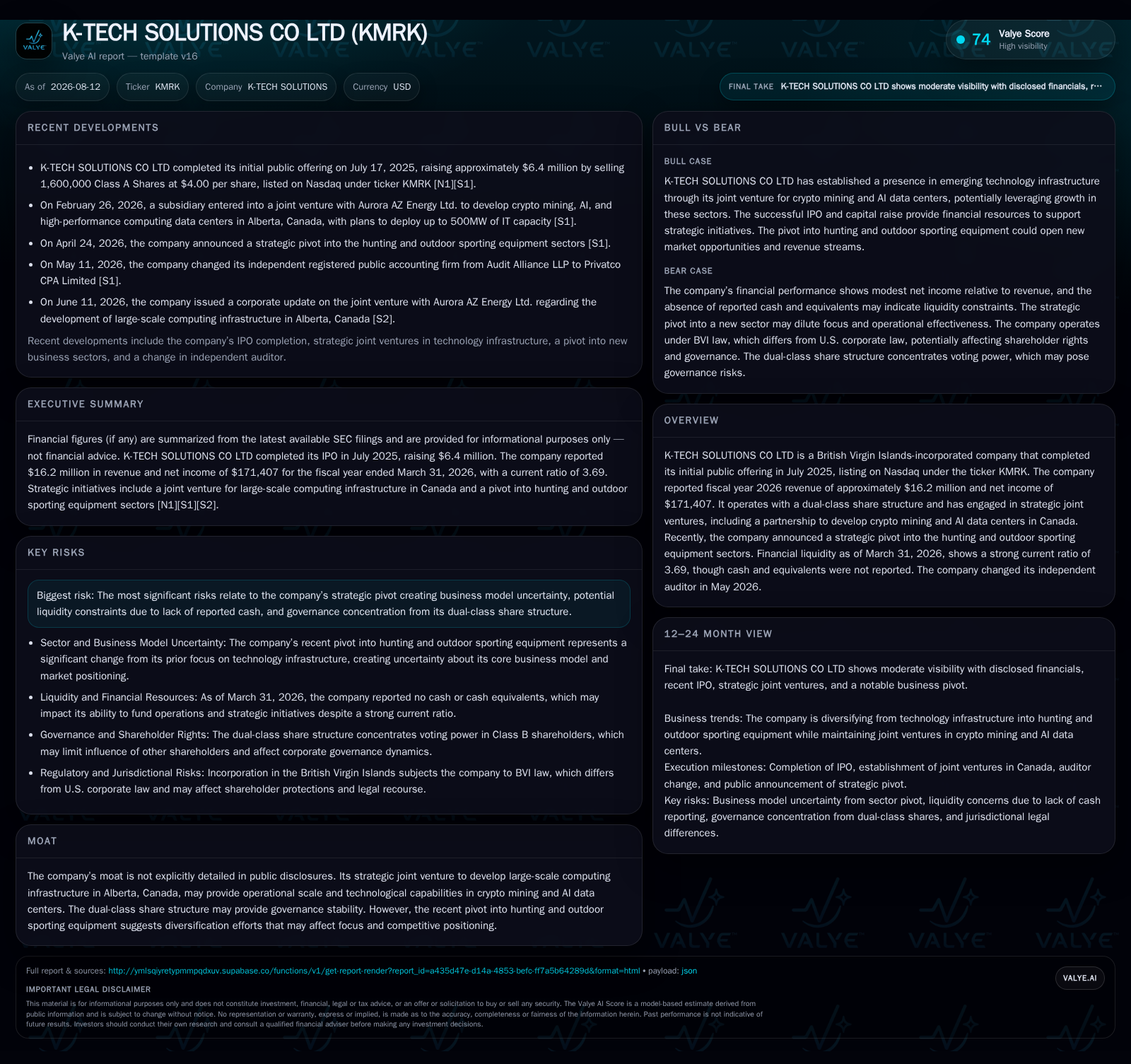
K-TECH SOLUTIONS reports mixed 2026 results with strategic joint ventures in computing infrastructure and a new product diversification.
K-TECH SOLUTIONS CO LTD's fiscal 2026 showed a revenue decline to $16.2 million amid a challenging electromechanical toy market. The company reinforced its foothold in large-scale computing infrastructure through a joint venture in Alberta, Canada, targeting crypto mining and AI data centers. Concurrently, it initiated a strategic pivot into the hunting and outdoor sporting equipment sectors, signaling diversification beyond its core toy manufacturing business. Liquidity remains strong supported by a $9.15 million cash balance and a healthy current ratio of 3.69, though net income contracted to $171,000. Operationally, reliance on contract-based sales underscores top-line volatility tied to backlog stability and tender success. The governance structure includes dual-class shares providing decision control but concentrating ownership risks.
Recent Operating Update
K-TECH SOLUTIONS issued its latest corporate update on June 11, 2026, highlighting progress in its joint venture with Aurora AZ Energy Ltd to develop large-scale computing infrastructure focused on crypto mining and AI data centers situated at Aurora's flagship Alberta site. This multi-phase project aims for an eventual deployment scale between 100MW and up to 500MW of IT capacity, positioning K-TECH within the growing data center ecosystem supporting high-performance computing workloads [S2][S5]. This JV represents a strategic expansion from the company's traditional electromechanical toy manufacturing operations.
In parallel, K-TECH communicated a notable strategic pivot into the hunting and outdoor sporting equipment market as of April 24, 2026. This diversification initiative indicates management's attempt to broaden revenue streams beyond volatile project-based toy contracts into more stable consumer goods segments [S21]. The near-term impact of this pivot remains uncertain given the sector transition but warrants monitoring as it may shift operational resource allocation and affect the company's competitive dynamics.
Business Model Overview
Traditionally, K-TECH operates in the industrial hardware space specializing in design, development, testing, and sale of plastic and electromechanical toys targeted mainly at infant and pre-school educational segments. Revenue streams derive predominantly from contract-based projects secured through competitive tenders involving government and non-government clients [S1][S16]. These contracts are inherently non-recurring, making backlog size and tender win rate critical KPIs driving revenue predictability and cash flow stability
The company’s end-to-end solution services encompass product design, prototype testing, production management, quality control, and after-sales support—positioning itself not just as a manufacturer but as an integrated solution provider within its niche industrial hardware segment [S1]. These services contribute incremental margin opportunities but also impose operational complexity requiring stringent quality control and timely project execution to avoid costly rework or penalties which can erode gross margins
The joint venture with Aurora diversifies business model exposure toward infrastructure equipment development for next-generation high-demand cloud workloads such as crypto mining and AI processing clusters. This places K-TECH partially in the infrastructure hardware developer category with significant capital intensity and regulatory interaction compared with its toy manufacturing origins.
Meanwhile, the pivot into hunting/outdoor sporting goods could leverage existing production capabilities or require new supply chain relationships but will expose K-TECH to different competitive pressures including brand recognition challenges and retail channel dynamics.
Industry Structure and Competitive Position
Within industrial hardware manufacturing focused on electromechanical products like educational toys, competition hinges on innovation speed, product quality standards, cost efficiency in production management, and reputation for timeliness—attributes that directly impact tender success rates. Peer groups include broader contract manufacturers such as Flex Ltd. or Jabil Inc., though these operate at larger scale with diversified portfolios. In electromechanical toy manufacturing scopes akin to Hasbro or Mattel (for context), differentiation is typically driven by licensed intellectual property rights and brand strength rather than pure hardware capabilities.
K-TECH's engagement in large-scale computing infrastructure via joint ventures positions it alongside infrastructure equipment developers operating in capital-intensive markets requiring multi-year project timelines marked by complex permitting, construction risks, and evolving technology standards.
The shift toward outdoor sporting goods opens exposure to consumer products sectors where factors such as retail distribution networks, seasonal demand patterns, product safety compliance, and brand loyalty become salient competitive factors—a markedly different environment from government tender-based contracts.
Growth Drivers
Key growth drivers remain centered on the ability to secure substantial project contracts constituting the backlog due to their non-recurring nature directly impacting top-line revenue visibility [S1]. Geographic exposure primarily involves Hong Kong operations tied closely to regional economic conditions influencing client purchasing activity
Expansion through strategic joint ventures unlocks access to higher-margin infrastructure segments potentially benefiting from rising global demand for data center capacity driven by digital transformation trends including AI compute acceleration.
Technological advancements fostering demand for updated electromechanical toy solutions provide moderate tailwinds alongside rising global interest in educational play products.
Operational improvements around production efficiencies and quality defect rate reductions support margin retention amidst pricing pressures.
The recent product portfolio diversification into hunting/outdoor sporting equipment could generate incremental revenue if appropriately timed with market cycles; however effectiveness depends on execution of marketing distribution strategies unknown at present.
Risks and Watchpoints
Project backlog volatility remains a paramount risk since K-TECH's revenues depend heavily on winning tenders for sizeable one-off contracts rather than recurring purchase agreements. Any failure or slippage here disrupts revenue flows materially.
Operating risks include potential delays or quality issues that can lead to cost overruns or delayed revenue recognition since accounting follows output measurement methods linked with completed work certifications [S1]
Liquidity risk exists despite strong balance-sheet liquidity as working capital needs fluctuate with contract timing; extended customer credit terms increase accounts receivable collection risk exposing company cash flow profiles particularly under sales slowdowns [S1][F1]
Governance risks arise from the dual-class share structure concentrating control which may deter some investors or complicate strategic decision-making transparency.
The pivot into unrelated product categories invites execution risk compounded by limited history in hunting/outdoor goods which may dilute management focus previously aligned exclusively with electromechanical hardware projects.
Additionally, internal controls deficiencies noted over financial reporting introduce reporting risk even though remediation measures are underway through personnel strengthening and process improvements [S15][S18].
What To Watch Next
Milestones related to roll-out progress of the Alberta computing infrastructure JV phases will be crucial indicators of successful expansion beyond historical operations. Monitoring contract tender announcements from customers provides insight into potential future backlog replenishment critical for short-term revenue stabilization. Sales trends from the newly targeted hunting/outdoor sporting equipment segment should begin materializing post-pivot announcements with implications for operational alignment. Cash flow performance especially operating cash conversion relative to net income captures working capital efficiency amidst extant receivable credit extensions. Updates on internal controls remediation efforts along with outcomes from auditor transitions will be pertinent regarding corporate governance health. Revenue guidance or shifts communicated during quarterly disclosures may signal directionality on company priorities between legacy toy manufacturing versus diversified product campaigns.
Financial Profile Discussion
As of March 31, 2026, K-TECH held current assets totaling approximately $10.2 million against current liabilities near $2.77 million resulting in a current ratio of about 3.69x indicating comfortable near-term liquidity [F1]. Total debt stood at approximately $844,295, with net debt at a similar level given available cash balances [F1].
Disclaimer: This is research-only, informational analysis and not investment advice. It may include AI-generated interpretation and general industry context. Always verify important details using primary sources.

Comments