
SUNation Energy’s Consolidation Drive and Regional Leadership in Residential Solar
SUNation Energy advances its regional scale through strategic M&A and vertical integration, navigating capital challenges amid a proposed merger with Suniva.
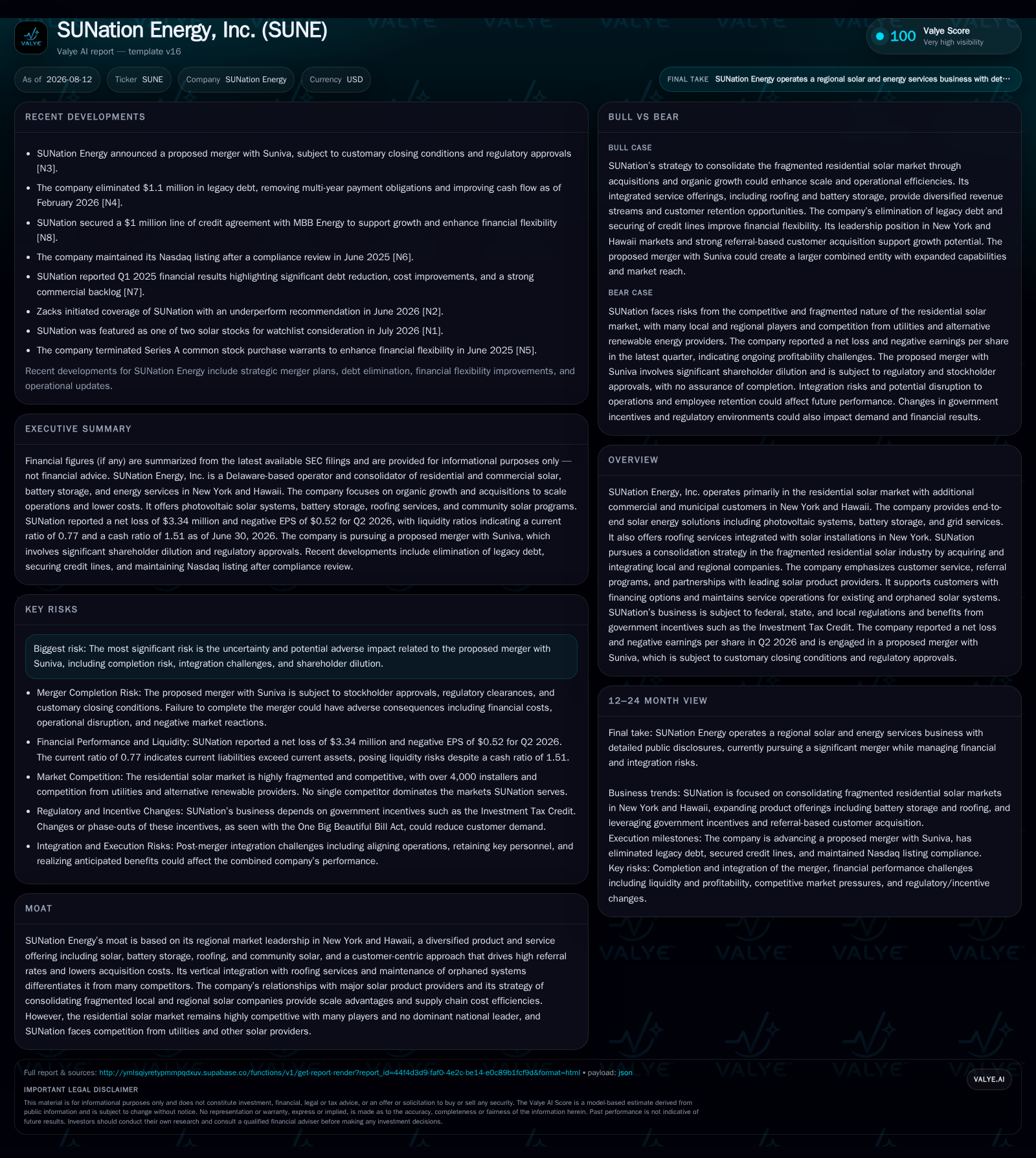
In its latest quarterly filing, SUNation Energy highlights ongoing strategic efforts centered around a proposed merger with Suniva and continued consolidation of fragmented residential solar markets in New York and Hawaii. The company’s integrated offering—combining photovoltaic system installation, battery storage, and roofing services—supports customer acquisition and retention through financing facilitation and referral programs. While its regional scale and vertical integration differentiate it from peers, SUNation faces risks from merger execution uncertainties, regulatory dependencies on government incentives, and capital constraints evidenced by its sub-1.0 current ratio. Key metrics such as installation rates, financing penetration, and referral impact will be critical to gauge the success of its growth thesis.
Quarterly Operating Update Highlights Strategic Consolidation Efforts
SUNation Energy’s Q2 2026 filing underscores an active strategic review process centered on a proposed merger with Suniva Inc., reflecting a decisive push for consolidation amid a highly fragmented residential solar industry [S2]. This ongoing transaction review consumes notable internal resources and incurs legal and advisory fees that pressure operating margins near term [S2][S3]. Concurrently, the company completed a $2.7 million equity raise in June 2026 to bolster liquidity supporting this strategic path [S3]. However, SUNation’s balance sheet reflects moderate leverage with total debt near $3.9 million against cash balances slightly above $3.1 million as of June-end 2026 [F1]. This dynamic constrains financial flexibility during critical merger deliberations.
Despite these capital constraints and execution risks—including possible deal failure or dilution—the strategic rationale rests on materializing scale benefits through regional market consolidation. Given SUNation’s footprint across New York and Hawaii—markets where over 75% of residential solar is served by local/regional installers—the proposed merger aims to enhance supply chain efficiencies and customer reach [S1]. However, no material update to risk factors signals increased caution remains warranted around integration complexities inherent in such transactions [S2]. This latest quarter hence serves as a pivotal moment for validating the company's consolidation-centric business model against real-time economic challenges.
SUNation’s Business Model: Integrated Solar Solutions Driving Customer Value
SUNation Energy operates principally by designing, selling, installing, financing facilitation of photovoltaic (PV) solar energy systems coupled with complementary battery storage solutions targeted mainly to residential homeowners in New York and Hawaii [S1]. The company distinguishes itself through vertical integration—particularly via its roofing service portfolio available in New York—which supports seamless solar system installations while addressing customer concerns about roof durability post-installation. This approach enhances perceived value over peers providing standalone solar setups.
Central to SUNation’s revenue mechanics are multiple streams: hardware sales including PV modules and batteries sourced from leading suppliers; installation service fees recognizing project complexity; ongoing system maintenance contracts enhancing recurring revenue potential; plus financing facilitation that expands affordability for end customers by enabling loan-based payment structures without upfront cash outlays [S1]. Under these loan models, SUNation receives milestone payments from financing partners aligned with installation progress—thus smoothing its own cash flows despite typical consumer payment deferrals.
Referral-based customer acquisition represents a keystone KPI underpinning margin resilience by lowering traditional customer acquisition costs (CAC) [S1][N1]. Positive client experiences foster organic growth which complements digital marketing efforts—a critical advantage given the fragmented nature of the residential solar market where brand trust drives buyer decisions. Operational KPIs such as installation cycle times further affect profitability by impacting crew utilization rates and fixed cost absorption but specific data remain proprietary
Competitive Positioning: Regional Scale Benefits Against National Giants and Fragmentation Challenges
Within the broader US residential solar ecosystem marked by roughly 4,000 individual contractors nationally, SUNation positions itself as a consolidator focused on local/regional dominance primarily in two states where regulatory environments and incentive schemes vary significantly compared to national footprints held by players like Sunrun or Vivint Solar [S1][N1]. Its geographic concentration affords deeper market knowledge but limits scale economies compared to aforementioned national peers who achieve wider supplier discounts through volume.
SUNation’s vertical integration strategy encompassing roofing services sets it apart from many regional competitors who rely solely on installation or leasing models. By controlling roofing alongside PV system deployment and maintenance capabilities, SUNation can better manage lifecycle customer satisfaction metrics while potentially securing higher margins via bundled offerings—an increasingly valued proposition amidst rising homeowner scrutiny especially in climates with older housing stock like New York.
However, competitive challenges persist: market fragmentation dilutes pricing power since local incumbents often compete aggressively on price or financing terms to capture share. Additionally, utilities expanding into distributed energy resources heighten industry rivalry. On diversification fronts, SUNation's engagement in community solar projects introduces novel recurring revenue paths though currently these represent a small percentage of total business line-up.
Growth Drivers Anchored on Market Fragmentation, Financing & Referral Programs
The structural growth narrative for SUNation leans heavily on continued climate-conscious adoption trends driving homeowner interest toward renewable energy paired with supportive government incentives primarily via the Investment Tax Credit (ITC) [S1]. These policies directly reduce net system costs thereby stimulating demand elasticity particularly important given typical customer price sensitivity.
Financing offerings facilitated by SUNation substantively lower barriers associated with high upfront expenditures customary to PV+battery deployments. Loan penetration improvement not only accelerates sales volume but improves CAC payback periods—a critical element whereby earlier cash recoveries boost free cash flow generation potential amid thin operating margins.
Moreover, referral program effectiveness compounds unit economics benefits by sustaining low-cost lead funnels that translate into higher close rates versus cold outreach. Lastly consolidation economies realized through acquisitions strengthen negotiating leverage over equipment suppliers reducing input costs while improving installation efficiency via scaled training and standardized processes—all bolstering gross margin recovery prospects.
Risks from Merger Integration, Regulatory Shifts, and Capital Constraints
Principal risks revolve around completion uncertainty for the Suniva merger process which includes shareholder approval hurdles along with integrating disparate company cultures and operational systems without service disruption [S2]. Failure or delay raises questions about short-term liquidity management given current liabilities exceeding current assets (current ratio at approximately 0.77 as of June 2026), suggesting tight working capital conditions that could constrain normal operations absent additional financings or asset disposals [F1][S2].
Regulatory risk also abides given heavy reliance on federal ITC continuation combined with state-level net metering policies subject to change due to utility lobbying or legislative adjustments. Any contraction or adverse modification could weaken pricing power or elongate customer payback horizons thus impacting future bookings.
Competitive pressures from national players enjoying broader resources alongside emergent utility-scale distributed energy solutions persistently challenge SUNation’s ability to maintain premium pricing or high referral rates in some segments. Lastly operational risks tied to weather-induced seasonality impact installation scheduling integrity requiring agile workforce management.
"Watchpoints": Key Metrics and Milestones to Validate Strategic Execution Progress
Investors should monitor announced progress on strategic alternative evaluations with emphasis on firm timelines for deal consummation notices or abandonment disclosures emanating from official filings or company guidance updates [S2][S3]. Operationally relevant indicators include quarterly counts of residential installations completed specifically segmented by geography (NY vs Hawaii) clarifying market penetration trajectories.
Changes in CAC benchmarks paired with analytics tracking referral rate trends will illuminate marketing efficiency evolution critical for sustainable margin improvement. Likewise tracking financing penetration rates among new customers evidences ability to mitigate demand sensitivity via loan adoption—a key enabler for volume expansion under prevailing economic conditions.
Finally monitoring quarterly cash flow trends including operating cash burn versus liquidity replenishments delivers insight into whether capital structure adjustments successfully extend runway across transaction windows preparing for post-merger integration phases.
Financial Profile Discussion: Liquidity Status Supports Near-Term Execution but Warrants Monitoring
As of June 30, 2026 SUNation held approximately $3.1 million in cash equivalents against total debt near $3.9 million—resulting in net debt roughly $0.87 million—and reported current assets totaling about $10.5 million versus current liabilities approximating $13.8 million yielding a current ratio around 0.77 indicative of tight working capital conditions necessitating prudent financial stewardship during ongoing strategic initiatives [F1][S2]
Going forward maintaining access to capital markets amidst Nasdaq listing compliance vigilance will be essential given recent stringent exchange requirements conveyed historically though the company is presently compliant with minimum bid price rules as per last annual disclosures [S1]. This balance sheet profile underscores the interdependence between financial health and successful execution of SUNation’s consolidation strategy within competitive regional solar markets.
Disclaimer: This is research-only, informational analysis and not investment advice. It may include AI-generated interpretation and general industry context. Always verify important details using primary sources.

Comments