
QT Imaging's Shift to AI-Enabled Breast Imaging: Commercial Viability and Market Dynamics
QT Imaging advances its proprietary volumetric breast scanner while navigating commercialization scale challenges and evolving toward AI-driven diagnostic SaaS integration.
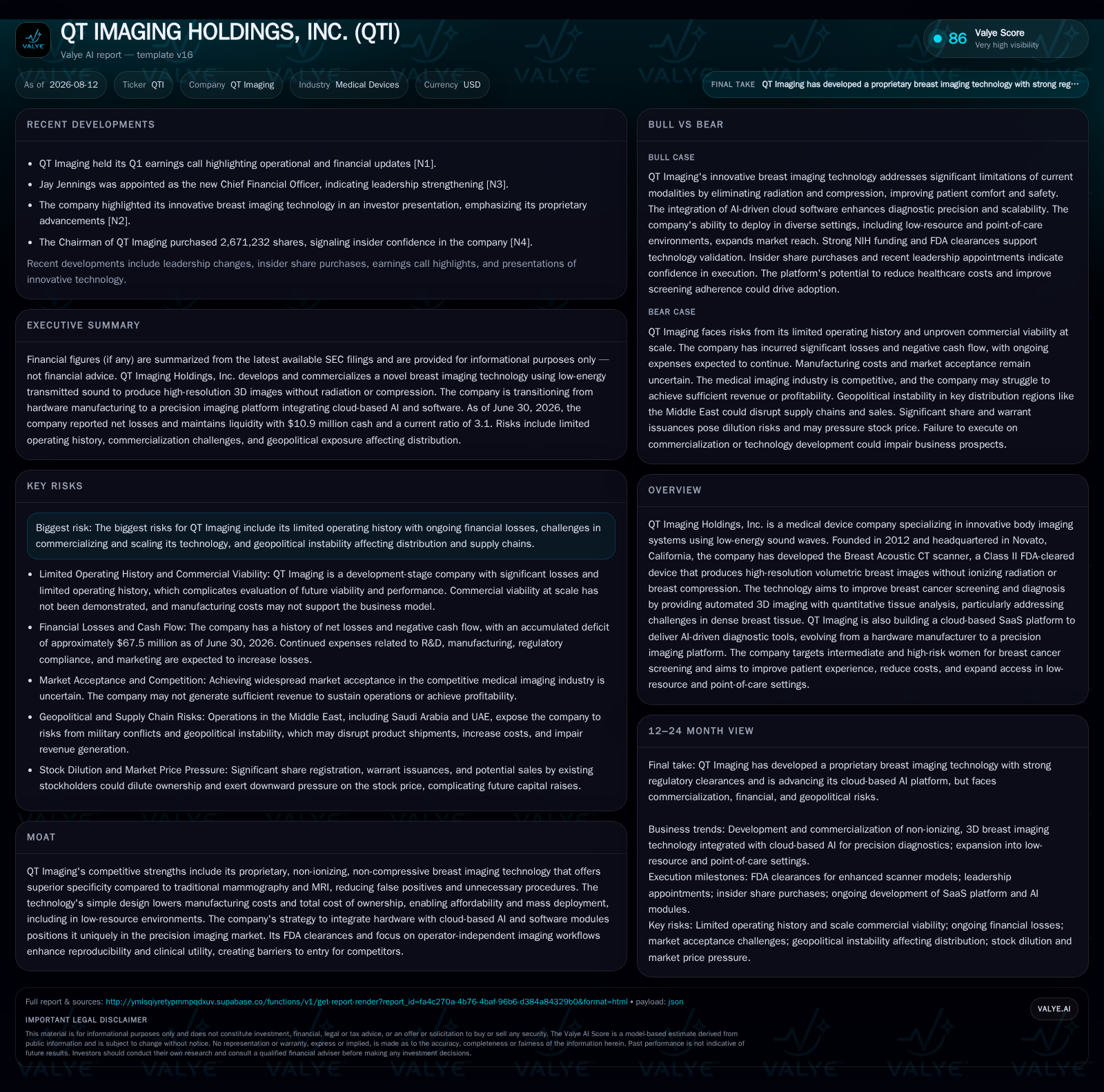
QT Imaging Holdings, Inc. reported in its Q2 2026 filing continued deployment of its FDA-cleared Breast Acoustic CT scanner at limited scale but flagged unresolved manufacturing cost and market adoption challenges. The company’s transition from hardware sales toward cloud-based AI diagnostic services aims to enhance clinical utility and recurring revenue potential. However, substantial execution risks remain amid regulatory complexities, competitive breast imaging peers, and the necessity to expand clinical adoption beyond early deployments. QT Imaging’s financial position reflects moderate liquidity with ongoing losses typical of development-stage medtech companies.
Q2 Operating Update: Deployment Scale Meets Commercialization Hurdles
QT Imaging Holdings’ Q2 2026 10-Q filing reiterates continued deployment of its Breast Acoustic CT scanners primarily in tens of units rather than at broad commercial scale [S2]. The company acknowledges that while this limited deployment has demonstrated technical viability and safety—backed by over 30,000 scans without adverse events [S1]—the commercial viability at larger scale remains unproven. Importantly, the filing underscores ongoing challenges around manufacturing the device at cost points compatible with their business model. Further complicating the path towards steady revenue growth is the reliance on distribution partners whose sales effectiveness will critically influence volumes achieved in clinical settings [S2]. This context aligns with QT Imaging being in an emergent stage where product-market fit is still evolving amid stiff breast screening competition.
QT Imaging’s managing team also flags expected expenditures for research & development alongside marketing efforts aimed at increasing adoption rates across facilities domestically and abroad. The absence of reported revenue growth or profitability milestones in recent quarters accentuates lingering commercialization risks amid significant operating losses to date [S2]. Nonetheless, the company maintains that its existing installed base provides a foundational proof point toward incremental scaling.
QT Imaging’s Business Model: Hardware Foundation Meets SaaS Ambitions
QT Imaging principally generates revenue from sales of its FDA-cleared Breast Acoustic CT scanner hardware, which delivers volumetric breast images using proprietary ultra-low frequency transmitted sound waves coupled with inverse-scattering reconstruction algorithms [S1]. This innovations-driven medical device substitutes traditional X-ray mammography by eliminating ionizing radiation exposure and breast compression typically associated with patient discomfort. These factors target an improved screening experience notably pertinent for women with dense breast tissue or requiring frequent monitoring.
However, hardware sales alone represent only part of QT Imaging’s broader monetization strategy. The company is actively developing a cloud-based Software-as-a-Service (SaaS) platform aimed at delivering AI-powered diagnostic tools including automated lesion segmentation and quantitative tissue characterization integrated via DICOM-compatible architecture [S22]. This integration seeks to transform QT Imaging from a hardware vendor into a precision imaging platform provider with recurring software revenue streams tied to data analytics and decision support. The dual revenue streams rely on capitalizing first on device install growth followed by subscription-based service adoption — a hybrid medical device-commercial software model increasingly prevalent within diagnostic imaging sectors.
Successfully transitioning to this mixed hardware-software model requires sustained R&D investment as well as operational execution to integrate AI capabilities seamlessly into clinical workflows. Achieving recurring SaaS margins would augment financial scalability given the high incremental margin potential relative to upfront hardware costs.
Competitive Positioning Through Proprietary Acoustic Tomography Innovation
QT Imaging’s core technological moat resides in its patent-protected acoustic tomography approach employing reflected and transmitted low-energy ultrasound waves to generate comprehensive three-dimensional breast images without compression or radiation exposure [S1]. This positions it distinctly versus incumbent breast screening modalities such as mammography (X-ray based) and MRI (high-cost alternative). The company’s multiple FDA clearances—including Class II designation—formalize product safety and operate as regulatory barriers deterring facile competitive entry into this segment [S24].
This proprietary imaging approach potentially improves diagnostic specificity by reducing false positives that drive unnecessary biopsies or adjunct imaging tests common in mammography workflows. Moreover, the modular design emphasizing simple hardware components aims to lower manufacturing complexity and total cost of ownership compared to conventional scanners or MRI systems.
From a clinical standpoint, a non-compressive open system improves patient comfort—often cited by radiologists as crucial for patient adherence to recommended screening intervals—while offering quantitative volumetric tissue analysis features. These attributes collectively establish switching cost incentives once integrated into physician diagnostic protocols.
Medical Device Industry Dynamics Shaping QT Imaging’s Adoption Curve
The regulatory environment for medical imaging devices like QT Imaging’s Breast Acoustic CT scanner is stringent and multifaceted. The product must undergo pre-market clearance as well as extensive ongoing post-market surveillance obligations enforced by authorities such as the U.S. Food and Drug Administration [S6,S7]. These durable regulatory requirements extend sales cycle lengths considerably beyond typical hardware products and contribute materially to high customer acquisition costs (CAC).
QT Imaging depends substantially on channel partners for sales execution reflecting standard industry practice among comparable imaging startups lacking fully developed direct sales infrastructure. This adds complexity since distributors’ success in clinical education, device installation, and after-sale support directly influences adoption momentum.
Furthermore, consolidation among healthcare providers and payors affects purchasing patterns; large healthcare networks exercise bargaining power potentially squeezing margins or selectively adopting newer technologies based on reimbursement policies—a major lever governing uptake,[S21]. Even after FDA clearance approval pathways are navigated successfully, obtaining reimbursement coverage from insurers remains an additional bottleneck determining commercial viability.
Nonetheless, increasing awareness regarding challenges posed by dense breast tissue and rising global breast cancer screening demand signal structural industry-level tailwinds supporting innovative alternatives targeting improved patient outcomes.
Beyond the Device: AI-Driven SaaS Growth as a Strategic Imperative
Recognizing limitations inherent in finite device unit volumes alone driving growth, QT Imaging has prioritized developing an AI-enabled cloud-based SaaS platform accompanying its hardware ecosystem [S22]. Leveraging advanced acoustic signal analysis techniques alongside volumetric data fusion accessible via secure cloud infrastructure enables real-time algorithmic assessments including automated lesion detection and volumetric tissue characterization.
Such integration promises enhanced reproducibility across operators by standardizing image interpretation aided by machine learning models—a critical advantage given traditional ultrasound reproducibility challenges documented broadly in medical literature. From an economic perspective, this shift improves potential gross margins due to software licensing leverage while creating higher customer switching costs tied to proprietary data sets collected over time.
Early deployment evidence remains limited as this platform is nascent but signals alignment with broader medical imaging trends where peer companies (e.g., Butterfly Network) seek similar hybridized hardware-software portfolios combining portability with AI diagnostic enrichment.
Scaling Risks: Manufacturing Costs, Sales Execution, and Market Penetration Challenges
The ability for QT Imaging to manufacture Breast Acoustic CT scanners at cost thresholds supportive of competitive pricing models represents a pivotal risk factor identified explicitly in recent disclosures [S2]. Failure to sustain acceptable unit economics would violate underlying assumptions on total cost of ownership essential for broad adoption by hospitals or diagnostic centers.
Similarly, execution risks tied to third-party distribution partnerships introduce uncertainties around achieving adequate penetration rate especially in markets characterized by long evaluation processes among clinicians unfamiliar with novel acoustic imaging technologies,[S2].
Operating losses persist materially reflecting investments necessary across R&D for both hardware refinements and SaaS development alongside upfront marketing efforts demonstrating commercial viability beyond pilot installations [F1],[S2]. These factors cumulatively heighten uncertainty around translation from early proof-points into scalable revenue engines capable of sustaining operations without additional capital infusions.
Navigating Regulatory & Reimbursement Terrain Impacting Growth Prospects
Regulatory clearance granted through FDA Class II pathways confers important protection but imposes continuous compliance burdens including quality system inspections, post-market surveillance reporting obligations regarding adverse events or malfunctions—as enumerated comprehensively in filings—raising potential disruption risk if standards are unmet [S6,S7,S23,S24]. Technical upgrades or modifications often require supplementary submissions prolonging time-to-market intervals further complicating go-to-market cadence.
Reimbursement access thereafter becomes critical for penetration since insurance coverage determinations dictate purchasing decisions across healthcare providers targeting Medicare/Medicaid patients prominently represented among screening demographics,[S21]. Regulatory delays or changes can therefore materially impact topline growth trajectories amid finite cash runs underpinning runway durations.
Near-Term Watchpoints: Metrics and Milestones to Monitor Progress
Key indicators validating QT Imaging's advancement will stem from observable improvements in clinical adoption rates reflected through rising devices deployed beyond small pilot counts alongside evidence of increasing utilization rates per installed unit indicating acceptance within workflow routines [S2,S3]. Concurrently monitoring incremental subscription growth within emerging SaaS platforms will illuminate success transitioning toward recurring revenue paradigms supporting margin expansion.
Geographically diversified rollouts extending beyond current U.S.-centric bases into reimbursed markets such as OECD economies represent important expansion catalysts contingent on navigating local regulatory frameworks strategically while addressing supply chain resilience highlighted as potential vulnerability given global sourcing dependencies.
Additionally, tangible progress securing third-party payor partnerships will be imperative given fragmented healthcare purchaser landscape dictating accessibility at point-of-care.
Financial Profile Discussion: Cash Runway, Debt Burden, and Investment Priorities
As of June 30, 2026, QT Imaging held approximately $10.9 million in cash balanced against total debt near $11.4 million yielding modest net debt around $0.5 million while maintaining current assets roughly triple current liabilities supporting reasonable short-term liquidity buffers favorable for sustained operational activities barring unexpected disruptions [F1]
Nevertheless continuing net losses nearing $21 million annually underscore ongoing cash burn necessitating either enhanced capital infusion or rapid commercialization scale achievement for longer-term sustainability absent dilutive financings or restructuring endeavors characteristic among early-stage medtech entities reliant on breakthrough product breakthroughs before profitability realization [F1],[S2].
Investment priorities remain weighted toward advancing AI software development integrated tightly with their core scanning technology addressing both clinical utility enhancements alongside anticipated margin accretion potential facilitated through scalable subscription pricing versus one-time device sales alone.
Disclaimer: This analysis synthesizes publicly disclosed information from QT Imaging Holdings’ SEC filings as of August 2026 combined with general industry knowledge pertinent to medical diagnostic imaging devices. It does not constitute investment advice or an endorsement of securities but aims solely to provide rigorous business-model context grounded in evidentiary detail.
Disclaimer: This is research-only, informational analysis and not investment advice. It may include AI-generated interpretation and general industry context. Always verify important details using primary sources.

Comments